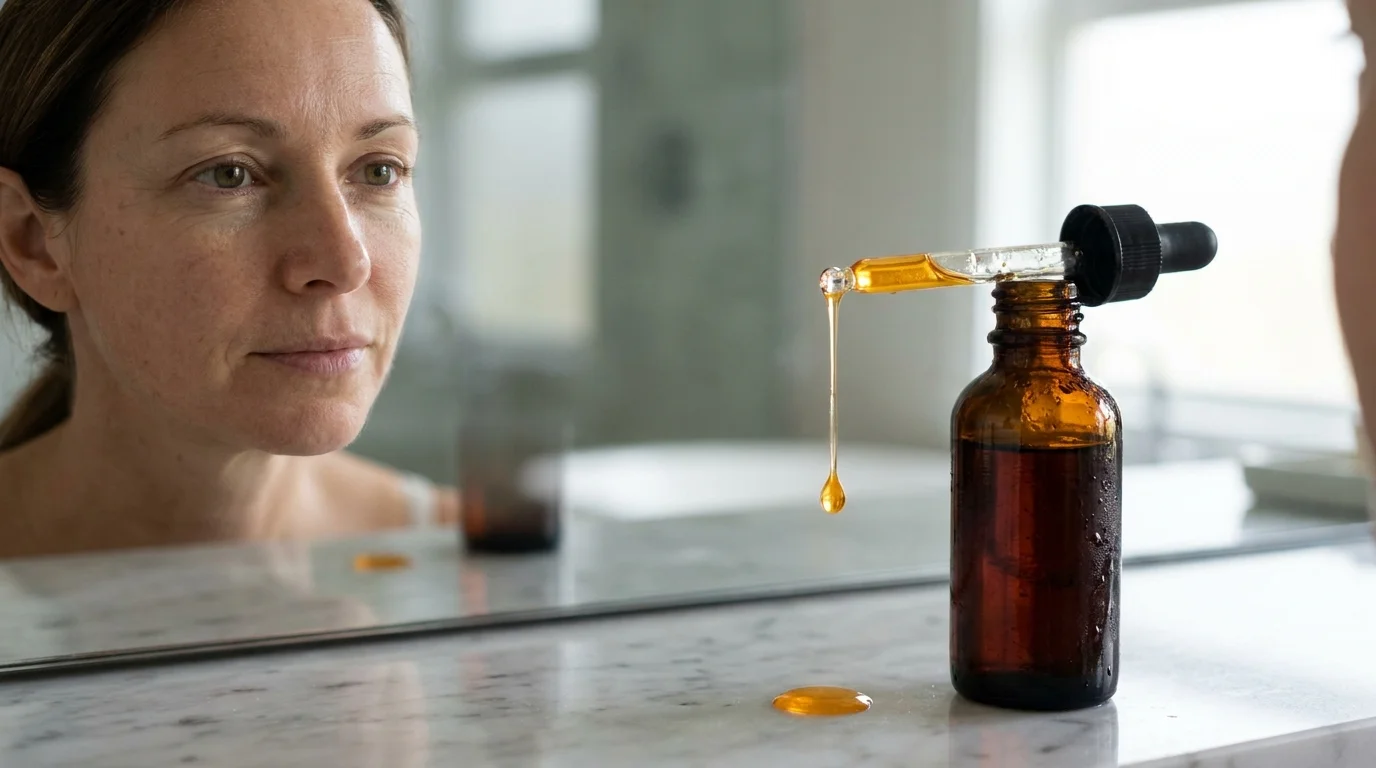
Sunlight slices through the bathroom window, hitting the heavy glass dropper bottle on the marble counter. You unscrew the cap, releasing a faint metallic scent reminiscent of pennies left in a copper bowl. Inside, the slightly sticky, pale orange liquid clings to the glass pipette, slow and heavy. It is the gold standard of morning beauty, promised to erase the quiet passages of time from your skin.
You pat three drops onto your freshly washed face, expecting an instant veil of brightness. Instead, as the liquid dries into a subtle, tight film, you lean closer to the mirror. The fine, delicate cross-hatching around your eyes and the soft parentheses framing your mouth do not look smoother. They cast sharp little shadows that make you look like you slept for three hours instead of seven.
The skin feels dry to the touch, almost papery, like a dried leaf left between the pages of a heavy book. This is the quiet morning betrayal experienced by thousands of mature women who faithfully follow the doctrine of antioxidant protection. The very bottle you bought to defend your youth is actively drawing a map of dehydration right across your cheeks.
The Dehydration Straw
The modern beauty industry treats active ingredients like magic paint, assuming whatever you brush onto your face remains inertly beneficial. In reality, your skin barrier is a delicate, breathing terracotta roof, designed to keep internal moisture from escaping into the dry morning air. When you apply L-ascorbic acid—the highly volatile, pure form of Vitamin C—you are not applying a simple hydrator; it acts like a microscopic sponge that pulls moisture from the deep layers.
L-ascorbic acid is highly osmotic, meaning it naturally seeks equilibrium by pulling water from its immediate environment. If your skin barrier is slightly compromised or thinned by maturity, this acidic molecule does not just sit on top; it actively extracts moisture from the upper layers of your epidermis to stabilize itself. This process turns your skin’s natural plumpness into a temporary, crepey parchment, highlighting the exact lines you spent eighty dollars to erase.
Think of it as pouring table salt over a freshly sliced tomato; the moisture is immediately drawn to the surface and evaporated, leaving the flesh underneath collapsed and wrinkled. When your serum has already begun an inevitable descent into oxidation—turning that deep, warning shade of amber-orange—it becomes even more aggressive. The oxidized acid is no longer acting as a shield; it is a drying agent that tricks the eye into seeing ten years of extra wear.
- Deep sectional sofas quietly ruin your knee joints and lower back
- Doomscrolling habits secretly force deep muscle tension into your pelvic floor
- Lemon water mornings leave adults over forty completely drained before lunch
- Sleep ring trackers drain your morning brain function and cause decision paralysis
- Liquid IV packets after yoga completely erase the calories you just burned
The Expert’s Warning
Dr. Marcus Vance, a clinical dermatologist in Portland who has spent twenty-four years studying epidermal barrier kinetics, calls this the acidic sponge effect. He recalls a patient, Evelyn, a forty-eight-year-old landscape architect whose daily outdoor work left her desperate for antioxidant defense. Evelyn was applying high-potency Vitamin C every morning, only to find her makeup settling into deep, dry valleys by noon. Once Dr. Vance had her swap the aggressive acidic drops for a stable, lipid-soluble derivative, her skin regained its bounce within four days, proving that the lines were not permanent age, but rather a structural thirst.
Tailoring the Routine to Your Barrier
If you live in an arid region or spend your days in heavily air-conditioned offices, pure L-ascorbic acid is a liability. Your skin is already fighting an uphill battle to retain its water content against dry air currents. For your barrier, lipid-soluble derivatives like Tetrahexyldecyl are the elegant solution, as they dissolve in your skin’s natural oils rather than demanding its water.
Those who flush easily or experience tight stinging after cleansing must avoid highly acidic pH formulas altogether. Pure Vitamin C requires an incredibly low pH of around 3.5 to penetrate the skin, which acts like a micro-peel on a fragile barrier. Instead, look for sodium ascorbyl phosphate, which operates at a neutral pH of 7, offering gentle protection without triggering a defense mechanism.
Reclaiming Plumpness: The Minimalist Protocol
Restoring your morning smoothness does not mean discarding your antioxidants entirely, but it requires a change in delivery. You must treat the application process like preparing soil for seed, ensuring the ground is deeply saturated before introducing any active compound. By buffering the acid, you prevent it from behaving like a dry sponge.
To keep your skin supple, never apply acidic serums directly to dry, bare skin right after your morning cleanse. Instead, build a protective cushion of hydration first, using simple, fragrance-free thermal waters or glycerin-rich toners. This provides an external water source for the serum to interact with, preserving your skin’s internal reserves.
You can safeguard your moisture levels by practicing this mindful preparation ritual every morning:
- Mist your face thoroughly with a simple, mineral-rich thermal water spray until the skin is damp but not dripping.
- Apply a thin layer of a pure hyaluronic acid or glycerin gel to build a protective cushion of surface moisture.
- Dispense only two drops of your Vitamin C serum, warming it between your palms before pressing—not rubbing—it into the damp cushion.
- Seal the entire application immediately with a barrier-mimicking cream containing ceramides to block evaporation.
The Tactical Winter and Summer Toolkit
- Optimal Formula Temperature: 55°F to 60°F (store your serum in a dark, cool drawer or cosmetic fridge to delay oxidation).
- Wait Time Before Moisturizer: Exactly 90 seconds to allow the serum to stabilize without drying out.
- Discard Window: Six weeks after opening, or the moment the pale straw color deepens into a rich pumpkin orange.
Restoring the Quiet Balance
In the pursuit of flawless preservation, we often treat our skin as an adversary to be conquered with high-percentage chemical solutions. We buy into the noisy marketing promises of immediate brightness, ignoring the quiet signals our face sends us every morning in the mirror. Real radiance is not a shiny film pulled tight over dehydrated cells; it is the natural, soft glow of a barrier that is calm, hydrated, and quietly supported.
Choosing to support rather than strip your skin yields benefits that go far beyond surface beauty. True skin health requires patience and a willingness to step back from aggressive, trend-driven rituals that yield instant, deceptive results. When you learn to listen to the subtle texture of your skin, you realize that less is almost always more. By stepping away from the harsh acidity of oxidized formulas, you give your skin the grace to heal, breathe, and reflect its natural light.
“The skin is not a slate to be scrubbed, but a living ecosystem that thrives on gentle consistency rather than chemical force.” — Dr. Marcus Vance
| Key Point | Detail | Added Value for the Reader |
|---|---|---|
| The Acidic Sponge Effect | Pure L-ascorbic acid pulls moisture out of the epidermis to stabilize its low pH. | Explains why high-potency serums cause instant fine lines instead of plumping. |
| Oxidation Warning | Orange or amber liquid indicates degraded, highly irritating oxidized acid. | Saves money and prevents barrier damage by identifying when to discard the serum. |
| Lipid Derivatives | Tetrahexyldecyl Ascorbate dissolves in oils rather than draining skin moisture. | Provides a safe, non-drying alternative for dry or mature skin barriers. |
Frequently Asked Questions
Why does my Vitamin C serum make my makeup flake by noon?
The low pH of pure L-ascorbic acid dehydrates the skin’s surface, causing your foundation to cling to dry skin cells. Swapping to an oil-soluble alternative eliminates this issue entirely.Should I stop using Vitamin C if my face feels tight after application?
Tightness is a clear distress signal. You should either buffer the serum with a hydrating toner first or switch to a gentler derivative like sodium ascorbyl phosphate.Does a darker orange color mean the serum is working harder?
Absolutely not. A dark orange hue means the formula has oxidized, turning into an inert, drying compound that can cause low-grade inflammation.How long does it take for the crepey texture to disappear after stopping?
Once you remove oxidized acid and deeply hydrate your barrier, your skin should recover its natural plumpness within forty-eight hours.Can I use Vitamin C at night instead to avoid morning dryness?
Yes, using it at night allows your natural sebum production to cushion the acid, though switching to a lipid-based derivative is still better for dry skin.