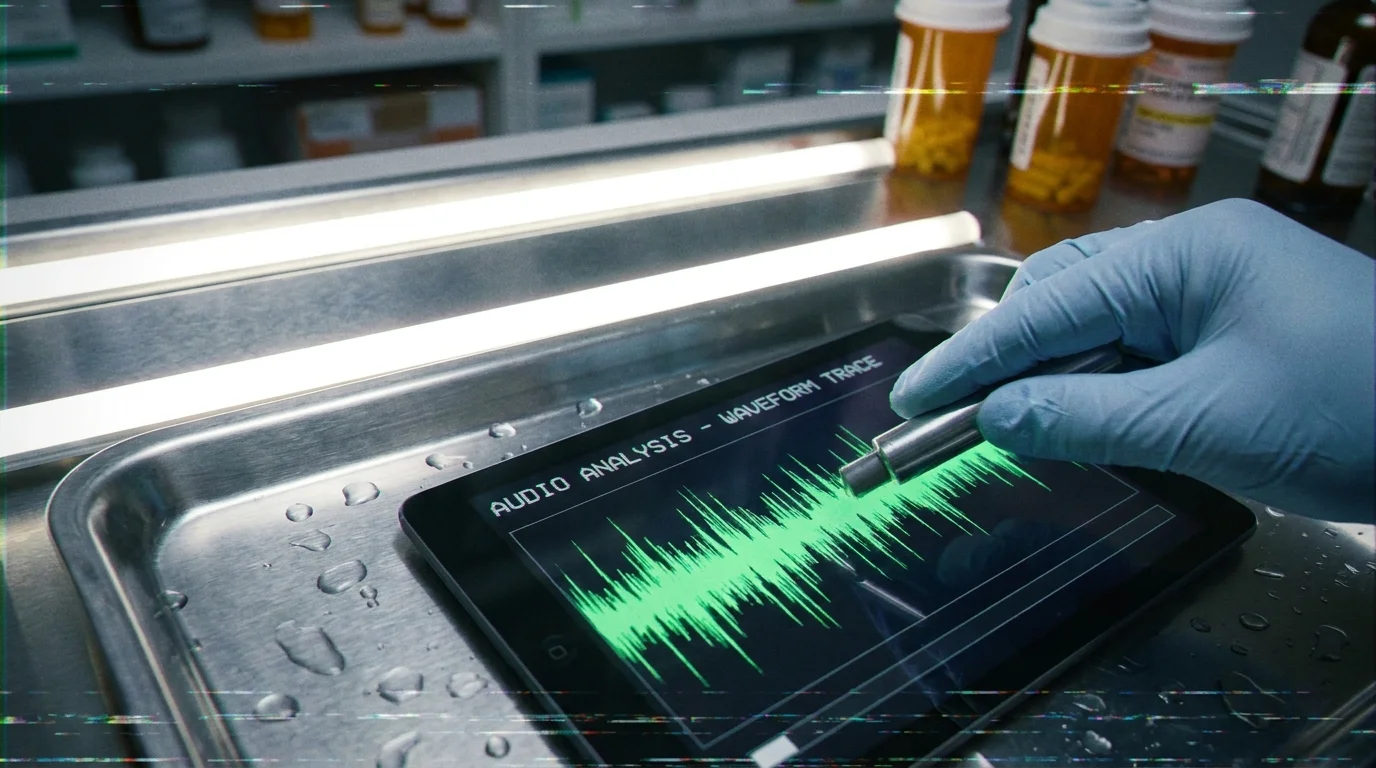
The examination room is quiet enough for you to hear the fluorescent tubes faint electrical hum. On the corner of the small laminate desk, a compact studio condenser microphone sits angled toward your chair. You take a breath, read two sentences aloud from a laminated index card, and watch a digital audio waveform spiking with jagged green peaks across a clinical tablet screen.
To your own ears, your voice sounds entirely unremarkable. Perhaps you notice a slight dry rasp from your morning black coffee or a subtle dip in volume from talking through back-to-back work meetings. Yet the software operating behind the tablet glass does not care about your accent, your word choice, or the emotion behind your cadence.
Instead, it captures the imperceptible physics of your vocal tract. Regional neurology clinics across the United States are reporting an unprecedented shift as acoustic voice analysis moves from quiet university trials into primary screening chairs, driven by a surge in search interest and patient queries about proactive brain health.
The traditional protocol for catching cognitive slip has long relied on subjective pen-and-paper assessments—recalling lists of unrelated nouns, identifying sketched animals, or drawing clock faces on blank sheets. But by the time a person struggles to place the hands at ten past eleven, delicate neural pathways have already degraded over years of silent compensation.
The Hidden Architecture of the Spoken Syllable
Speech is arguably the most complex fine-motor task your brain coordinates on any given morning. Pronouncing a single phrase requires near-instantaneous synchronization between roughly one hundred individual muscles across your diaphragm, larynx, soft palate, tongue, and lips. The signal travels like a rapid cascade down your brainstem, striking vocal cords like hammers against piano wire.
When early neurodegenerative processes begin targeting cortical regions, the gross motor actions remain intact long after the micro-mechanics falter. You can still hold a conversation across the dinner table without anyone noticing a flaw, but your central processing unit starts taking fractional pauses to calculate the mechanical transition between sounds.
The clinical signal currently sparking diagnostic waves centers on a very specific variable: micro-pauses between consonants. In healthy motor speech, shifting from an unvoiced stop consonant like a ‘p’ or ‘t’ into an open vowel takes a predictable span of sixty milliseconds. In populations experiencing the initial stages of cognitive attrition, that transition stretches into an eighty- or one hundred-millisecond stall.
- Darkening bedroom digital clocks blocks harsh night glare switching restless brains into heavy sleep
- Standing on locked knees forces sharp pelvic tilts sparking rigid lower back morning stiffness
- Mustard plaster chest wraps resurfaced as proven home relief that loosens tight rattling phlegm
- Cedar barrel saunas trigger sudden arterial shearing leaving dizzy adults gasping for breath
- Ground clove tooth packs stop persistent gum irritation under a numbing herbal tingling seal
It feels like breathing through a heavy wool blanket; the tongue searches for its landing pad for just a fraction of a heartbeat longer. Because this gap happens at a sub-audible scale, your spouse, your friends, and your regular primary care physician cannot hear it. Yet the algorithm, parsing the jagged green lines on the screen, isolates the stall with mathematical coldness.
Dr. Evelyn Vance, a fifty-two-year-old clinical speech researcher in Ann Arbor, recently monitored this exact divergence during a regional pilot program. She evaluated a sixty-three-year-old retired civil engineer who sailed through standard cognitive evaluations with a near-perfect score of twenty-nine out of thirty. However, his acoustic screen registered persistent 110-millisecond consonant stalls alongside low-amplitude pitch perturbations. Fourteen months later, specialized PET scans confirmed early-stage tau protein accumulation along his left temporal lobe, confirming what the microphone had already whispered over a year prior.
Deciphering the Acoustic Layers
Vocal biomarkers are not monolithic. Just as blood work separates triglycerides from free glucose, acoustic diagnostics divide your spoken habits into distinct mechanical channels.
The Articulatory Transition Lag: This is the clinical marker causing the current stir among regional clinicians. It measures the absolute speed of your acoustic transitions. When your brain’s premotor cortex experiences subtle signaling fatigue, moving your tongue from the alveolar ridge behind your teeth back to the throat produces tiny micro-frictions. These are not stutters; they are silent mechanical hesitation loops.
Acoustic Shimmer and Jitter: Shimmer tracks cycle-to-cycle variation in the amplitude of your voice, while jitter measures tiny irregularities in pitch frequency. When laryngeal nerves experience low-grade motor strain, the vocal folds fail to close with symmetrical tightness, causing invisible micro-tremors in pitch stability that software flags in seconds.
Prosodic Cadence and Pausal Ratio: This layer evaluates the rhythm of natural delivery. Everyone pauses to gather thoughts, but an acoustic screening distinguishes between an intellectual pause (reflecting on an answer) and an acoustic-articulatory stall (knowing the answer but waiting for motor-speech orchestration to complete the loop).
Navigating the Voice Screening: A Baseline Strategy
If you find yourself scheduled for a screening at a regional clinic, approaching the tool with a clear sense of its mechanics eliminates unnecessary white-coat tension. The objective is never performance; it is steady, natural baseline capture.
Vocal acoustics fluctuate naturally with hydration, ambient humidity, and acid reflux. A single bad night of rest will not mimic neurodegenerative micro-pauses, but severe vocal cord strain can obscure subtle readings.
- Hydrate with room-temperature water sixty minutes before entering the clinic room to ensure mucosal flexibility.
- Breathe deeply into your lower ribs rather than your upper collarbones to establish stable subglottic pressure.
- Read the clinical passage at your natural, everyday speed without exaggerating consonants or attempting to sound like a radio presenter.
- Mention any history of sinus congestion, seasonal allergies, or cervical spine adjustments to the technician prior to recording.
Tactical Diagnostic Toolkit:
- Optimal Recording Window: Between 10:00 AM and 2:00 PM, avoiding morning voice grogginess and late-evening mental exhaustion.
- Standard Sample Length: 45 to 90 seconds of standardized phonetically balanced reading.
- Consonant Latency Target: Healthy clinical margins sit beneath 65 milliseconds; sustained readings exceeding 100 milliseconds trigger deeper diagnostic imaging.
- Baseline Frequency: A repeat test every 12 months provides a clear trajectory, filtering seasonal illness from true neurological decline.
Listening to the Unspoken Clock
There is an innate vulnerability in offering your voice to a machine. We think of our voices as the purest reflection of our identity, our warmth, and our emotional center. Realizing that your speech also functions as a structural readout of your deep brain health can feel unnerving at first glance.
Yet moving toward acoustic analysis transforms how we confront aging. Instead of waiting for moments of sudden disorientation or frightening memory gaps to force a crisis, subtle acoustics grant the gift of precious time. Catching changes when they exist only as microscopic pauses between letters allows for lifestyle intervention, targeted cardiovascular optimization, and clinical therapeutics when the brain remains overwhelmingly resilient.
Your voice has spent your entire life telling other people who you are and what you think. Now, through a simple microphone on a clinic desk, it has learned how to tell you precisely how you are doing inside.
The voice does not lie about the state of the brain; it reveals motor coordination failures years before the conscious mind realizes a step was missed.
| Key Point | Detail | Added Value for the Reader |
|---|---|---|
| Consonant Micro-Pauses | Diagnostic latency exceeding 100ms between stop consonants and vowels. | Detects motor coordination stalls long before memory tests fail. |
| Acoustic Shimmer & Jitter | Frequency and amplitude micro-tremors measured at the millisecond scale. | Separates normal physical fatigue from true neurodegenerative signals. |
| Diagnostic Timeline | Reveals neuromuscular shifts 2 to 5 years earlier than standard tests. | Provides a massive proactive window for clinical and lifestyle protocols. |
Frequently Asked Questions
Can an acoustic screening diagnose Alzheimer’s or Parkinson’s on its own?
No single vocal screen functions as a standalone diagnostic tool. Instead, it serves as an ultra-sensitive tripwire, alerting clinicians that you need targeted follow-up, such as blood biomarker panels or specialized neuro-imaging.Does having a raspy voice or sore throat ruin the test results?
Acoustic software analyzes time intervals between consonant sounds alongside pitch mechanics. While acute inflammation can alter vocal fold vibration, algorithms easily isolate the timing of your motor speech from temporary hoarseness.How long does an acoustic voice evaluation take in a clinic?
The actual recording takes between sixty and ninety seconds. Including setup, microphone calibration, and real-time processing, the entire clinical screening usually finishes in less than five minutes.Can I use a smartphone app at home to test my own voice accurately?
While consumer smartphone apps are entering the market, regional clinics use calibrated condenser microphones in acoustically quiet spaces. Consumer phone microphones often compress audio files, which can erase the very micro-pauses clinicians are looking for.What is the next step if my vocal acoustic screening shows irregular flags?
An irregular screen is not a diagnosis of dementia. If your inter-consonant pauses or vocal micro-tremors fall outside normal ranges, your physician will typically order blood panels, a structural brain MRI, and a detailed cognitive health workup.