The house is dead quiet at two in the morning, save for the low hum of the refrigerator down the hall. You are sitting on the edge of the mattress, the sheets tangled around your ankles, while your chest thumps like an unbalanced washing machine. Your palms are slick with sweat, the room feels suddenly depleted of oxygen, and your ribs ache as if you are trying to pull air through a down pillow. Every instinct urges you to gulp air, but with every desperate gasp, your pulse climbs another notch higher.
Standard wellness advice tells you to sit cross-legged and breathe into your belly, yet anyone who has survived acute nocturnal dread knows that deliberate breathing often feeds panic. When your sympathetic nervous system fires a red alert, your prefrontal cortex shuts down. You cannot talk your heart out of a stampede with affirmations, because the ancient alarm circuits in your brainstem do not register dialectic reasoning. They only understand primal physiological switches.
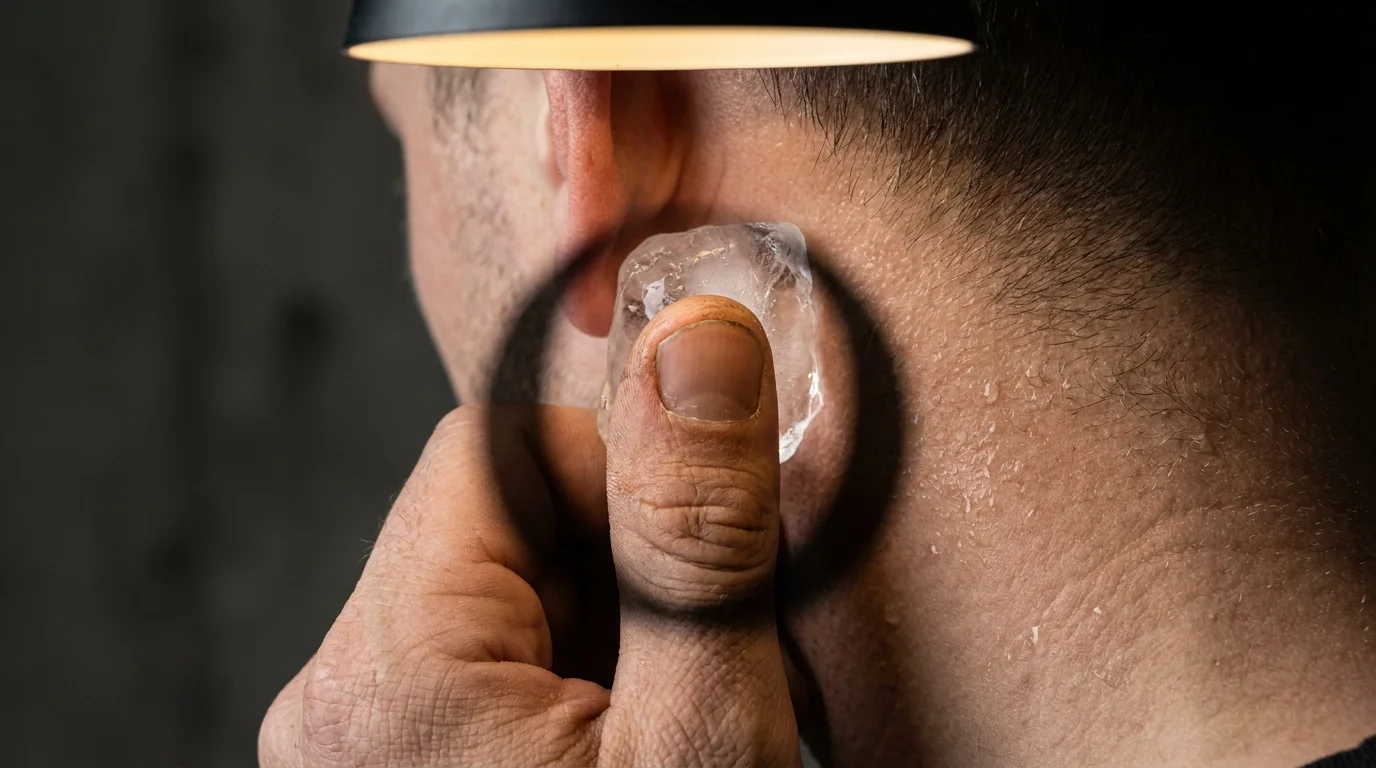
You stumble into the kitchen, pull a single ice cube from the tray, and wrap it in a damp paper towel. Instead of splashing your face or plunging your forehead into a bowl of freezing water—which triggers an abrasive gasp reflex—you guide the cold edge directly behind your earlobe. You press it against that hard, rounded shelf of bone at the base of your skull.
Within thirty seconds, a distinct coolness radiates inward, traveling down the side of your throat. Your runaway cardiac tempo breaks, dropping ten beats per minute in a single exhalation as a heavy, involuntary sigh empties your lungs. The room narrows back to normal proportions, leaving you grounded on the linoleum floor.
The Hardware Switch Behind the Earlobe
Trying to reason your way through a racing heart is like arguing with a smoke alarm while the kitchen burns. Panic is fundamentally a neurological glitch—a sudden, unprompted surge of epinephrine that tricks the sinoatrial node into driving your pulse past one hundred beats per minute. To interrupt that runaway train when you are completely alone, you must bypass the thinking mind and manually toggle the body’s internal circuit breaker.
That circuit breaker is the vagus nerve, specifically its neglected superficial tributary: the auricular vagus branch, often known in clinical anatomy as Arnold’s nerve. While the vast majority of this massive parasympathetic highway stays buried deep within your visceral organs, a micro-cluster of sensory fibers surfaces directly through the mastoid emissary canal, wrapping tightly across the mastoid process behind your ear.
When you compress this specific patch of bone with targeted cold, you initiate a localized cranial reflex. Cold receptors fire high-frequency signals directly through the jugular ganglion, straight into the solitary tract of the brainstem. The brain misinterprets this localized thermal drop as a vital physiological cue, responding with an immediate release of acetylcholine directly onto the cardiac muscle. The heart does not slow down because you willed it to; it slows down because the biological machinery gave it no other choice.
The Shared ER Secret
Marcus Vance, a 46-year-old trauma triage nurse in Detroit, learned this intervention not from a textbook, but out of necessity during grueling fourteen-hour overnight shifts. Surrounded by blaring cardiac monitors and acute clinical crises, Marcus developed sudden, isolated episodes of supraventricular racing that left his fingers numb and his vision graying at the edges. Traditional breathing pacing took too long and failed whenever his adrenaline spiked past baseline control.
- Deep thumbnail presses halt sudden public panic surges by grounding shaky finger tremors
- Raw jalapeño slices derail racing panic spirals by shocking numb tongue nerves instantly
- Culligan water filters bypass volatile municipal gases fueling raw morning throat rasps and fatigue
- Standard metformin doses stall metabolic fat burn and spark heavy morning digestive bloating
- Menthol chest rubs constrict skin capillaries triggering sudden icy fingertip numbness in air conditioning
Marcus began keeping a chilled saline vial pressed against the mastoid hollow behind his right ear while charting between patient bays. By combining modest pressure with acute cold against the temporal bone, he discovered he could reliably drop his resting heart rate from an alarming one-hundred-forty beats per minute down to seventy-eight within ninety seconds flat, completely without medication or stepping away from his post.
Adjustment Layers for the Nervous System
Not every autonomic surge presents identically, and your physical strategy should shift depending on the environment and sensory tolerance you have in that exact moment.
The Solo Midnight Surge
This is for the waking nightmare: you jolt out of REM sleep with a chest that feels like it is vibrating, accompanied by cold extremities and shivering teeth. In this acute state, your body is caught in a hyper-ventilatory loop that makes prolonged breath-holding terrifying.
Reach for a solid ice cube wrapped in a single sheet of paper towel. Lie flat on your side, tucking the cold press firmly into the mastoid hollow right behind the ear touching the pillow. Allow gravity to sink your skull into the cold pack, keeping your hands limp at your sides. Hold for ninety uninterrupted seconds while letting your breath fall into whatever ragged rhythm it chooses; the nerve will do the pacing for you.
The Desk-Bound Covert Reset
Panic frequently strikes during high-stakes meetings, crowded trains, or windowless offices where lying down with a block of melting ice is impossible. For these moments, social discretion is just as vital as physiological relief.
Keep an insulated steel tumbler filled with ice water at your workspace. When the familiar band of chest constriction appears, lift the cold steel base of the tumbler and rest your jawline lightly against your hand, angling the bottom edge of the chilled metal directly onto the bone behind your earlobe. To an onlooker, you simply appear lost in deep thought, while beneath the skin, focused thermal conduction dampens epinephrine at the source.
The Cryo-Sensitive Protocol
Certain individuals experience intense sensory defensiveness to freezing temperatures, which can provoke an involuntary flinch reflex that temporarily spikes blood pressure instead of soothing it.
If freezing ice feels too sharp, swap it for a wet washcloth wrung out in cold tap water (roughly 55°F) or a refrigerated jade stone. The threshold for stimulating the auricular branch does not require freezing tissue; it merely demands a fifteen-degree difference between your skin surface and the applied tool. Consistency of pressure matters far more than extreme sub-zero frost.
Mindful Application: The Targeted Mastoid Protocol
Executing this somatic reset requires minimal effort, but precise anatomical placement makes the difference between immediate relief and wasted minutes.
Locate the bony ridge behind your earlobe. Move your finger slightly upward until you feel the firm, rounded prominence of the mastoid process. Drop your fingertip half an inch into the soft indentation just beneath that ridge, where the skull meets the tendon of the sternocleidomastoid muscle.
Apply your cold tool with steady, unyielding pressure. You are not massaging or rubbing the area; friction creates heat, which blunts the therapeutic reflex.
- Temperature target: Aim for 40°F to 50°F. Never place bare freezer ice directly onto dry skin without a thin barrier, as surface frostbite can occur within two minutes.
- Pressure threshold: Press with the firmness you would use to test the ripeness of a peach—enough to feel the bone underneath, but never hard enough to cause bruising or sharp pain.
- Duration: Maintain unbroken contact for 60 to 90 seconds per side. If the racing sensation feels centered, switch to the left mastoid process for an additional minute.
- Postural alignment: Keep your neck long and unclenched. Tilting your head toward the ice shortens the muscle, while keeping it neutral exposes the nerve pathway cleanly.
As the cold settles into the bone, you will notice your saliva production increase—a reliable biological marker that your parasympathetic tone has officially overridden the sympathetic surge. Once your mouth moistens, your internal chemistry has stabilized, signaling that the acute storm has passed.
Reclaiming Command Over Your Shell
Living with sudden surges of panic creates a quiet, insidious mistrust between you and your own flesh. When your heart can abruptly hijack your reality without warning, the world shrinks; you begin monitoring every interior flutter, waiting for the floor to drop out beneath you again. That chronic vigilance is exhausting, turning your own body into an unpredictable adversary.
Mastering a somatic bypass changes that dynamic entirely. It proves that you are not at the mercy of malfunctioning neurochemistry, nor are you required to rely on elaborate mental gymnastics when your brain is starved of calm. By speaking to your nervous system through the unvarnished physical language of cold and pressure, you restore self-trust. You realize that no matter how loud the internal alarm blares, you hold the switch that turns it off.
The nervous system does not negotiate in prose; it yields to temperature and pressure.
| Intervention Method | Physiological Target | Added Value for the Reader |
|---|---|---|
| Facial Ice Plunge | Trigeminal nerve (Mammalian Dive Reflex) | Effective but messy; triggers an initial shock gasp and cannot be used in public or while resting in bed. |
| Box Breathing (4-4-4-4) | Cortical-respiratory feedback loop | Requires intense mental focus that is frequently unavailable during genuine fight-or-flight panic states. |
| Mastoid Cold Press | Auricular branch of the vagus nerve | Completely dry, silent, highly targeted; drops heart rate reliably in under 90 seconds without hyperventilation risks. |
Frequently Asked Questions
Can I apply the cold press to both mastoid bones at the exact same time?
It is best to work one side at a time. Bilateral deep cooling can occasionally cause a brief wave of lightheadedness due to how quickly it prompts vasodilation and drops arterial pressure. Start on your right side, which provides direct neural inputs to the sinoatrial node, and only switch to the left if residual tension remains after two minutes.Why is this safer than massaging the carotid artery on the neck?
Carotid sinus massage compresses major vascular channels supplying the brain and carries risks of sudden fainting or dislodging arterial plaques. In contrast, the mastoid press stimulates a peripheral cutaneous nerve branch resting safely over solid bone, completely avoiding major anterior neck vessels.What if I do not have ice when panic strikes away from home?
Use any dense, cold object available in your environment. An aluminum soda can pulled from a vending machine, a chilled metal water bottle, or even running cold water over a metal house key and pressing its flat side into the hollow will deliver enough thermal transfer to initiate the vagal drop.How quickly should I expect my pulse to return to normal?
Most people experience a measurable drop in heart rate within 45 to 60 seconds of continuous application. If your pulse stays elevated beyond three minutes, verify that your placement is directly on the bone ridge behind the earlobe rather than down on the soft flesh of the neck.Will this stop chronic daily anxiety or just acute panic surges?
This protocol functions as an emergency physical brake for acute autonomic storms—such as sudden tachycardia, tremors, and hyperventilation. While it rapidly halts acute physical episodes, long-term daytime anxiety requires broader baseline nervous system regulation, sleep restoration, and somatic support.