The kitchen counter sits in gray pre-dawn silence while the electric kettle begins its familiar, aggressive hiss. You know the script by heart: that first dark, steaming mug promises clarity, yet by ten in the morning, your pulse thumps behind your ears and your shoulders have crept toward your jaw. It is the familiar transaction of standard caffeine—borrowed energy repaid with interest in the currency of sudden midday collapse.
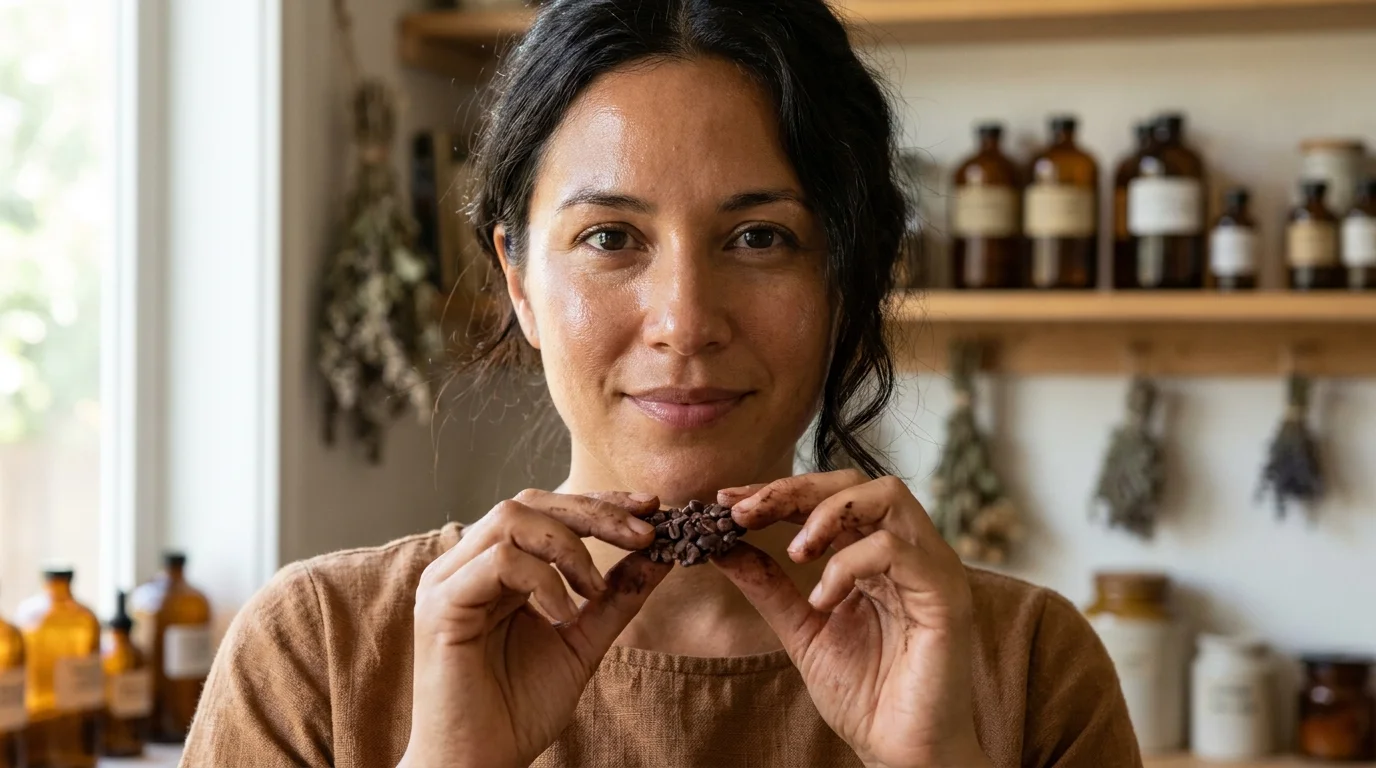
Now imagine reaching into a small glass jar instead. You pull out a sparse handful of rough, fractured shards, obsidian and deep mahogany in the morning light. They carry the dry, fermented perfume of a forest floor after rain, laced with an unsweetened, woodsy earthiness that bears little resemblance to confectionary aisle bars.
When you bite into them, there is no polite melting or velvety rush of cane sugar. The crush between your molars is flinty, wood-firm, and unapologetically bitter. Within twenty minutes, your thoughts do not race or stumble over one another; instead, a quiet wave of clarity settles over your forehead, wide, steady, and entirely free of that hollow tremor in your ribs.
The Cardiovascular Gentle Surge: Trading Caffeine for Theobromine
Most morning routines treat mental fatigue as an electrical failure that requires high-voltage shocks. Standard coffee delivers an abrupt hit of caffeine, an alkaloid that violently antagonizes your adenosine receptors while sending a distress signal straight to your adrenal glands. Your body produces a sharp spike of cortisol and adrenaline, artificially mimicking a mild fight-or-flight crisis just so you can answer incoming emails.
Crushed cacao beans follow an entirely different physiological route. Their primary active stimulant is not caffeine, but theobromine—its gentler, molecular cousin. Where caffeine constricts peripheral blood vessels and spikes arterial tension, theobromine acts as a targeted vasodilator. It softly opens your vascular pathways, lowering cardiovascular resistance while coaxing steady cerebral circulation directly into your prefrontal cortex.
Think of traditional coffee as a sudden, loud whip crack in an enclosed room: it startles your central nervous system awake through acute shock. Cacao nibs, by contrast, act like quietly opening heavy double doors to let fresh air flood a stifled workspace. You get the mental brightness without forcing your adrenal glands to bleed emergency hormones before noon.
- Commercial contrast tubs spike arterial pressure shifts leaving adults with dizzy spells
- Stacked reading pillows alter cervical spine angles triggering dull base skull throbbing
- Magnesium stearate binders inflame gut mucosal linings triggering stubborn afternoon belly bloating
- Chilled matcha tonics disrupt stomach lining circulation triggering sudden sharp belly cramps
- Rigid desk chairs trap lower ribcage expansion sparking shallow chest suffocation panic
For Marcus Vance, a 42-year-old architectural draftsman in Seattle, that biochemical nuance changed everything. Facing long mornings bent over intricate CAD blueprints, Marcus spent years battling an involuntary right-thumb tremor and cold, sweat-damp palms caused by his third pour-over coffee. When a visiting colleague introduced him to raw, unroasted Criollo nibs sprinkled over morning oats, the change was dramatic. Within a week, the background tension coiled in his neck dissolved, yet his ability to hold complex 3D spatial models in his mind lasted straight through three in the afternoon without a single cold finger.
Calibration Layers: Matching the Bean to Your Rhythm
Not every brain handles whole botanicals the same way. Finding your sweet spot with unadulterated cacao depends on your baseline metabolic pace and how your stomach handles raw plant fiber.
For the Sensitive Stomach
Raw nibs contain dense cellulose and astringent tannins that can feel heavy if dropped into an empty digestive tract. If you tend toward morning acidity, do not consume them dry. Grind one tablespoon into a coarse gravel and fold it into warm steel-cut oats or thick, full-fat Greek yogurt. The lipids and warm starches buffer the astringency, letting the theobromine absorb across the gut wall without a trace of nausea.
For the Deep-Work Specialist
If your day demands uninterrupted blocks of analytical focus or creative composition, pair your nibs with a modest source of L-theanine, such as a cup of shade-grown green tea. The vasodilating properties of theobromine pair seamlessly with theanine’s alpha-wave brain calming, providing rock-solid mental stamina that holds steady for five or six continuous hours.
For the Fast Oxidizer
Those who burn through meals quickly should keep the nibs whole. Chewing them slowly forces your salivary enzymes to break down the natural cocoa fats alongside the hard bean fragments. This slow mechanical breakdown meters the delivery of active bioflavonoids, preventing any sudden peak and ensuring a flat, predictable plateau of wakefulness.
Mindful Application: The Ten-Gram Protocol
Introducing unroasted nibs into your morning requires little effort, but precision keeps the experience grounded and effective.
Begin with a modest, deliberate quantity rather than treating them like mindless trail mix. A kitchen scale or standard measuring spoon keeps your intake within the sweet spot where focus flourishes without overstimulating your digestive tract.
- Measure your baseline: Start with exactly 10 grams (roughly one level tablespoon) of certified raw, unsweetened nibs during your first week.
- Preserve the enzymes: Never bake or boil the nibs directly; high thermal heat degrades the delicate theobromine and polyphenols.
- Masticate thoroughly: Grind each bite between your teeth until it forms a rustic paste before swallowing, ensuring maximum compound bioavailability.
- Time the intake: Consume your portion roughly 45 minutes after waking, alongside a tall glass of room-temperature water to support increased blood volume.
Your tactical toolkit remains wonderfully simple: a tight-sealing amber glass jar to protect delicate plant lipids from light oxidation, a small brass tablespoon, and raw cacao sourced from cold-fermented, sun-dried pods that preserve the bean’s wild, bitter character.
The Bigger Picture: Reclaiming Your Nervous System’s Autonomy
Our culture has normalized being vibrating, anxious husks by mid-morning, accepting gut aches and short tempers as the unavoidable cost of high productivity. We drain another paper cup of dark roast to fix the very exhaustion the previous cup created, trapped in an exhausting loop of our own making.
Stepping away from that cycle is not merely about choosing a different grocery item; it is a quiet refusal to treat your body like an engine that only runs on emergency alarms. By swapping aggressive adrenaline triggers for compounds that support smooth, natural vascular flow, you reclaim your morning. You discover that focus does not have to feel like a high-wire act—it can feel as steady, quiet, and grounded as the earth beneath your feet.
The secret to enduring focus is not shocking the brain into wakefulness, but giving the vascular system the ease it needs to think.
| Key Point | Detail | Added Value for the Reader |
|---|---|---|
| Active Alkaloid | Theobromine (~2% by weight) vs. high caffeine in coffee | Gentle vasodilation without the heart rate spikes or jittery tremors. |
| Endocrine Impact | No acute cortisol or adrenaline surge | Protects your adrenal reserves and avoids the dreaded 2:00 PM energy cliff. |
| Sensory Texture | Firm, crunchy, unsweetened seed fragments | Encourages mindful chewing and slower gastric nutrient uptake. |
| Magnesium Density | Rich in bioavailable elemental magnesium | Relaxes physical muscular tension while supporting calm neurological firing. |
Frequently Asked Questions
Will raw cacao nibs keep me awake if eaten later in the day?
While theobromine is much gentler than caffeine, it has a longer half-life in the human body. To protect your sleep architecture, enjoy your nibs before 1:00 PM.Are cacao nibs the same thing as dark chocolate chips?
No. Chocolate chips contain added cocoa butter, sugar, and emulsifiers, and have undergone high-heat roasting that degrades delicate stimulant compounds. Nibs are simply raw, peeled, crushed cacao beans.How bitter do raw cacao nibs actually taste?
They taste like baker’s chocolate combined with roasted nuts and dark berries. There is zero sweetness, but the deep roasted aroma softens the bite once you get accustomed to real, unprocessed cacao.Can I grind cacao nibs into a powder for smoothies?
Yes, a standard coffee grinder or small spice mill will turn them into a coarse powder. Just pulse in short bursts to avoid heating the fats and turning the nibs into liquid chocolate paste.Do raw cacao nibs contain any caffeine at all?
Yes, but in trace amounts. A standard 10-gram serving typically contains less than 15 milligrams of caffeine—roughly one-seventh the amount found in an eight-ounce mug of drip coffee.