The bedroom clock reads 2:14 AM. The house rests in quiet stillness, but your chest feels wound tight, betrayed by a sudden, razor-thin tickle at the very back of your mouth. You try swallowing quietly to suppress it, yet the friction only sharpens the sensation until an involuntary cough shatters the room. Your eyes water, your ribcage aches, and that dry, prickly flutter refuses to settle back into sleep.
Most nightstand remedies fail here because they treat a mucosal scratch like a systemic infection. You reach for chalky lozenges or thin, artificial syrups that wash straight down your esophagus, barely making contact with the irritated tissue before vanishing. They leave behind a chemical sweetness and an empty promise, while the exposed sensory nerves remain raw and twitching in the cool night air.
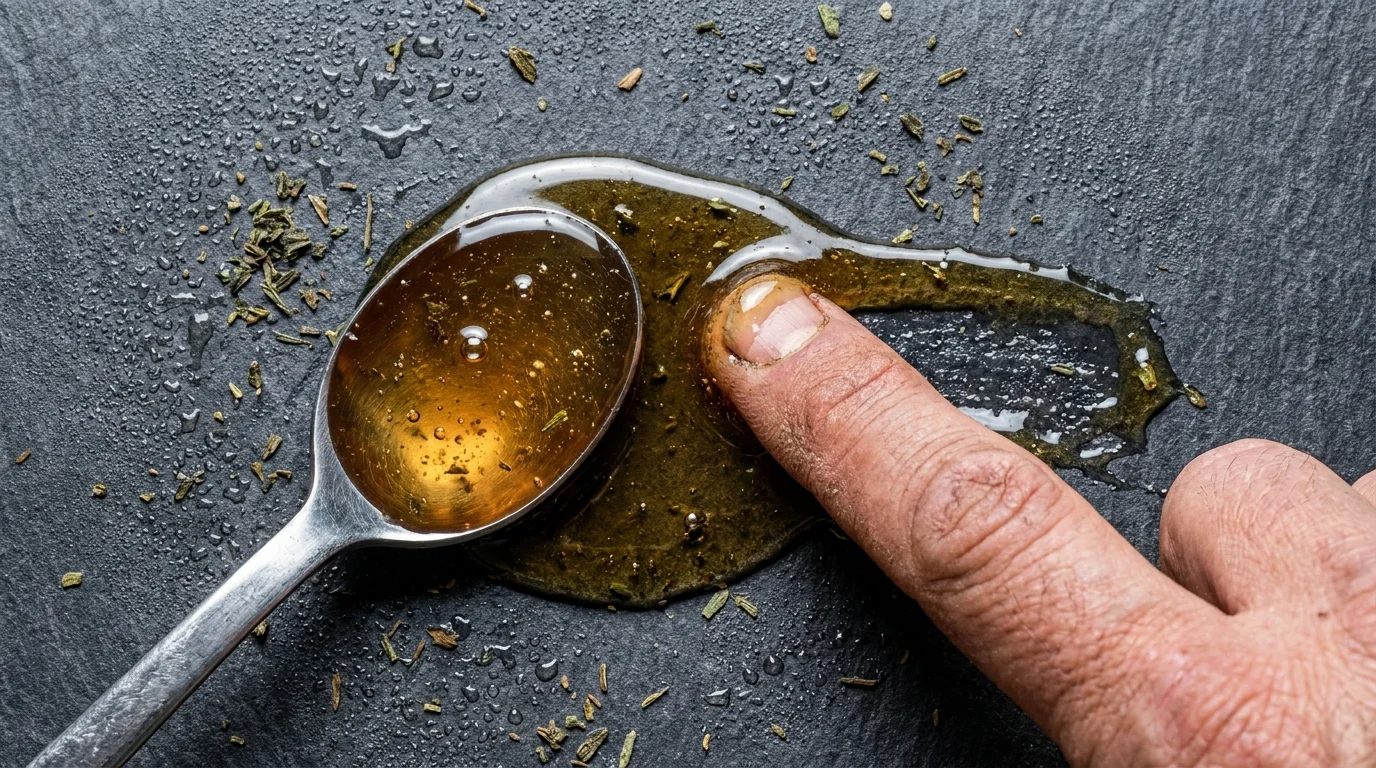
Step into the kitchen instead, where the silence feels softer under the dim stove hood. When you pull a jar of raw thyme honey from the pantry, you are not simply reaching for a natural sweetener; you are holding a dense, resinous shield. Its aroma is earthy, warm, and sharp with herbal oils, holding the quiet power to bathe those twitching vocal folds in calm.
The Exposed Wire: Calming the Pharyngeal Reflex
To understand why that maddening cough repeats itself every forty seconds, imagine an exposed electrical wire lying across a drafty floor. Every breath of dry indoor air sweeps past your pharyngeal wall like a stiff breeze, sending an electrical spark straight to your brainstem’s cough center. The body registers this tiny spot of dried mucosal tissue as a foreign intruder, triggering a violent convulsion that only rubs the raw nerve ends harder against each other.
Conventional suppressants attempt to numb this loop from the top down by dulling your central nervous system, but raw thyme honey coats the wire directly. Thyme-foraged nectar naturally boasts an exceptionally high viscosity and low moisture content, allowing it to cling tenaciously to the soft palate and upper throat rather than cascading down immediately. Beneath that heavy, protective blanket, the natural presence of thymol and carvacrol—volatile compounds gathered by bees from wild blossoms—exerts a mild, soothing antispasmodic action right at the nerve endings.
Clara Vance, a 54-year-old clinical herbalist based in the high desert of Central Oregon, keeps a crock of this specific amber honey on her nightstand throughout the dry winter months. She explains that during dry cold spells, clients frequently arrive with hoarse, rasping voices that no steam bowl could quiet. By teaching them to let unheated thyme honey melt deliberately against the soft palate without swallowing water afterward, she found their nocturnal spasms subsided in minutes, allowing the throat tissue to finally rest and regenerate under its own moisture.
- Raw cacao nibs restore razor focus without afternoon nervous system jitters
- Commercial contrast tubs spike arterial pressure shifts leaving adults with dizzy spells
- Stacked reading pillows alter cervical spine angles triggering dull base skull throbbing
- Magnesium stearate binders inflame gut mucosal linings triggering stubborn afternoon belly bloating
- Chilled matcha tonics disrupt stomach lining circulation triggering sudden sharp belly cramps
Tailoring the Amber Shield: Finding Your Layer
Not every ticklish cough stems from the exact same irritation, and your nightly protocol should match the specific friction you experience.
For the Midnight Waker
If you wake abruptly from a dead sleep with a sharp, air-starved hacking fit, your pharynx has likely dried out from mouth-breathing under forced heat. Take half a teaspoon of unpasteurized thyme honey and press it firmly against the roof of your mouth with your tongue. Let body heat slowly liquefy the resin, allowing a micro-layer to slide over your tonsillar pillars without triggering a swallow reflex.
For the Spoken-Word Professional
If you spend your daylight hours lecturing, pitching, or speaking on calls, your evening cough is driven by mechanical muscle fatigue and micro-abrasions on the vocal cords. Stir a generous spoonful into two ounces of lukewarm water—never hot, to protect the fragile live enzymes and volatile monoterpenes—and gargle gently for five seconds before swallowing to ensure deep pharyngeal coverage.
For the Dry-Climate Sleeper
Those living in arid altitudes or sleeping next to baseboard radiators face continuous moisture theft throughout the night. Pair a single slow spoonful with a quarter-turn pinch of unrefined sea salt dissolved directly on the tongue beforehand. The mineral trace prompts immediate salivation, creating an ideal slipway that allows the thick honey to form an airtight moisture seal that lasts until morning light.
Mindful Application: The Nocturnal Protocol
Treating a persistent midnight tickle requires gentle patience rather than hurried swallowing. Rushing the process washes the restorative coating away before it can anchor to the pharyngeal wall.
- Select an unheated, unfiltered raw thyme honey that appears cloudy or semi-crystallized, indicating intact enzymatic vitality and preserved plant polyphenols.
- Scoop exactly one level teaspoon using a wooden or ceramic spoon to avoid metal reactivity with delicate organic acids.
- Place the honey on the center of your tongue, close your lips, and tilt your chin upward at a slight twenty-degree angle.
- Allow the spooned mass to melt solely through ambient mouth warmth over forty-five seconds, breathing smoothly through your nose.
- Swallow once, smoothly and deliberately, then avoid drinking water or liquids for at least twenty minutes to let the antimicrobial matrix adhere undisturbed.
By resisting the impulse to chase the sweetness with cold water, you preserve the protective barrier through several sleep cycles, shielding the sensitive nerve receptors while you rest.
The Bigger Picture: Reclaiming Rest Without Force
In a culture accustomed to subduing physical discomfort with aggressive, synthetic formulations, turning to a slow, unhurried spoonful of herb-infused honey feels like an act of quiet trust. You are no longer fighting your body or attempting to silence its alarms with heavy chemicals. Instead, you are providing the exact physical buffer your delicate tissues are begging for: warmth, dense moisture, and the grounded calm of wild herbs.
When you master this simple, pantry-born ritual, the dreaded midnight tickle ceases to be an exhausting battle. You return to your pillow not drugged or groggy, but comfortably cushioned, drifting back into restful slumber while your throat quietly heals in the dark.
The most reliable healing often comes not from forcing a symptom into silence, but from shielding the tissue long enough for the body to remember its own stillness.
| Key Point | Detail | Added Value for the Reader |
|---|---|---|
| Viscosity & Adhesion | Unpasteurized thyme honey clings to the pharyngeal wall far longer than standard clover varieties. | Prolongs mucosal contact, keeping irritated nerve endings covered against cool bedroom air. |
| Volatile Phenols | Naturally high levels of plant-derived thymol and carvacrol derived from thyme blossoms. | Delivers localized antispasmodic action that calms the cough reflex without systemic grogginess. |
| Enzymatic Integrity | Zero heat processing preserves natural glucose oxidase and bio-active enzymes. | Maintains natural antimicrobial defense without stripping your mouth’s protective native flora. |
Frequently Asked Questions
Can I use regular supermarket honey if I cannot find raw thyme honey? Standard clover honey provides temporary moisture, but it lacks the dense viscosity and the potent thymol concentration that make thyme honey uniquely effective for nerve-level throat spasms.
Why shouldn’t I dissolve the honey into a steaming mug of tea? Temperatures above 110 degrees Fahrenheit degrade the live enzymes and evaporate the volatile essential oils that provide thyme honey with its signature throat-calming properties.
Is this practice safe to use during late-night heartburn or reflux? Yes, unlike acidic citrus lozenges, raw thyme honey produces a soothing demulcent effect that creates a protective cushion against ascending gastric vapors.
How quickly should I expect the tickle to subside? Most people notice the sharp, scratchy trigger softening within sixty to ninety seconds as the honey warms and coats the back of the mouth.
Can I give a spoonful to my toddler during night coughs? While safe for older children, raw honey should never be given to infants under one year of age due to the risk of infant botulism.