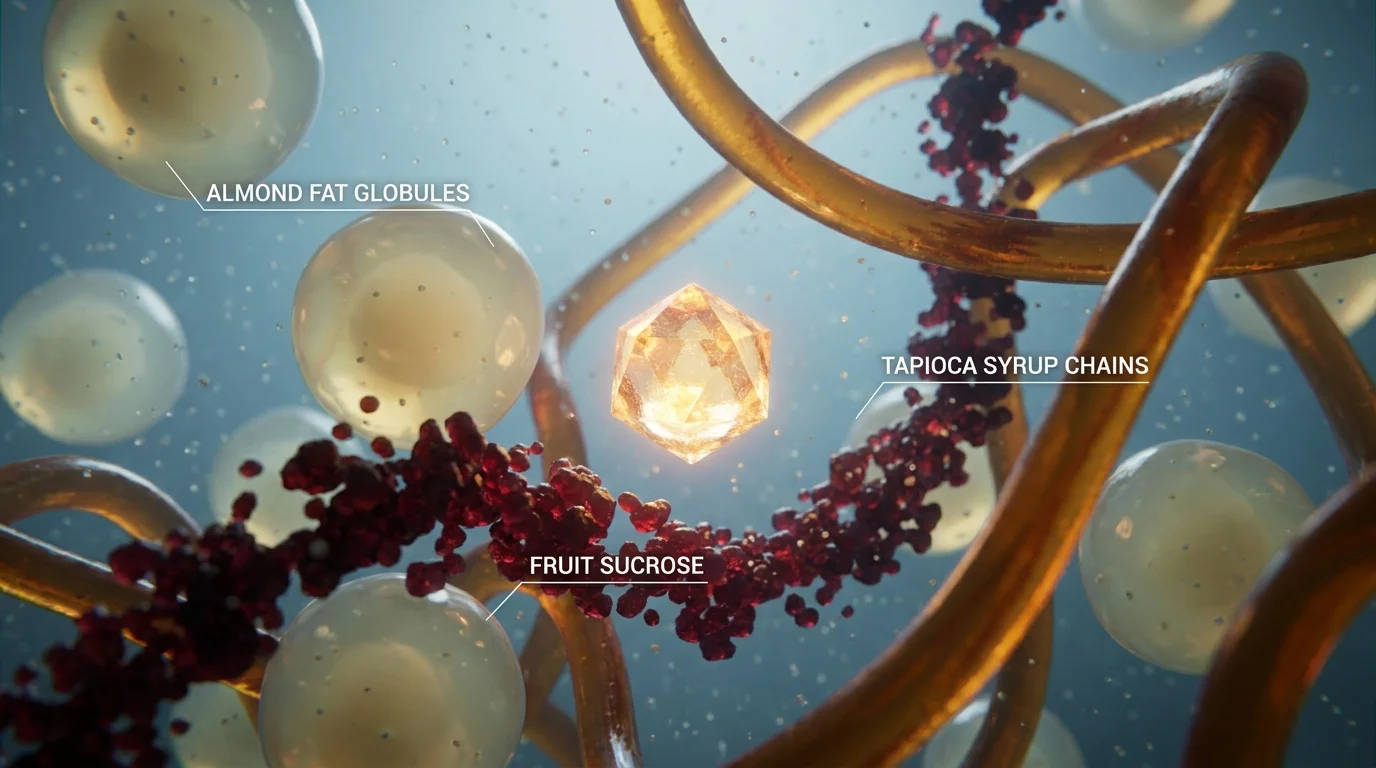
The refrigerator light hums in the quiet of a cold kitchen. You peel back the thin foil lid of an almond-milk berry yogurt, expecting a clean, restorative start to your morning. Instead, you look down at a watery, grayish liquid pooling over a dark, jelly-like sediment at the bottom of the plastic cup. **Your spoon cuts through** a spoonful of watery almond yogurt mixed with a thick pool of fruit jam, revealing an unnaturally glossy texture that clings to the plastic. It tastes cloyingly sweet, carrying the faint chemical whisper of stabilizers designed to make crushed nuts mimic the velvet weight of dairy.
You tell yourself this is the clean, compassionate choice for your body. But beneath that vibrant green leaf on the label lies a stark formulation reality. Traditional dairy yogurt relies on lactose, a naturally occurring sugar that ferments into lactic acid, creating a self-thickenining, gently tart food. When you strip away the cow, you strip away the natural chemistry of milk. To make water, almonds, and pea protein look, feel, and taste like breakfast, food labs must build an illusion from scratch.
The Health Halo Swap
We have bought into a brilliant marketing trick. We assume that because a product is plant-based, it is inherently restorative to our metabolic health. But plant-based yogurts are often formulated more like confectionery than cultured food. **The sugar substitute swap** is how manufacturers compensate for the lack of natural lactose sweetness and rich fat texture, pumping in tapioca syrup, organic cane sugar, and starches to keep the mixture from separating.
Think of it as a liquid candy bar in a plastic tub. A standard chocolate bar contains about twenty-four grams of sugar. A single six-ounce container of flavored oat or coconut yogurt frequently clocks in at twenty-six grams of rapid-acting syrups. Without the structural milk fats to slow down your digestion, this flood of simple sugars hits your bloodstream like a freight train, leaving you empty, unfocused, and shaking by mid-morning.
The Metabolic Fallout
Dr. Marcus Thorne, a 42-year-old clinical lipidologist in Denver, spent years treating patients who could not understand why their systemic inflammation markers remained high despite a fully plant-based transition. ‘They were swapping their morning Greek yogurt for oat-based vanilla pots,’ Thorne notes. ‘They thought they were saving their arteries, but they were actually **bathing their biochemical pathways** in refined fructose every single morning.’ Thorne realized his patients were consuming upwards of eighty grams of hidden syrups before noon, all under the guise of clean eating.
- Castor oil packs actually break down thick scar tissue over time
- Baking soda pastes instantly calm angry red mosquito bites and hives
- Cold water face splashing builds sharper morning focus than double espresso
- Grocery delivery apps quietly steal your natural balance and core strength
- Vitamin C serums make morning fine lines look noticeably deeper instantly
Deconstructing the Plant-Based Aisle
The Oat Illusion
Oats are naturally starchy and yield a sweet, pleasant liquid when processed. However, because oat milk is mostly carbohydrates, manufacturers must add highly refined rapeseed oil and extra cane sugar to give it the mouthfeel of dairy. It behaves in your body like a bowl of sweet oatmeal cooked in heavy syrup, spiked with thickeners. **This triggers a sharp** insulin response that halts fat oxidation for hours.
The Almond Waterway
Almonds contain very little natural sugar or fat when watered down into commercial milk. To make this watery mixture look like yogurt, processors rely heavily on cornstarch, locust bean gum, and pectin, layered over a massive bed of liquid sugar. It is a highly engineered starch gel, not a fermented dairy alternative. You are essentially paying for thickened water and sugar syrup.
The Coconut Trap
Coconut milk has the natural fat, but its distinct tropical flavor is difficult to mask. To appeal to a mass market, manufacturers saturate it with vanilla extract and coconut sugar. **The heavy saturated fats** combine with these added sugars to create a high-calorie, low-protein dessert that mimics dairy yogurt only in its cold temperature.
The Mindful Blueprint
To fix this, you do not need to abandon plant-based eating. You simply need to change how you read the back of the package. Treat the nutrition facts panel like a structural blueprint for your cellular health rather than a marketing brochure.
- Look for the ‘Added Sugars’ line first and ensure it is under four grams.
- Avoid brands that list tapioca syrup, brown rice syrup, or cane juice in the first five ingredients.
- Ensure there is a solid protein source, such as pea or pumpkin seed protein, to balance the carbohydrates.
**Prioritize the protein ratio** to keep your hunger hormones quiet and your focus sharp throughout the morning hours. If your yogurt lacks protein, you will find yourself searching the pantry for a snack within sixty minutes of finishing your bowl.
The Bigger Picture
Real wellness is not about consuming foods that look like health but act like treats. When you step back from the bright green labels and the promise of dairy-free purity, you begin to see food for what it actually does to your body. **Simplifying your morning fuel** means seeing through the sweet illusions of the grocery aisle, choosing simplicity over marketing, and letting your body run on clean, stable energy that keeps you grounded all day.
‘The modern grocery store is a theater of health illusions; your only protection is reading the ingredient list from right to left.’ — Dr. Marcus Thorne
| Key Point | Detail | Added Value for the Reader |
|---|---|---|
| Sugar Density | Many plant-based yogurts contain up to 26g of sugar per serving. | Helps you identify and avoid morning insulin spikes. |
| Structural Fillers | Manufacturers use tapioca starch and gums to mimic dairy fat. | Reveals why these yogurts often cause bloating and digestion issues. |
| Protein Deficit | Most nut yogurts offer less than 2g of protein per cup. | Guides you to add your own clean protein powder or hemp seeds. |
Are all plant-based yogurts bad for your metabolic health? No, but you must choose unsweetened varieties and add your own whole fruit to avoid the refined syrups.
Why is there so little protein in almond yogurt? Almond milk is mostly water; without added pea or soy protein, it lacks the amino acids needed for muscle recovery.
What should I look for on the ingredient label? Look for simple ingredient lists containing only nuts, water, active cultures, and natural thickeners like agar-agar.
Does organic cane sugar affect my blood sugar differently? Your liver processes organic cane sugar and refined white sugar the exact same way, triggering the same insulin response.
How can I make my unsweetened plant yogurt taste better? Stir in a handful of fresh wild blueberries, a dash of organic cinnamon, and a spoonful of raw pumpkin seeds for texture.