The air in the room turns thin, resembling the feeling of breathing through a pillow. Your collar feels three sizes too small, your fingertips prickle with static, and the walls seem to subtly lean inward as an internal siren begins to wail without sound. In that exact fraction of a second, reasoning with yourself is like whispering into an offshore gale. Logic has left the building; the primitive wiring behind your eyes has seized full command of the vessel, convinced that your mundane Tuesday afternoon conference call is a fight against mortal ruin.
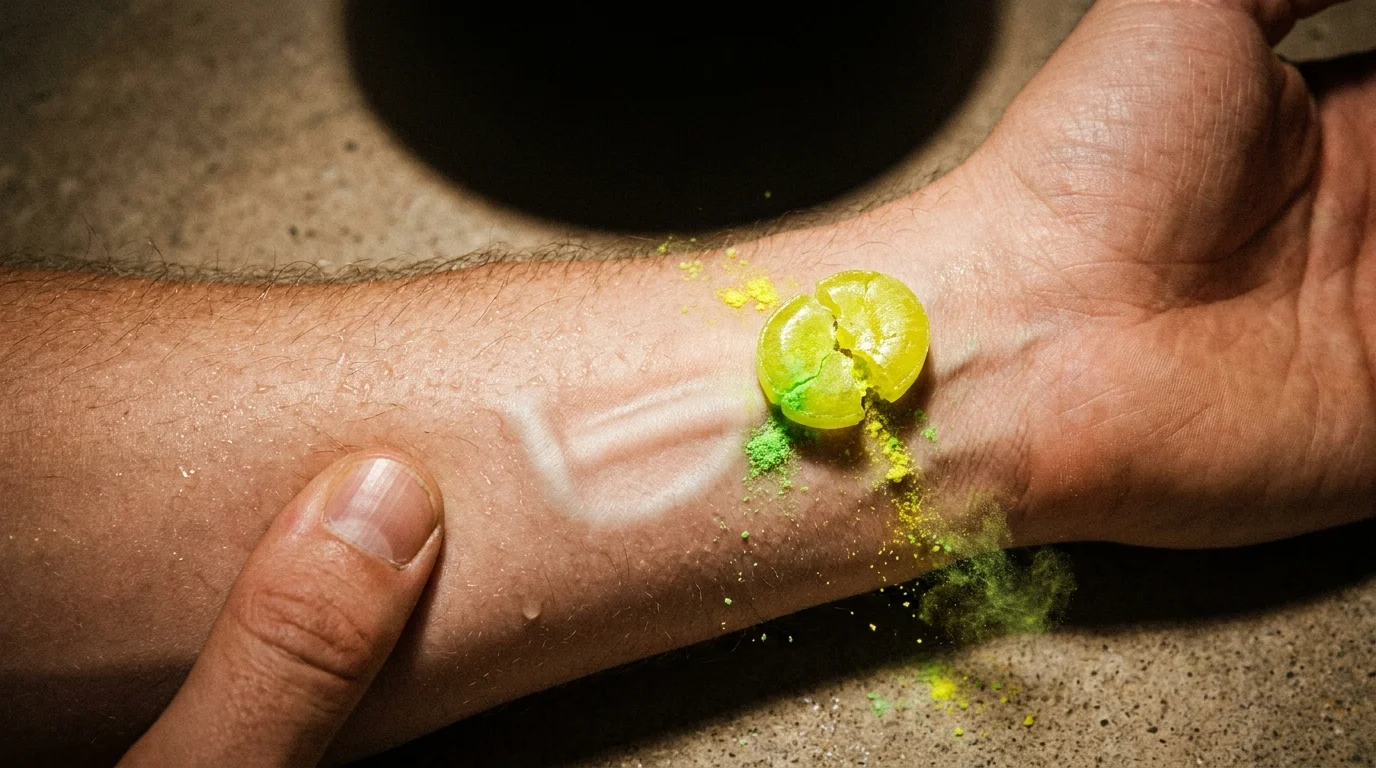
You reach into your coat pocket, your fingers fumbling past loose coins and crumpled receipts until they pinch a small, yellow plastic drum. You tear the wrapper, pop the neon green marble onto your tongue, and close your mouth. Within three seconds, a searing, eye-watering lightning bolt of malic acid coats the roof of your mouth, provoking a violent surge of saliva that floods your oral cavity and forces your jaw to clench in visceral surprise.
Your eyes water, your toes curl inside your shoes, and your breath catches sharply. Then, just as suddenly as the lightning struck, the siren inside your skull goes dead quiet. The runaway loop of dread, seconds away from a full-blown physical detonation, vanishes—derailed completely by a cheap novelty confection meant for middle-school dares.
The Biological Circuit Breaker: Hijacking the Amygdala
When panic takes the wheel, your brain does not care about gentle affirmations or deliberate belly breathing. The amygdala—the brain’s ancestral alarm system—fires erratic, high-frequency danger signals straight down your spinal cord, initiating a cascade of adrenaline, blood pooling in the limbs, and shallow hyperventilation. Trying to talk yourself down using your prefrontal cortex during this storm is an uphill battle against raw biology.
To stop an acute spiral, you need an intervention that operates faster than cognitive thought: a sensory hammer that demands an immediate, involuntary bodily response. This is where the sheer chemistry of extreme malic acid crystals delivers an unexpected neurological rescue.
Malic and citric acids, when concentrated at the extreme levels found in Toxic Waste candies, trigger a massive gustatory shock wave across the glossopharyngeal and facial nerves. The brain categorizes this overwhelming sourness not as a casual snack, but as an immediate physical threat—an ingestion of an abrasive, potentially dangerous organic substance. In an instant, the autonomic nervous system is forced to divert its massive electrical payload away from abstract dread and toward immediate survival.
- Deep sectional lounging twists pelvic alignment triggering stubborn lower back and knee stiffness
- Croscarmellose sodium binders resist stomach breakdown triggering painful rock-hard belly swelling
- Raw manuka honey seals painful cracked heels overnight through active floral enzymes
- Levator scapulae muscles trap chronic workplace micro-stress triggering burning neck and shoulder aches
- Grapeseed cooking oil releases stinging fumes triggering heavy sinus pressure and sudden brain fog
The salivary reflex isn’t just about wetting your mouth; it acts as an autonomic switch. When extreme sourness hits, your parotid glands dump liters-per-minute equivalents of protective enzymes to neutralize the pH drop, an act that fundamentally relies on a sudden, reflex-driven spike in parasympathetic activation. In the simplest terms: your brain cannot maintain an imaginary catastrophe while dealing with an undeniable, full-mouth sensory emergency.
The Clinic in the Pocket: Sarah’s Emergency Pivot
Sarah Lin, a 34-year-old architectural draftsman from Chicago, spent three years terrified of taking the ‘L’ train after a sudden, debilitating panic attack trapped her between stations in a tunnel. Traditional grounding techniques—counting five blue objects or pressing her feet into the floorboard—regularly failed her once her pulse vaulted past 130 beats per minute. Her therapist, an unconventional clinician familiar with dialectical behavior therapy resets, suggested carrying a plastic drum of Toxic Waste candies in her handbag instead of relying purely on mental endurance.
During a stalled commute on the Blue Line last November, as the cabin lights flickered and her chest began to cave under familiar dread, Sarah slipped an apple-flavored sour core onto her tongue. The sheer ferocity of the sour punch shocked her back into the present moment within ten seconds; the physical discomfort of the candy broke her catastrophic thought chain so thoroughly that she actually chuckled through watering eyes. What years of whispered self-talk couldn’t touch was settled by forty-five seconds of raw biochemical distraction.
Adjustment Layers: Choosing Your Sensory Anchor
Not every nervous system handles intense chemical shock in identical ways, and managing acute dread requires choosing the right tool for your specific somatic threshold.
For the High-Spike Panic Responder
If your episodes hit like an unexpected tidal wave—complete with blurred vision, racing heartbeat, and sudden nausea—you require the full, unadulterated malic acid load. The original Toxic Waste formula provides roughly thirty to forty-five seconds of unyielding, mouth-puckering intensity before melting into standard sweetness. Keep the candy rolling against the center and sides of your tongue where the foliate and circumvallate papillae cluster, ensuring the maximum possible input along cranial nerve IX.
For the Subtle, Creeping Dread Loop
If your anxiety arrives as an insidious, creeping fog that slowly tightens your jaw and knots your stomach over hours, a sudden nuclear sour shock might feel too jarring. In this space, allowing a moderately sour alternative—like a standard sour gummy or a crystallized lemon wedge—provides a sustainable, rolling stream of tactile distraction without overstimulating sensitive mucosal lining.
Mindful Application: The 60-Second Neuro-Reset
Using taste to short-circuit a panic loop is an applied craft, not a magic trick. You are deliberately invoking an ancient survival reflex to clear a modern psychological stall. Follow this exact somatic sequence when you feel your chest begin to cave.
- Unwrap deliberately: Pay acute attention to the tactile rustle of the plastic packaging, using the sound to pull your attention slightly forward into physical reality.
- Place on the center-tongue: Do not chew or tuck the candy into your cheek; let the acid crystals dissolve directly against your most sensitive taste receptors.
- Observe the salivary flood: Notice the sudden, heavy rush of saliva pooling beneath your tongue, acknowledging it as your body switching gears from defense to digestion.
- Ride the thermal shock: Close your eyes for thirty seconds and lean directly into the sharp, tongue-curling burn rather than fighting the grimace.
- Track the softening sweet: As the sour shell dissolves away into mild sugar, take three slow, unforced nasal breaths, recognizing the return of baseline reality.
Your tactical toolkit should remain dead simple: keep two or three individually wrapped pieces in your daily bag, your desk drawer, and your car console. Ensure they stay dry and cool; humidity can melt the surface malic acid crystals, blunting the crucial first five seconds of pure sensory shock.
The Bigger Picture: Reclaiming Trust in the Body
Living under the shadow of sudden panic often leaves you feeling fundamentally betrayed by your own physiology. You begin to treat your body as an unpredictable, hostile houseguest capable of pulling the fire alarm at the worst possible moments. Yet the realization that something as simple, humble, and unpretentious as a sour candy can halt that alarm reminds us of a comforting truth: your nervous system is not broken.
It is simply a finely tuned biological machine operating on ancient rules. When you learn to speak to it in its native language—the raw, undeniable reality of direct physical sensations rather than the convoluted dialect of worried thoughts—you stop being a hostage to the spiral. You discover that peace of mind is rarely something you have to argue your way into; often, it is simply waiting on the other side of an unexpected splash of sour.
The nervous system cannot maintain a phantom catastrophe when the physical mouth is screaming about lemons.
| Key Point | Detail | Added Value for the Reader |
|---|---|---|
| Neurological Hijack | Malic acid triggers cranial nerves VII and IX instantly. | Bypasses slow conscious thought to interrupt fear signals. |
| Parasympathetic Reflex | Severe sourness forces parotid gland saliva dumping. | Physiologically opposes the dry-mouth adrenaline state. |
| Tactile Grounding | Intense facial grimacing and sensory absorption. | Snaps somatic attention back to immediate physical realities. |
Frequently Asked Questions
Does this cure the root cause of panic disorders?
No, this is an acute emergency intervention designed to interrupt active spirals, not a substitute for underlying therapeutic work or professional care.Can I use sour spray or drops instead of hard candy?
Yes, concentrated sour sprays or pure citric acid drops work effectively, provided they deliver enough immediate intensity to trigger a salivary flood.Will the high acidity harm tooth enamel if used often?
Frequent exposure to malic acid can erode enamel; rinse your mouth with clean water shortly after use and avoid brushing your teeth for thirty minutes.Why doesn’t regular hard candy work just as well?
Standard sweets lack the extreme acid concentration required to register as an emergency sensory threat, failing to pull the brain out of its loop.Is this safe for people with sensitive stomachs?
Those with severe acid reflux, active gastritis, or mouth ulcers should avoid extreme sour candies and consider ice cubes or cold water shocks instead.