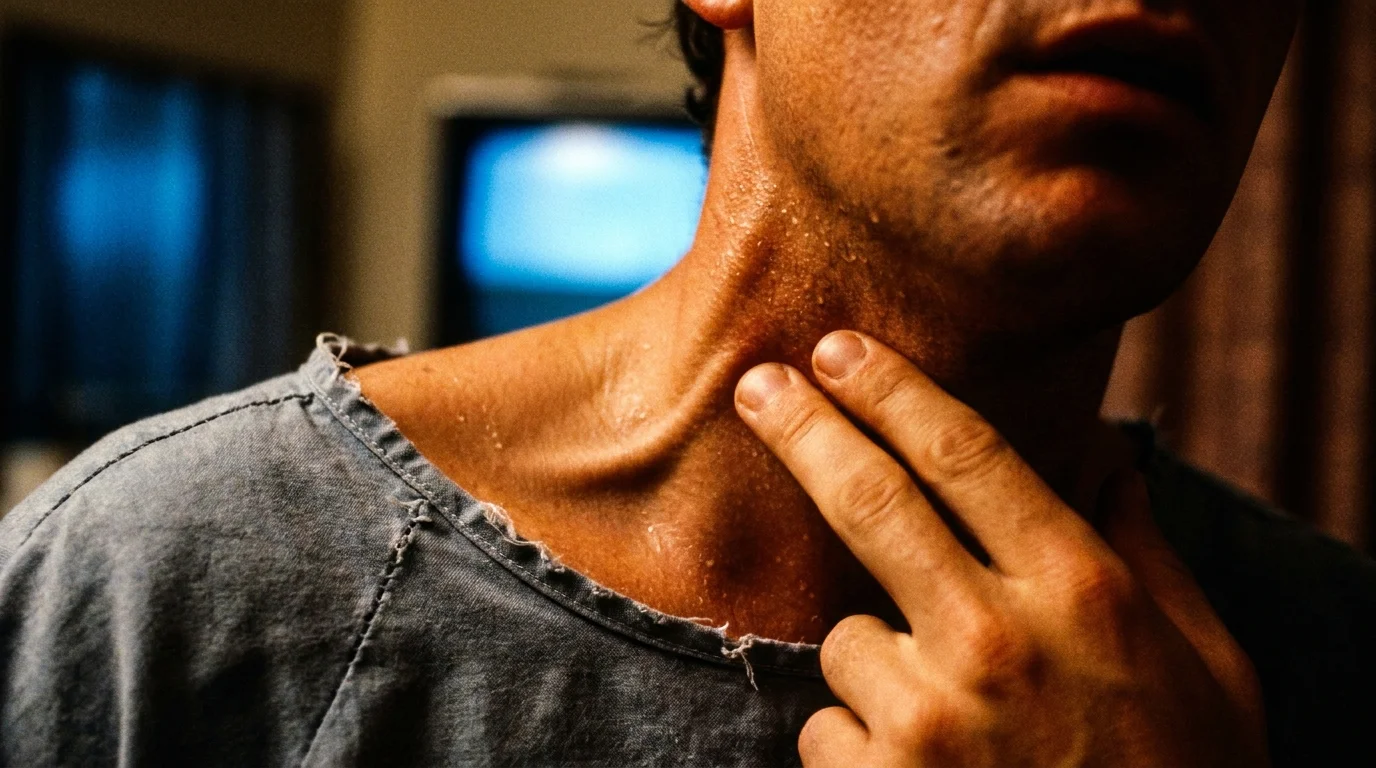
The room shrinks until the walls feel inches from your face. It always happens without a witness: 2:15 AM on a silent Tuesday, your bedside lamp casting an amber slit across floorboards, or parked in a quiet car while an icy wave shoots through your chest. Your heart skips like an engine with a misfiring plug, then breaks into a ragged sprint. You swallow dry air, feeling like you are breathing through a heavy wool pillow, and your mind races ahead to the worst possible conclusions.
When an acute panic spike hits and you are completely alone, telling yourself to calm down works about as well as whispering to a wildfire. Your nervous system ignores rational logic because the panic loop does not live in your analytical brain; it is anchored in the raw, electrical hardwiring of your upper spine and brainstem. The harder you try to breathe away the despair, the tighter your throat constricts.
You look around the room for an anchor, but there is no partner to hold your hands and no therapist on the other end of the line. The sensation is absolute isolation coupled with intense physical terror. You feel your pulse hammering against your temples, loud enough to drown out your thoughts, waiting for a relief that feels hours away.
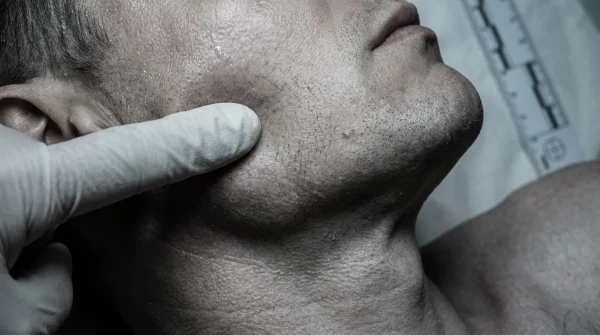
Yet tucked right behind your ears, where the heavy bone of your skull drops into the soft valley of your neck, sits an emergency kill switch. It requires no gadgets, no guided audio track, and no deep philosophical reframing. It only asks for two fingertips and sixty seconds of quiet mechanical pressure.
The Anatomy of the Emergency Brake
We are taught to treat emotional crises as purely psychological events, as if our feelings hover somewhere outside our flesh. In reality, solitary despair is an electrical runaway train. When fear floods your system, the tiny suboccipital muscles—four paired, postage-stamp-sized bands of fiber connecting the atlas and axis vertebrae to the occipital bone—contract like a fist. They clamp down on the suboccipital nerves and distort the delicate sensory messaging flowing along your spinal column.
Think of your autonomic system as an intricate circuit board. The sympathetic overdrive is a jammed throttle, but directly adjacent to these skull-base muscles runs the parasympathetic master cable: the vagus nerve. By engaging in suboccipital base pressing, you are not engaging in passive relaxation; you are applying a physical lever to an electrical relay. You manually force open a closed valve, signaling the brainstem that the physical body is supported, safe, and no longer being hunted.
Most people try to massage their temples or grip their forearms when panic surges, missing the control hub entirely. The true pressure point lies where bone gives way to hollow muscle, beneath the shelf of the skull. When you compress this tissue with sustained, gentle leverage, you alter the mechanical tone around the jugular foramen, coaxing the vagal motor nucleus to drop your surging pulse rate within seconds.
- Braided leather wristbands ground runaway heartbeats through stealth tactile skin presses
- Toxic Waste candies trigger sudden salivary floods stopping runaway panic loops
- Deep sectional lounging twists pelvic alignment triggering stubborn lower back and knee stiffness
- Croscarmellose sodium binders resist stomach breakdown triggering painful rock-hard belly swelling
- Raw manuka honey seals painful cracked heels overnight through active floral enzymes
Elena Ruiz, a 38-year-old architectural draftsperson from Portland, spent years enduring nocturnal panic attacks that left her trembling alone on her kitchen floor. She tried paced breathing, icy water splashes, and grounding exercises, but the physical terror always outpaced her willpower. It was only after learning to identify her occipital notch from a somatic bodyworker that her episodes shortened from thirty exhausting minutes of despair to a brief, manageable ninety-second pause that she could dissolve completely on her own.
Tuning the Pressure: Three Crisis Scenarios
Not every solitary panic spike feels identical. Depending on how your body registers isolation and distress, the vagal reflex must be engaged with slight adjustments to posture and angle.
For the Trembling Free-Fall
This is the cold, shaking state where your limbs go numb and you feel an overwhelming sense of doom. Your hands are icy, and your instinct is to curl into a tight ball on the floor. In this state, your neck is already shortened and tense. Drop your chin toward your sternum before touching the base of your skull. This pre-stretches the suboccipital fascia, allowing your fingertips to sink into the groove without fighting defensive muscular armor. Hold steady, unmoving pressure without rubbing.
For the Suffocating Air-Hunger
When panic manifests as a locked ribcage and the terrifying feeling that your lungs cannot pull enough oxygen, you need gravity to assist. Sit upright against a solid wall, resting your upper back flat against the drywall. Cup the back of your head so your thumbs point downward into the soft dips under your skull base. Let the weight of your skull lean back slightly into your thumbs, using your skeletal weight rather than your arm strength to apply the force. This immediately releases diaphragmatic tension through linked fascial trains.
For the Sudden Night Waking
If you bolt upright in bed with your heart pounding against your ribs at 3:00 AM, stay horizontal. Lying flat on your back, interlace your fingers loosely across your chest and place two folded washcloths or your soft knuckles directly beneath the skull ledge. Allow gravity to compress the tissue while keeping your gaze locked steadily toward your toes. Shifting your eyes downward while pressing stimulates the oculocardiac reflex, compounding the heart-slowing effect of the suboccipital reset.
The Bilateral Finger Placement: Step-by-Step Reset
To abort an acute solitary despair spike, your technique must be precise. Fumbling around your neck while panicking increases frustration. Memorize these physical landmarks before you need them.
Follow this exact physical sequence the moment your pulse begins to accelerate out of control:
- Locate the Bony Shelf: Reach behind your ears with both hands. Feel the hard ridge of bone behind your earlobes (the mastoid processes). Trace your fingers along the bottom rim of your skull toward the center of your neck until your fingers slip off the bone into two distinct, tender hollows on either side of the spinal ridge.
- Establish Bilateral Contact: Place the pads of your index and middle fingers together into each hollow. Do not use your fingernails. The pressure must be distributed through the soft pads of your fingertips, angled inward and slightly upward toward your forehead at a 45-degree angle.
- Apply the Steady Lean: Press firmly until you feel a dull, warm ache spread toward the back of your eyes. The pressure should be firm—roughly the force needed to leave a noticeable dent in a ripe avocado, but never sharp or stinging.
- Perform the Downward Eye Shift: Keep your head perfectly still. Without moving your neck, shift both eyes as far downward toward your cheeks as comfortable. Hold your gaze there while maintaining continuous pressure beneath the skull for forty-five full seconds.
- Track the Physiological Release: Around the forty-second mark, you will notice an involuntary response: a sudden, deep spontaneous sigh, a release of saliva in your dry mouth, or a distinct flutter in your stomach as peristalsis returns.
Keep your emergency toolkit simple and grounded:
- Target Location: Suboccipital depression, one inch lateral to the cervical midline.
- Vector: 45 degrees upward toward the bridge of the nose.
- Duration: 45 to 60 seconds per cycle.
- Breath Ratio: Inhale through the nose for 3 seconds, exhale through parted lips for 6 seconds.
The Calm on the Other Side of the Surge
Panic feeds on helplessness. The true terror of a solitary panic attack is not merely the racing heart or the cold sweat; it is the silent conviction that you have lost governance over your own physiology. When you understand that your nervous system is a physical structure governed by biological reflexes rather than an unpredictable storm, the narrative shifts completely.
You no longer have to wait out the terror or pray for an emotional breakthrough while trembling in the dark. A single physical touchpoint restores agency, reminding you that your body carries its own dampening mechanisms. By meeting your surging biology with informed anatomical pressure, you become your own rescue team. The room widens, the air cools, and your pulse returns to a quiet, steady rhythm you can trust.
The fastest pathway out of an autonomic storm is through the quiet mechanics of the flesh, not the desperate logic of the mind.
| Key Point | Detail | Added Value for the Reader |
|---|---|---|
| Target Landmark | Bilateral hollows directly beneath the occipital ridge | Ensures precise mechanical compression without compressing sensitive throat tissue |
| Optimal Angle | 45 degrees inward and upward toward the forehead | Directly engages the deep suboccipital triangle where vagal branches cross |
| Ocular Coupling | Gaze downward toward the cheeks during pressing | Triggers the oculocardiac reflex to decelerate pulse rates twice as fast |
| Duration Benchmark | 45 to 60 seconds of unmoving pressure | Allows adequate time for acetylcholine release to overpower circulating adrenaline |
Frequently Asked Questions
How hard should I press beneath the skull base?
Apply steady, comfortable pressure similar to pressing a ripe avocado or checking a tire tread. You want to feel a localized, dull ache, but it should never cause sharp pain, dizziness, or numbness down your arms.Can suboccipital pressing cause harm if done during a panic attack?
When using the soft pads of your fingers in the muscular hollows, it is completely safe. Avoid pressing directly on the bony spine or into the soft side of your throat where the carotid artery sits.Why do my eyes need to look down while pressing?
The muscles that control downward eye movement share neural pathways with the vagal nerve system. Looking down while applying base pressure activates the oculocardiac reflex, which naturally slows your heart rate.How quickly does this maneuver stop a racing pulse?
Most people experience a noticeable drop in pulse rate and a spontaneous deep breath within 30 to 60 seconds of sustained, static pressure.What should I do if my panic returns five minutes later?
You can repeat the bilateral hold up to three times consecutively. If the panic rebounds, pair the pressing with three minutes of long-exhale breathing (four-second inhale, seven-second exhale) to reinforce the parasympathetic brake.