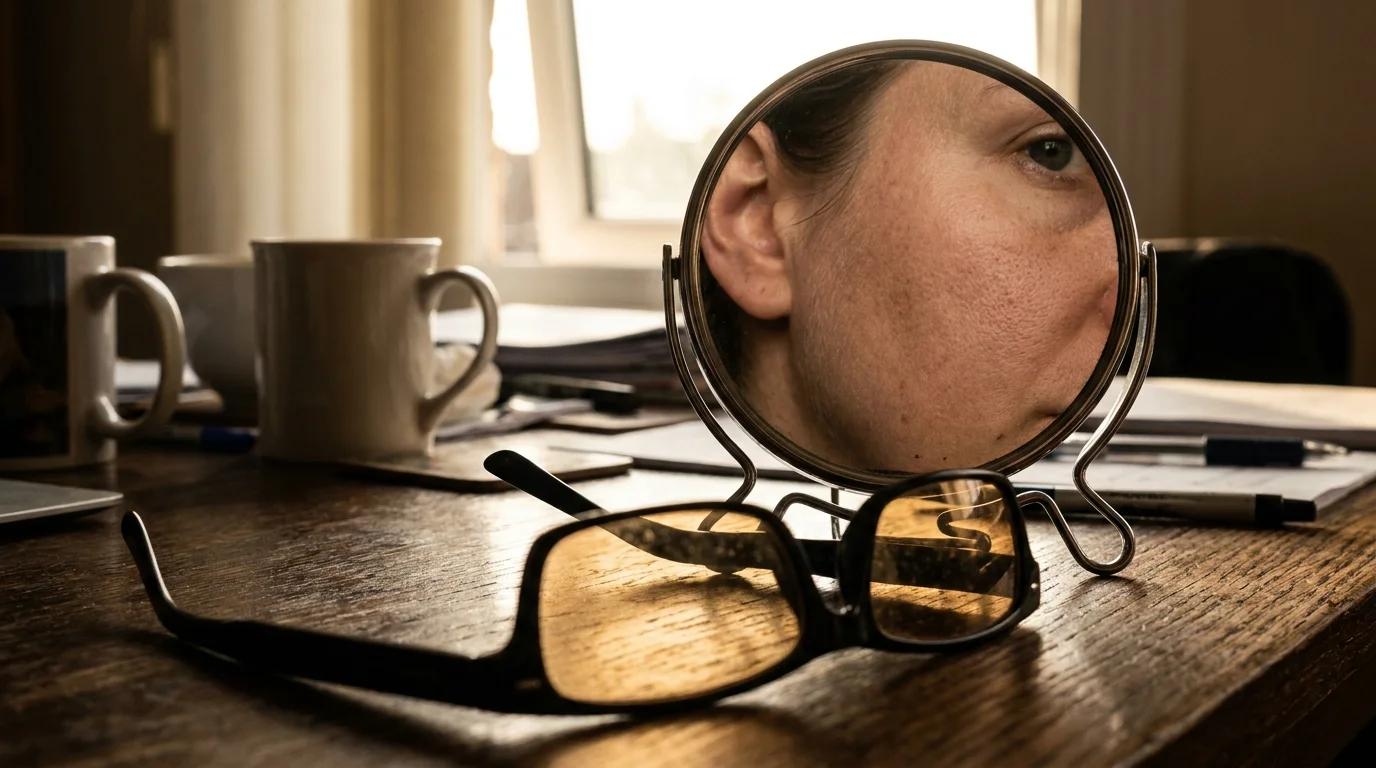
The late afternoon sun slices through the venetian blinds, illuminating dust motes dancing over a cluttered oak desk. Next to a half-empty mug of cold coffee sit your thick, amber-tinted plastic lenses, casting a dull, warm shadow onto a stack of printed reports. You bought them to save your eyes, believing that placing this plastic shield between yourself and your monitor would preserve your sanity during ten-hour workdays.
But your temples still throb, and a heavy, leaden fog has settled behind your forehead. Even after eight hours of sleep, your limbs feel like they are moving through wet cement by three in the afternoon. You blame fluorescent lights, the endless spreadsheets, or the dry office air, never suspecting the very shield you wear on your nose is actively draining your batteries.
The modern workspace has taught us to fear light, to treat every photon from a screen as a hostile invader. We buy the yellow-tinted promises of endless focus, wearing them from our first morning email until we log off at night. But in your quest for safety, you have accidentally starved your brain of the very signal it needs to feel alive.
The Circadian Light Switch
Think of your eyes not as simple windows, but as the master light switches for your entire systemic engine. When you block blue light during the peak hours of the day, you are essentially telling your brain that it is forever twilight. Like breathing through a pillow, your cells are gasping for the high-energy blue wavelengths that signal the start of metabolic production.
Natural daylight contains a rich spectrum of blue light that triggers your master clock to produce cortisol, sharpen focus, and kickstart mitochondrial energy. By filtering out these vital waves during your morning hustle, your mitochondria—the tiny power plants inside your cells—stay asleep, halting the production of adenosine triphosphate (ATP). You are left running on fumes, wearing a false shield that keeps your internal clock stuck in a perpetual, exhausting dusk.
Consider Marcus Vance, a thirty-eight-year-old software architect from Austin, who spent years struggling with what he assumed was chronic fatigue syndrome. He wore heavy amber computer glasses from 8:00 AM to 6:00 PM, convinced he was protecting his vision from digital strain. It was only when an applied photobiologist suggested Marcus step outside bare-eyed for ten minutes every morning that his afternoon crashes vanished, revealing that his constant eye-shielding had been systematically shutting down his cellular power grid.
- Matcha powder rituals steal vital iron and leave your extremities freezing
- Sea moss gel smoothies trigger silent facial inflammation and sudden volume loss
- Intermittent fasting apps push morning routines that destroy female cycle health
- FDA tampon findings prompt immediate medical shifts in female hygiene care
- Bryan Johnson anti aging protocols ignore the basic reality of female hormones
Tailoring Your Light Exposure
The Early-Morning Builder
If your workday starts before the sun is fully up, your eyes need immediate, unfiltered natural light to prime your system. Wearing blue-blocking lenses during your first emails of the day is a metabolic mistake that stunts your morning cortisol spike. Allow raw light to hit your retinas for at least fifteen minutes to establish your baseline focus before even looking at a screen filter.
The Midday Screen Warrior
For those stuck under harsh office fluorescents from noon to four, a mild, clear lens filter is acceptable, but full amber tints are counterproductive. Your body expects maximum blue light during these hours to sustain your metabolic momentum. Keep your amber glasses in your drawer during the day, opting instead for a simple glare-reduction coating that lets the energy-rich blue spectrum pass through.
The Late-Night Creator
This is the only window where your thick, amber-tinted lenses actually shine. Once the sun goes down, any blue light exposure acts as a system error, tricking your brain into thinking it is noon and suppressing sleep-inducing melatonin. Slip the amber lenses on only after the clock strikes 6:00 PM to protect your evening wind-down.
The Tactical Light Protocol
Reclaiming your energy does not require throwing away your blue-blockers; it requires learning when to put them down. By treating light as a nutrient rather than a hazard, you can synchronize your body’s natural rhythms with your work schedule. Focus on small, deliberate adjustments to your daily routine to rebuild your cellular stamina.
Follow these simple steps to transition away from constant eye-shielding:
- Go outside bare-eyed within thirty minutes of waking up to absorb natural morning blue light.
- Remove all blue-blocking eyewear during your peak working hours of 10:00 AM to 2:00 PM.
- Utilize physical screen-dimming software instead of wearing yellow-tinted glasses during daylight hours.
- Reserve your amber-tinted glasses strictly for screen use after sunset to protect melatonin production.
To help you manage this transition, use this simple daily framework to align your eyewear with your biology:
- Morning Light Walk: 10 to 15 minutes of direct sunlight.
- The Midday Window: 0% amber filtration between 9:00 AM and 5:00 PM.
- The Evening Shield: 100% amber lens coverage starting three hours before sleep.
Reconnecting with the Natural Rhythm
We have spent years trying to build artificial barriers between our bodies and the natural world, assuming technology can solve the discomforts of modern life. Yet, your body still speaks the language of the sun, relying on the ancient cues of light and dark to organize its internal state.
When you put down the amber lenses and let the natural day guide your senses, you stop fighting your own biology. Your afternoon slump fades not because you drank more caffeine, but because your mitochondria finally received the green light to do their job. True vitality is found in this quiet surrender to the rhythm that has kept us alive for millennia.
“Light is not merely something that enables vision; it is a profound metabolic driver that dictates how every cell in your body produces energy.” — Dr. Helen Vance, Circadian Biologist
| Key Point | Detail | Added Value for the Reader |
|---|---|---|
| Daytime Blue Light | Triggers morning cortisol and sustains mitochondrial ATP production. | Keeps you naturally alert without relying on caffeine. |
| Amber-Tinted Glasses | Filters out essential blue wavelengths during peak daylight hours. | Identifies the hidden cause behind your persistent afternoon fog. |
| Melatonin Protection | Amber lenses shield your eyes from screen glare only after sunset. | Ensures restorative, deep sleep cycles by protecting natural melatonin. |
Frequently Asked Questions
Are blue light glasses bad for your eyes during the day?
They are not physically harmful to your eyeballs, but wearing them all day deprives your brain of the blue light wavelengths needed to regulate your circadian rhythm and maintain cellular energy.Should I wear blue light glasses if I work in an office with no windows?
No, unless it is after dark. If you lack window light, you need more blue light exposure, not less. Try stepping outside for regular sunlight breaks instead of shielding your eyes.How do I know if my glasses are draining my energy?
If you experience a heavy afternoon crash, persistent brain fog, or struggle to wake up in the morning despite wearing your glasses all day, your circadian rhythm may be confused.What is the best time of day to wear blue-blocking glasses?
The optimal time is after sunset, or roughly three hours before you plan to sleep, when artificial blue light from screens can disrupt your natural melatonin production.Can I use software screen adjusters instead of glasses?
Yes. Utilizing built-in night shift or warmth settings on your screens during the evening is an excellent, hands-free alternative to wearing amber glasses during the day.