The room is dead quiet at 2:14 AM, but your bedroom floor feels like it is vibrating beneath your feet. Your chest is rattling like a cold engine turning over too fast, hammering against your ribs with a sudden, deafening urgency that leaves your palms clammy and your mouth dry. You are entirely alone, sitting upright on the edge of the mattress, waiting for the surge to peak while wondering if your heart is actually about to give out.
Standard advice tells you to close your eyes and practice box breathing, but when panic has already hijacked your nervous system, trying to count four-second cycles feels like breathing through a pillow. Your lungs resist, your diaphragm locks up, and the desperate mental effort to ‘calm down’ only amplifies the racing cadence in your neck. The body does not take verbal orders during an adrenergic flood.
Solitary panic spikes are uniquely brutal because there is no external voice to tether your focus, no hand to ground you, and no distraction strong enough to drown out the internal alarm. What your body demands in that dark hallway or empty living room is not a psychological pep talk. You need an immediate, mechanical switch—a physical reflex that works on biological hardware rather than fragile mental discipline.
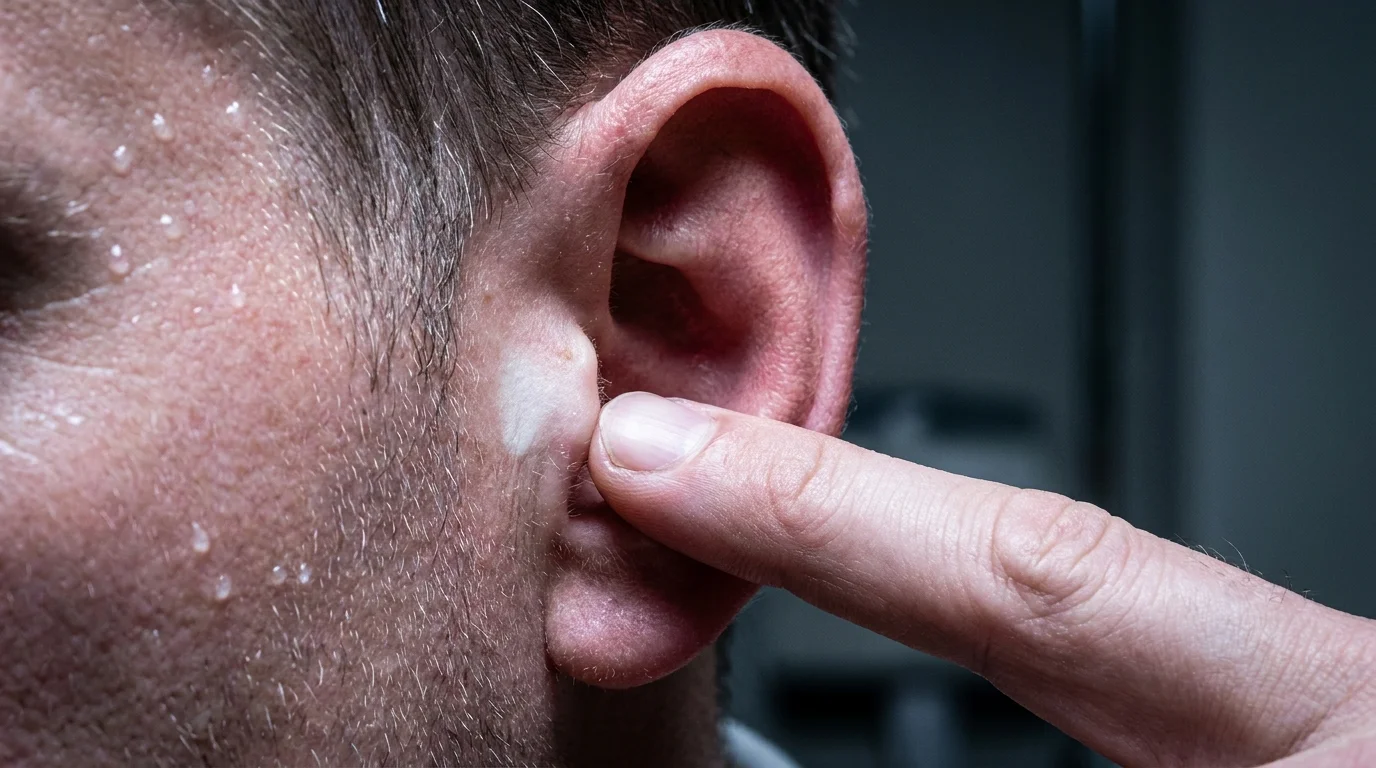
That switch sits right on your face, disguised as a modest flap of cartilage you normally ignore. By applying deliberate, targeted pressure to the tragus—the small, rounded projection guarding the entrance to your ear canal—you can tap directly into the auricular branch of the vagus nerve, forcing your runaway heart rate to drop back to baseline in seconds.
The Biological Backdoor to the Heart
Think of your autonomic nervous system not as a mysterious emotional weather pattern, but as a dual-circuit electrical breaker. In an acute panic attack, your sympathetic circuitry dumps norepinephrine directly into your bloodstream, slamming the accelerator to the floor and locking the throttle. Trying to reason yourself out of that state is impossible because your prefrontal cortex has effectively gone offline.
To slow a runaway pulse, you must send an undeniable somatic instruction to the heart’s natural pacemaker: the sinoatrial node. While the deep vagus nerve runs through the neck and down into the viscera, its only surface-level cutaneous outlet on the human body terminates right here in the external ear. Neuroscientists refer to this small conduit as Arnold’s nerve.
- Inner wrist pressing halts crowded room panic surges without drawing single glances
- Tabasco sauce drops shock runaway panic loops to restore steady rhythmic breathing
- Morning omeprazole capsules stall daily metabolic clearance triggering bloated midday stomach cramps
- Canola cooking oil scorches at high pan heat triggering sudden sinus pressure
- ZeroWater filter pitchers strip vital minerals leaving parched lips and heavy fatigue
When you compress the tragus inward against the ear canal, mechanical pressure stimulates sensory afferent fibers that feed directly into the nucleus tractus solitarii in your brainstem. In response, your brainstem discharges acetylcholine through the main vagal trunk, prompting an immediate drop in arterial heart rate. You are not waiting for your mind to find peace; you are manually pumping the brakes.
A Clinician’s Secret for the Midnight Surge
Dr. Julian Vance, a 46-year-old emergency physician and clinical neurologist based outside Seattle, spent years watching solitary panic patients arrive in the ER with resting heart rates north of 140 beats per minute. Their labs were pristine, their cardiac enzymes clean, yet their bodies were completely trapped in an involuntary tachycardic feedback loop. ‘When someone is alone in the middle of the night, panic feeds on its own somatic symptoms,’ Vance explains. ‘The moment they feel their pulse race, the terror spikes, which accelerates the pulse further. During my residency, we learned that targeted tragus occlusion could mechanically mimic carotid massage without any of the dangerous arterial compression risks, providing patients with an instantaneous physical off-ramp they could perform entirely alone.’
Tailoring the Compression to Your Crisis State
Acute panic manifests differently depending on whether your body leans toward trembling agitation, hyperventilation, or frozen dread. Applying tragus ear pressing correctly requires small postural adjustments based on your specific physical symptoms.
For the Tachycardic Freeze (Cold Extremities and Pounding Chest): When your limbs go ice cold and your pulse is hammering so hard your vision seems to pulse with it, adopt a seated posture with your feet planted flat on the floor. Use both index fingers to press your tragus flaps firmly inward, sealing the auditory canals completely. Once sealed, introduce a slight anteromedial traction—pulling the cartilage fractions of an inch forward toward your jawbone. This dynamic stretch amplifies the parasympathetic discharge, signaling the heart to lower output pressure within twenty to thirty seconds.
For the Air-Hunger Spike (Hyperventilation and Shaky Hands): If your panic is accompanied by rapid, shallow panting and a tight band around your ribs, unilateral pressure is far more effective. Place your dominant thumb on the corresponding tragus, pressing firmly inward while keeping the opposite ear unblocked to maintain ambient spatial awareness. Use your free hand to stabilize your sternum. The asymmetrical vagal input gently interrupts the phrenic nerve spasms causing your shallow breathing, freeing your lungs to drop into full diaphragmatic expansion without forcing a rhythm.
For the Sensory Overload Collapse (Ringing Ears and Dizziness): Sometimes panic comes with an unbearable cacophony of internal buzzing, dizziness, and buzzing ears. Lie flat on your side on the carpet or sofa, resting your head directly on your bottom arm. Use your top index finger to push the tragus flat against the ear canal while gently humming a single low note on your exhale. The bone conduction from the humming, coupled with the cutaneous ear compression, saturates the cranial nerves with calming vibration, dissolving the feeling that the floor is dropping out from beneath you.
The 90-Second Mechanical Override
When panic strikes, complex protocols become useless. Commit this physical sequence to muscle memory so your hands can move even when your thoughts are clouded by dread.
- Locate the cartilage hinge: Position the fleshy pad of your index finger or thumb directly on the outer triangular ridge of the tragus, avoiding the softer earlobe below.
- Engage the firm seal: Press inward until the auditory canal is entirely closed, applying steady force equivalent to checking a firm avocado for ripeness (roughly 3 to 4 on a 10-point pain scale; it should feel full and tense, never sharp).
- Add forward torsion: While maintaining inward compression, gently roll your fingertip 1 millimeter forward toward your cheekbone to hook the nerve bundle running along the anterior border.
- Release the jaw: Drop your tongue from the roof of your mouth and let your teeth part slightly, unclenching the masseter muscles to clear thoracic nerve pathways.
- Hold through the sigh: Maintain unbroken pressure for 60 to 90 seconds. You will notice an involuntary deep swallow or a sudden dropping sensation in your belly; that is the sinoatrial node downshifting.
The Tactical Toolkit for Acute Episodes:
- Target Duration: 60 to 90 seconds per application (do not release early if the heart is still thumping).
- Optimal Angle: Inward against the ear canal with slight forward traction toward the jaw joint.
- Pressure Intensity: Consistent, dull mechanical tension (no fingernail digging or sharp canal pain).
- Postural Base: Seated upright with back supported or lying on your side; avoid standing during active compression.
Reclaiming Sovereignty When the Room Is Empty
Panic is deeply insidious because it tricks you into feeling like a bystander in your own body. When an attack strikes while you are alone, the isolation amplifies every skipped beat, every flush of heat, and every dizzy wave, making you feel fragile and broken. The sudden rush of adrenaline tells your brain that you are under catastrophic threat, and without another human presence to reflect calm back to you, the fear spirals unchecked.
Learning to use your own anatomy as an emergency brake restores a fundamental sense of somatic self-reliance. You begin to understand that a runaway heart is not a sign of emotional weakness or impending death; it is simply an overactive survival reflex that got stuck on high. Knowing that your fingertips hold a direct physical lever to shut down that alarm rewrites your relationship with anxiety. You are no longer waiting to see if panic will swallow your evening. You have the tools, the knowledge, and the leverage to bring your own heart back home.
Targeted tragus compression bypasses emotional reasoning, delivering an unignorable physiological command directly to the brainstem to slow cardiac output.
| Key Point | Detail | Added Value for the Reader |
|---|---|---|
| Anatomical Target | Auricular branch of the vagus nerve (Arnold’s nerve) innervating the tragus flap. | Provides an accessible, skin-surface access point to the parasympathetic highway without invasive tools. |
| Mechanical Action | Firm inward occlusion with a subtle forward roll toward the temporal bone. | Ensures precise mechanical stimulation of mechanoreceptors rather than superficial skin touching. |
| Physiological Outcome | Rapid release of acetylcholine at the sinoatrial node, slowing cardiac pacing. | Stops nocturnal tachycardia and physical panic tremors within 60 to 90 seconds without drugs. |
| Solitary Utility | Can be performed independently in dark, quiet spaces without external coaching. | Eliminates the acute dread of managing panic alone by establishing an immediate physical routine. |
Frequently Asked Questions
Does pressing the tragus hurt or damage the inner ear?
No. The pressure should be firm but dull, using the fleshy pad of the finger rather than a nail or hard object. You are only pressing the cartilage inward to close the canal opening, never inserting anything into the ear canal itself.How fast should I expect my heart rate to decline?
Most people experience a noticeable drop in pulse intensity within 30 to 60 seconds, accompanied by an involuntary sigh, a swallow, or a sudden release of muscular tension in the abdomen.Can I perform tragus pressing on both ears simultaneously?
Yes. Bilateral compression creates a stronger parasympathetic surge and completely muffles ambient room noise, making it especially effective for sensory-overload panic spikes.Is tragus pressing safe for someone with diagnosed arrhythmias?
While tragus stimulation safely mimics natural vagal reflexes, anyone with serious pre-existing cardiac conditions like sick sinus syndrome or heart block should consult their cardiologist before intentionally stimulating vagal slowing reflexes.What should I do if the racing heartbeat returns after releasing?
It is common for adrenaline to come in waves. Simply pause for two minutes, drink a sip of room-temperature water, and reapply the compression for another 90-second cycle while maintaining an open, unclasped jaw.