When your car seat slopes backward, your knees rise above your hips, forcing your sacrum into a severe posterior tilt that pinches your lower lumbar discs against the seat back. You feel it ten minutes into the morning drive: a dull, hot friction at the beltline that slowly tightens like a cinch strap. The smell of cold commuter coffee lingers in the cup holder while the heater hums against the glass, but your attention is entirely locked onto the base of your spine.
By the time you park beneath the humming fluorescent lights of the office garage, stepping out requires an awkward, tentative brace against the door frame. Your legs feel detached, and your lower back behaves like a rusty hinge refusing to lock into place. Most drivers assume their lower spine aches stem from poor mattress support or hours spent at an office desk, completely missing the daily mechanical trap hiding in their vehicle.
The modern automotive seat is built for crash safety ratings rather than human skeletal longevity. When the seat pan drops lower in the rear than in the front, gravity pulls your pelvis into a continuous backward roll, flattening the natural inward arch of your back. This position wedges your vertebrate plates together at the anterior edge, squeezing delicate lumbar discs outward toward sensitive nerve roots.
The Hammock Trap: Why Ergonomics Fail on the Asphalt
Automotive designers craft vehicle interiors around high-speed deceleration physics, anchoring your hips deep into a bucket structure so you cannot slide forward during sudden braking. Yet what protects you in a high-speed collision quietly mangles your daily posture over a forty-mile commute. By holding the thighs on an upward grade and lowering the tailbone into a trough, the cabin mimics a nylon hammock that constantly bows your spine into a sharp C-curve.
Think of your spine as a stacked column of wet river stones balanced over a level basin. When the basin tips backward, every stone above it must slide or wedge to prevent the entire column from toppling over. In this collapsed position, the muscular tissues around your lower vertebrae are forced into a permanent, low-grade defensive contraction to keep you upright, turning muscles meant for short stabilization bursts into exhausted, trembling shock absorbers.
Marcus Vance, a forty-eight-year-old regional logistics surveyor from Columbus, spent three years enduring sharp spinal aches that radiated straight into his glutes. He cycled through heat patches, chiropractic adjustments, and standing workstations, yet twenty minutes behind the wheel of his low-slung sedan reliably set his lower back on fire. His turnaround came when he stopped treating his spine as fragile and started treating his car seat as a defective wedge that needed mechanical leveling.
- Salted chicken broth restores dry bronchial passages thinning stubborn chest mucus fast
- Steeped peppermint teabags drain swollen morning eyelids under a cooling menthol seal
- Cold facial dunks switch on razor sharp focus without morning coffee jitters
- Chilled plunge tanks clamp muscle blood flow leaving stiff aching morning knees
- L-theanine sleep gummies trigger sudden racing thoughts and jarring 3 AM heart pounding
Adjustment Layers for Every Commute Profile
Not every cabin creates the identical spinal shear. The severity of disc pinching changes depending on the vehicle chassis, the pedal box layout, and how far your legs must reach to navigate stop-and-go traffic.
The Compact Sedan and Hatchback: These cockpits sit close to the pavement, requiring a low floor pan that naturally forces your feet out in front rather than flat below your knees. Because the space is cramped, drivers regularly pitch the seat cushion steep to gain thigh support, inadvertently sharpening the pelvic tilt. If you pilot a compact, your priority is raising the rear cushion height to level the seat base with the floor.
The Crossover with Deep Sport Bolsters: Many modern sport-utility vehicles feature aggressive side bolsters and scooped rear cushions that pinch your outer thighs together while dropping your tailbone into a localized crater. This double-action compression locks your sacroiliac joints into immobility. For these seats, you need a firm fill that eliminates the dip without crowding your shoulders against the lateral wings.
The Manual Transmission Commuter: Depressing a heavy clutch pedal fifty times per mile introduces an asymmetrical twisting force straight through a tucked pelvis. When your left leg extends forward while your pelvis is tilted backward, the left lumbar facet joints endure uneven grinding. Drivers working a three-pedal setup must preserve a neutral hip angle to protect the lower spine from lateral torque.
The Mindful Application: The Folded Towel Correction
You do not need an overpriced memory foam pad that turns squishy in summer heat and freezes rock-hard in January. The most dependable mechanical fix sits in your bathroom linen closet right now.
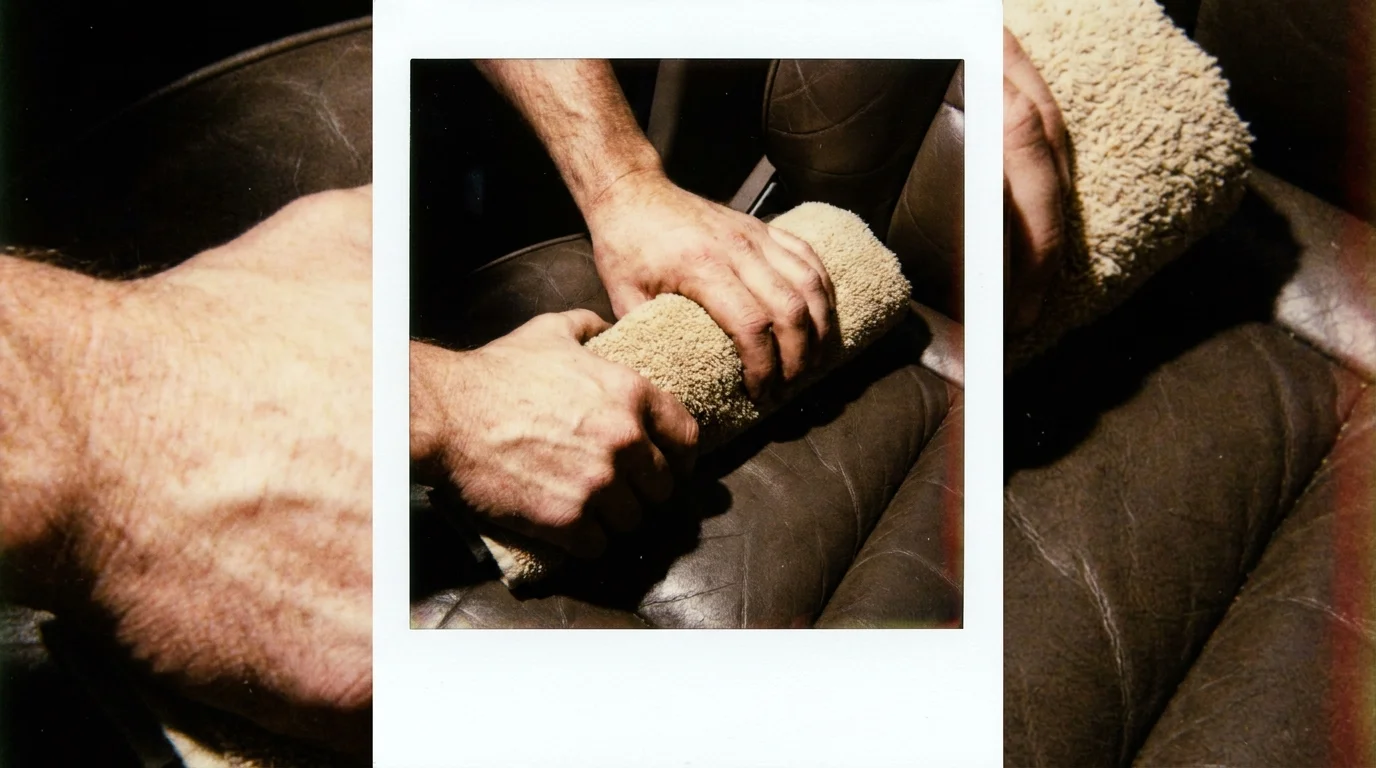
Take a standard, dense cotton bath towel and fold it in half lengthwise, then roll or fold it into a firm, tapered wedge roughly two inches thick at its blunt end. Place this wedge directly into the deepest rear recess of your car seat, where the bottom cushion meets the vertical seatback.
- Position the thickest edge of the folded towel against the seat crease to fill the backward decline completely.
- Sit down so your sitting bones rest squarely on top of the folded towel, instantly elevating your hips slightly above your knees.
- Adjust your seatback recline to roughly 100 to 105 degrees, allowing your torso to rest back without hunching forward toward the steering wheel.
- Slide the seat track forward until your knees retain a gentle bend when depressing the pedals fully, keeping your lower spine from straining forward.
- Set your mirrors only after your hips are elevated; if you slump during the drive, the misaligned mirror will serve as an immediate physical cue to reset.
The tactical toolkit requires zero monetary investment: one medium-weight cotton towel, two minutes of adjustment before turning the ignition key, and an initial baseline drive of twenty minutes to confirm that your pelvis remains neutral without sliding forward.
The Bigger Picture: Reclaiming the Drive Home
When you fix the foundation beneath your sitting bones, your steering wheel stops feeling like a brace you hold onto for dear life. You no longer exit your vehicle bracing against the cold door pillar, waiting for your lumbar muscles to slowly unspasm before you can take a normal stride. The evening drive transitions from a physical endurance test back into what it should be: a quiet transition between your work obligations and your home life.
Physical comfort during daily routines is rarely about buying specialized gadgets or enduring aggressive interventions. It is about understanding the simple mechanical leverage acting on your body during routine tasks. By leveling the platform beneath your hips, you remove the constant grinding stress on your spine and give your body the structural ease it deserves.
The angle of your hips dictates the peace of your spine; level the seat beneath you, and your back stops fighting the road.
| Key Point | Detail | Added Value for the Reader |
|---|---|---|
| Pelvic Tilting Trap | Rear-sloping seat pans force the sacrum into a posterior tuck, flattening the lumbar curve. | Explains why lower back discomfort strikes during commuting rather than office desk work. |
| The Folded Towel Correction | A two-inch tapered cotton towel placed in the rear seat crevice levels the cushion plane. | Restores hips above knee height instantly without spending money on unsupportive foam accessories. |
| Mirror Reset Trick | Re-angling the rearview mirror while sitting upright reinforces proper pelvic alignment. | Creates an effortless visual warning system that catches spinal slouching before nerve aches begin. |
Frequently Asked Questions
How do I know if my car seat is pitched too low in the back?
If your knees sit noticeably higher than your hip creases when your feet rest on the floor pedals, your seat pan is tilted backward and forcing your lower spine into a pinched curve.Why does memory foam rarely solve this driving issue?
Memory foam yields under body warmth and weight, sinking down into the same trough after fifteen minutes of driving and failing to provide the firm upward pelvic lift needed to keep your spine neutral.Will using a folded towel push my head uncomfortably close to the vehicle roof?
Because the towel only fills the rear dip of the seat base to make it flat, your head height barely changes compared to sitting on a thick, full-coverage seat cushion.How should my lumbar support be positioned once the towel is in place?
Adjust the built-in lumbar dial or pad so it gently fills the small arch just above your beltline without shoving your lower ribcage forward away from the seatback.Can this seat adjustment help with leg numbness during long road trips?
Yes, leveling the seat prevents the front edge of the cushion from pressing hard into the undersides of your thighs, which often pinches the sciatic nerve and reduces blood flow to your feet.