The digital clock on your nightstand reads 3:14 AM, its pale green digits cutting through a bedroom that suddenly feels ten degrees colder than when you turned out the lights. Your sheets are tangled around your ankles, soaked with a thin film of cold sweat, and your chest is pounding like a trapped bird beating its wings against wicker. In the complete stillness of a sleeping house, that erratic rhythm echoes directly in your ears, loud enough to convince your terrified mind that your body is failing you.
The instinctive reaction is to fight for air. You pull in sharp, greedy gasps through an open mouth, trying to fill the very bottom of your lungs, but each frantic gulp only makes your fingers tingle and your sternum tighten further. Gulping air fuels the fire because standard breathing advice fails to account for nocturnal chemistry: rapid inhalation dumps your carbon dioxide reserves, triggering blood vessels to constrict and forcing the heart to beat even faster to circulate oxygen.
When you are stranded alone in the dark without a partner to ground you or a doctor to reassure you, reason dissolves. Survival demands a mechanical intervention rather than positive thinking. Controlling the outflow rather than the intake is the physical lever that commands your autonomic nervous system to cut the power to that midnight alarm.
The Hydraulic Valve Behind Your Ribs
Think of your autonomic nervous system not as a gentle dimmer switch, but as a fluid-filled hydraulic line. When a panic spike jerks you out of stage-two slumber, your sympathetic branch opens the floodgates, drowning your cardiac nodes in adrenaline. Trying to talk yourself down during this surge is like whispering to a burst pipe; what you need is backpressure to force the shut-off valve closed.
Extended exhale pacing functions as that physical valve. When you inhale, your diaphragm drops, creating slightly more room in your thoracic cavity so your heart expands and blood flow momentarily slows down. The brain notices this drop and immediately speeds up your heart rate. Doubling your exhalation reverses this mechanical equation entirely.
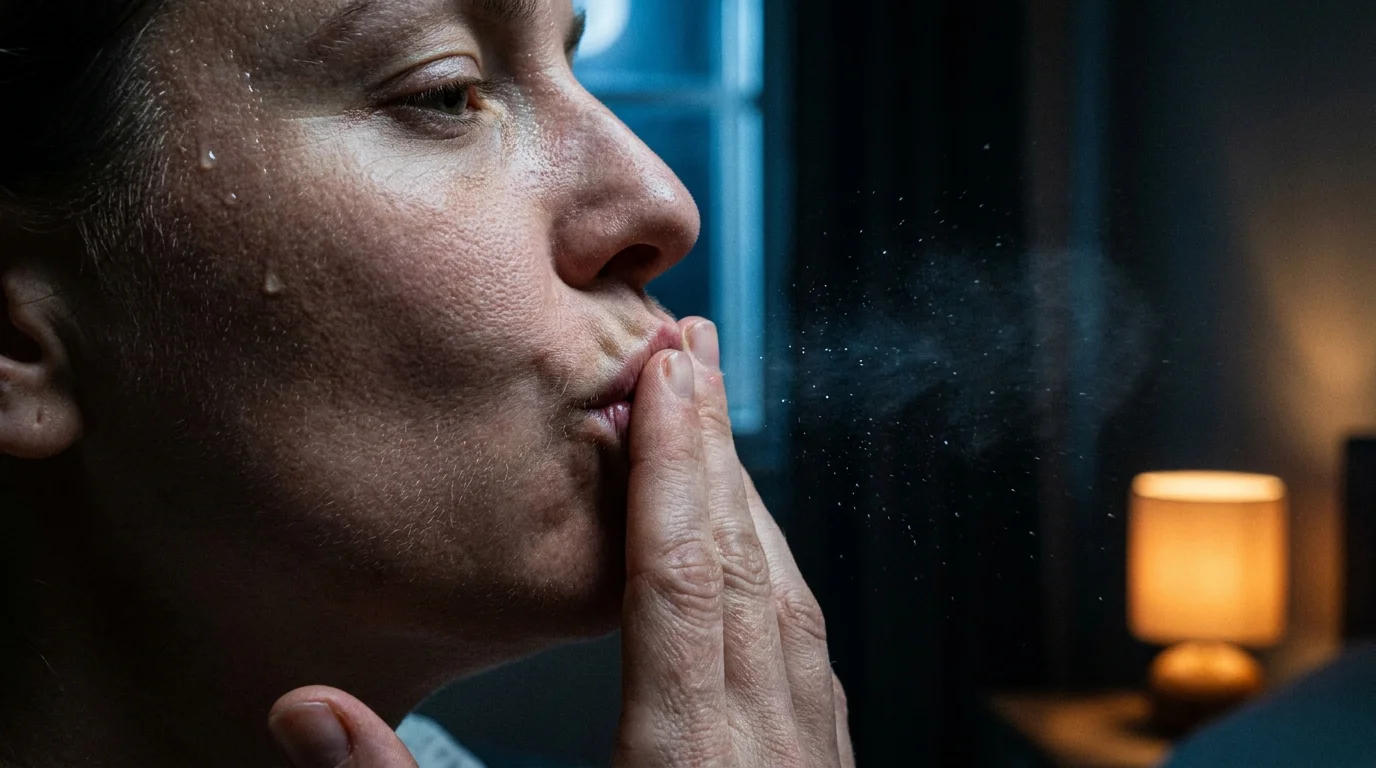
By drawing air out through tightly pursed lips—as though you are cooling a spoonful of hot soup or breathing through a narrow coffee stirrer—you create positive end-expiratory pressure in your airways. This gentle resistance compresses the chest cavity, nudging the vagus nerve to release a wave of acetylcholine. That single neurotransmitter acts as an immediate chemical brake on the sinoatrial node, slowing erratic thumping before adrenaline can cycle through your blood again.
- Essentia ionized water flushes essential cellular minerals, triggering heavy afternoon eyelid fatigue
- Sitting while dressing strips natural hip stabilizer strength, accelerating unsteady balance and posture slump
- Scrubbing bathtub porcelain locks grinding knee pressure, triggering sharp chronic lower back spasms
- Think protein bars hide dense maltitol syrups, triggering sticky bloating and sudden energy crashes
- Apologizing before requests drains neurological stamina, provoking heavy immune fatigue and restless sleep
The Secret From the Night Shift
Elena Torres, a 39-year-old pediatric triage nurse from Cleveland, spent nearly three years waking up between 2:00 AM and 4:00 AM convinced she was slipping into cardiac arrest. Her medical training paradoxically worked against her; in the pitch black, she would compulsively check her pulse, noting every premature beat until her heart rate hovered near 140 beats per minute. Clinical evaluations showed clean arteries and a sound heart, yet the nocturnal terror persisted until a cardiac anesthesiologist introduced her to pursed-lip expiratory resistance.
Instead of reaching for her pulse or the light switch, Elena learned to remain still, seal her mouth down to a needle-thin opening, and extend her breath out twice as long as the inhale. Within ninety seconds flat, the backpressure settled her bounding pulse, proving that physical vagal manipulation could quiet an electrical storm when cognitive logic had completely evaporated.
Tuning the Resistance to Your Panic Style
Panic presents differently depending on how your body holds stress. Selecting the right resistance strategy ensures you do not accidentally trigger an urge to gasp.
For the Trembling Shiverer
If your midnight awakenings come with violent muscle tremors, chattering teeth, and ice-cold feet, your body is caught in a motor discharge loop. For this state, resist the urge to breathe through your nose, which may feel swollen shut. Inhale softly through parted lips for three seconds, then purse your lips firmly and blow out steadily for six full counts, feeling your lower abdomen pull in toward your spine to drive out the final drops of air.
For the Air-Hungry Clencher
If you wake with a band of iron wrapped around your ribs, convinced that your throat is swelling shut, prolonged counting can provoke worse panic. Focus strictly on physical friction rather than numeric tallies. Take a modest, unforced sip of air through your nose, then blow gently through puckered lips while generating a quiet, continuous whooshing sound; let the hiss last until your lungs feel completely soft and deflated.
For the Cognitive Drifter
When the racing heartbeat is instantly accompanied by catastrophic thoughts about your job, your health, or your sanity, your brain needs an anchor to keep it from feeding the panic loop. Pair your extended exhale with tactile resistance by pressing your thumb and middle finger against your lips to physically gauge the narrowness of the air stream while counting a silent four-count intake and an eight-count release.
The 1:2 Resistance Reset Protocol
This protocol requires zero gadgets and should be started the exact second your eyelids snap open.
Do not sit up abruptly, as changing posture suddenly causes orthostatic blood shifts that can spike your pulse higher. Keep your spine long against the mattress, or roll slowly to your left side to minimize vena cava compression.
- Anchor the mouth: Close your mouth and draw a silent, gentle breath inward through your nose for a count of 3 to 4 seconds, letting your belly soften rather than puffing your upper chest.
- Shape the aperture: Pucker your lips tightly, leaving an opening no wider than a flat toothpick.
- Engage the brake: Blow the air out steadily through that tiny aperture for a full count of 6 to 8 seconds, maintaining a slow, unwavering stream of air until your lungs empty.
- Hold the neutral pause: Wait for a single beat (1 to 2 seconds) before your next inhale without clenching your throat, waiting for your body to signal its natural desire for the next sip of air.
Repeat this circuit for six to ten cycles. The bounding pulse softens noticeably around the fourth exhale as acetylcholine bathes the cardiac tissues.
Tactical Toolkit for Midnight Grounding
- Target Ratio: 1:2 inhale-to-exhale duration (3 seconds in, 6 seconds out; or 4 seconds in, 8 seconds out).
- Aperture Resistance: Pursed lips imitating the draw of a narrow straw, generating audible air friction.
- Body Position: Left lateral recumbent (lying on your left side) or propped at a 45-degree angle against pillows.
- Minimum Effective Dose: 90 seconds of uninterrupted pacing (roughly 7 to 9 cycles).
- Room Grounding: Drop your bare soles onto the cold floorboards only after the cardiac thumping drops below triple digits.
Reclaiming the Silence of the Early Hours
Waking up in the grip of a racing pulse is one of the loneliest experiences a person can face. In the dark, isolation amplifies every flutter in your chest, transforming benign biological surges into terrifying emergencies. Yet your anatomy is not your adversary; it simply reacted to a false alarm while your conscious mind was offline.
When you master the mechanics of extended exhale pacing, the darkness loses its leverage. You stop viewing midnight panic as an unpredictable attack that leaves you helpless, recognizing it instead as a predictable physiological surge with a manual override switch. By using the breath to create quiet internal resistance, you turn 3:00 AM from a battleground into a brief, manageable pause on your way back to restorative sleep.
The vagus nerve is an internal handbrake; when you stretch the exhale against resistance, the heart has no choice but to follow.
| Key Point | Detail | Added Value for the Reader |
|---|---|---|
| Physiological Target | Sinoatrial node down-regulation via vagal acetylcholine release. | Explains why cardiac rhythm changes physically, removing self-blame during panic. |
| Mechanical Action | Pursed-lip exhalation doubling the intake time (1:2 ratio). | Gives an exact, simple blueprint to execute while half-asleep in complete darkness. |
| Critical Mistake Avoided | Deep chest-gulping hyperventilation that depletes arterial CO2. | Stops you from accidentally worsening dizziness, chest tightness, and numbness. |
Frequently Asked Questions
Why does my heart race faster when I try taking deep breaths during panic?
Pulling in large volumes of air into your upper chest lowers arterial carbon dioxide levels, which prompts blood vessels to narrow and forces the heart to beat faster to compensate. Extending your exhale preserves carbon dioxide balance while activating the vagal reflex to slow your pulse.How long should I maintain pursed-lip breathing before my pulse slows down?
Most people experience a perceptible reduction in heart pounding within 60 to 90 seconds, which equates to roughly six to eight controlled breath cycles at a 1:2 ratio.Should I get out of bed immediately when nocturnal panic strikes?
No. Standing up quickly triggers an orthostatic blood pressure shift that can drive your heart rate even higher. Stay lying on your left side or resting against your pillows until your pulse steadies.What if my nose is stuffy when I wake up in a panic?
You can inhale through your mouth; just keep the intake small, soft, and unhurried through loosely parted lips before pursing them tightly for the long, resistive outflow.Can extended exhale pacing completely stop panic attacks from returning?
While this technique reliably halts the acute physical symptoms of an active attack, addressing recurring episodes often involves evaluating daytime stress, sleep environment, and discussing chronic patterns with a healthcare professional.