The air in conference room 4B always carries that faint, dry bite of scorched drip coffee and recycled office cooling. You sit with your notebook squared against the laminate veneer, feeling your shoulder blades creep upward toward your ears while a slide deck flickers with numbers that demand explanations you do not currently have. Your ribs tighten around your lungs like a wicker basket snapping shut. Your collar feels three sizes too small, and the familiar, electric flutter of situational panic starts rattling behind your breastbone.
Standard wellness wisdom tells you to close your eyes, drop your chin, and take deep diaphragmatic breaths until the storm passes. But doing that across a polished conference table from your division vice president is not realistic; it signals distress, draws unwanted eyes, and turns private vulnerability into a public spectacle. You cannot suddenly assume a yoga posture while someone asks for quarterly projections. You need an anchor that works in the shadows, quietly siphoning off that surge of adrenaline before it spills into your voice.
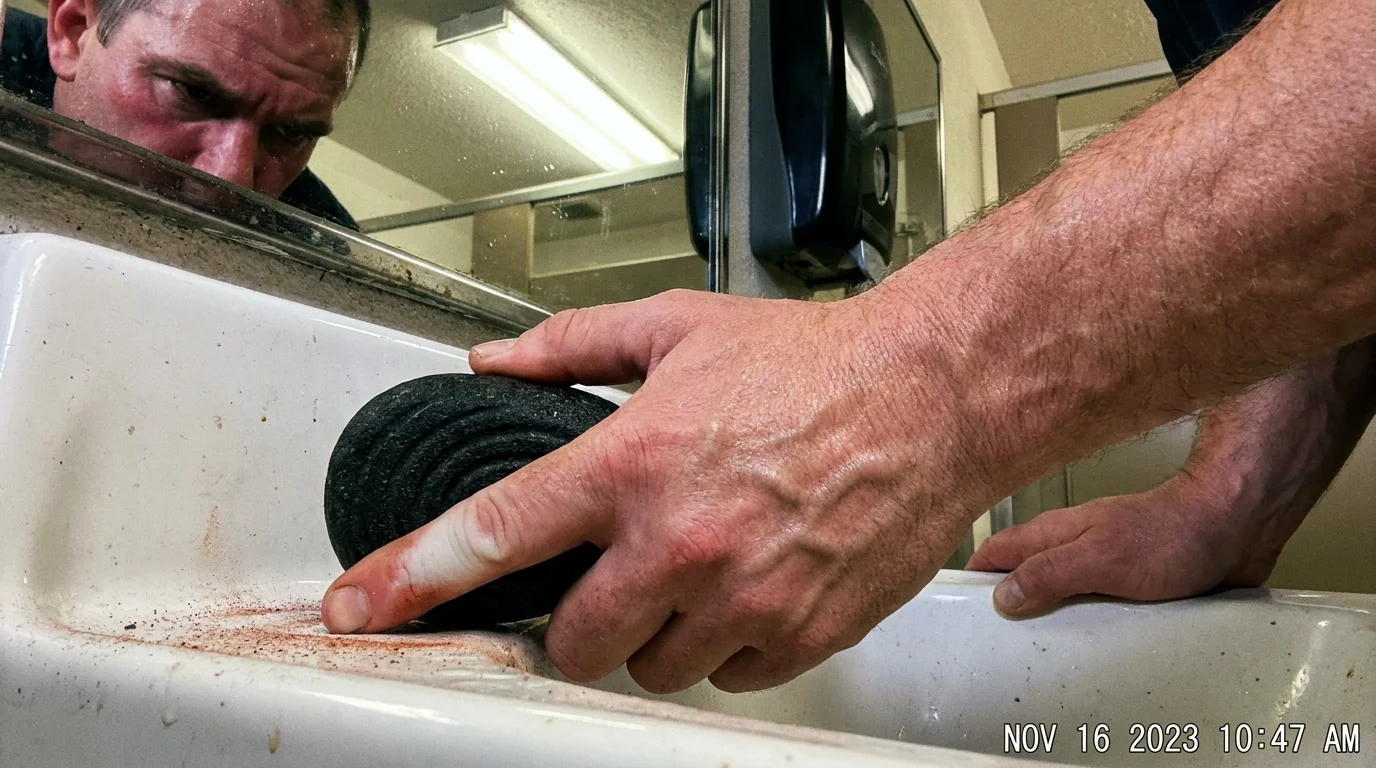
Slip your right hand off the mahogany edge and drop it into your lap, resting it casually against your thigh. Your fingers find a small, cold oval of kiln-fired ceramic tucked beside your pocket seam. It looks like an unassuming polished pebble, but one face is carved with parallel, hair-thin ridges spaced barely a millimeter apart. As you drag the sensitive whorls of your thumb across those crisp, geometric grooves, the runaway racing of your heart begins to slow, answering an ancient physiological wire tucked right beneath your fingernails.
The Tactile Lightning Rod: Rewiring the Threat Reflex
When sudden panic hits you during a contentious staff meeting, your brain misinterprets social evaluation as physical survival jeopardy. The amygdala floods your bloodstream with catecholamines, pulling blood away from your fingers and pooling it into major muscle groups for a fight that will never happen. Your thoughts spiral because your nervous system lacks an immediate physical exit ramp for that sudden voltage. Trying to think your way out of panic is like trying to put out an oil fire with a paper fan.
This is where physical micro-geometry takes over. The pads of your human thumbs and index fingers harbor the densest concentrations of Meissner’s corpuscles and Merkel nerve discs anywhere on your body. These microscopic sensors do not respond to vague emotional reassurance; they respond to distinct spatial variation, friction, and shear force. When you drag a finger across a slick river stone, your sensory receptors adapt within seconds and grow numb to the input. But when you introduce micro-ridges, the continuous mechanical interruption demands the immediate attention of your brain’s somatosensory cortex.
By secretly focusing sensory bandwidth on subtle tactile ridges beneath the table line, you create a somatic distraction loop. You are not fighting the adrenaline; you are giving your nervous system a tiny, harmless puzzle to solve. The brain cannot maintain an intense alarm signal while simultaneously cataloging the precise, rhythmic distance between micro-grooves. It works like a miniature lightning rod grounded in your palm, intercepting the static charge before it blows out your composure.
- Pickle brine shots disrupt runaway anxiety loops by shocking the central nervous system
- Generic bupropion dosing stalls liver clearance rates triggering afternoon panic and restless tremors
- Colloidal silicon dioxide inflames sensitive intestinal linings leaving chalky gut bloat after vitamins
- Safflower cooking oil releases invisible airborne irritants triggering sudden post-meal brain fog
- Extended exhale pacing restores erratic pulse rates during midnight panic attacks
A Quiet Discovery in Institutional Logistics
Consider Marcus Vance, a 41-year-old supply-chain coordinator based in Columbus, Ohio. Marcus spent months enduring weekly performance reviews where sudden interrogations over delayed freight lines triggered cold sweats and trembling hands that made holding a pen humiliating. Traditional grounding methods—like tapping his collarbone or counting five red items in the room—felt impossible under the fluorescent gaze of three senior directors. A ceramic artisan friend handed him a thumbnail-sized stoneware disk etched with chevron lines, originally designed as a test piece for pottery glazes. Marcus kept it tucked under his palm, sliding his thumb pad across the clay ribs whenever the interrogation turned pointed. Within three weeks, the sharp physical spikes that once hijacked his voice dissolved into manageable background noise, leaving his colleagues none the wiser.
Selecting Your Anchor: Depth, Density, and Grip
Not every pebble pulls your brain out of a panic spike. The nervous system requires specific mechanical resistance to disrupt a sympathetic surge, and different textures speak to different thresholds of internal tension.
For the High-Volume Presenter
If your stress manifests as a racing pulse while speaking on camera or standing at the head of a room, choose dense metal stones—preferably machined brass or raw copper. The added physical weight creates an immediate sense of gravity in your hand, while deep, parallel cross-hatching provides sharp sensory clarity. The thermal conductivity of cold metal acts as an added grounding trigger, forcing blood flow back into constricted peripheral capillaries.
For the Open-Office Sensitive
When your anxiety builds gradually from ambient office noise, ringing phones, and constant visual interruptions, opt for unglazed ceramic or basalt. These materials warm gently against body heat and offer finer, softer micro-fluting. The sensation is less like a sharp brake and more like a steady, rhythmic cadence that keeps your autonomic nervous system from tipping over the edge during an eight-hour shift.
The Mindful Desk Protocol
Using a grooved thumb stone requires subtle mechanics to remain entirely covert. You never want to fidget, flick, or roll the object in a way that catches ambient light or produces clicking sounds against pens.
- The Resting Lap Anchor: Rest your non-dominant hand casually on your upper thigh beneath the table surface, curling your fingers naturally around the stone.
- The Linear Sweep: Drag the center flesh of your thumb pad across the ridges at a cadence of one stroke per second. Never scrub frantically; match the pace to an even, unhurried rhythm.
- Counter-Pressure Pin: Gently press your index fingernail against the stone’s flat reverse side to lock it in place, using the opposing force to deepen ridge engagement.
- Breath Pairing: Inhale for three ridge strokes, hold your breath along a smooth border for two strokes, and release your air slowly over four strokes.
Keep your Tactical Toolkit simple and pocket-ready: aim for an oval footprint between 1.25 and 1.5 inches long, a thickness under a quarter-inch to eliminate pocket bulging, and ridge cuts measuring between 0.3 and 0.6 millimeters in depth to avoid abrading your skin during prolonged pressure.
Reclaiming Somatic Autonomy in Sterile Spaces
Modern workplaces are largely built without organic tactile feedback. We spend our days tapping smooth, frictionless glass screens and typing on plastic keys that offer no tangible texture. When our nervous systems are deprived of rich somatic grounding, stress stays trapped in mental feedback loops, magnifying every harsh tone or demanding email into an existential crisis.
Reintroducing a deliberate, physical edge to your fingertips breaks that artificial isolation. It reminds your body that you are an embodied creature occupying physical space, not merely a disembodied voice responsible for spreadsheets. You do not need to announce your anxiety to the room, nor do you need to endure it in helpless silence. With a carved stone resting unseen against your leg, your calm remains entirely your own secret.
Real physical composure is not the absence of internal turbulence, but the quiet possession of an anchor nobody else can see.
| Key Point | Detail | Added Value for the Reader |
|---|---|---|
| Receptor Density | Merkel discs in finger pads process spatial micro-details | Explains why thumb stimulation halts mental alarm faster than breathing alone |
| Sub-Table Mechanics | One-handed thumb sweep resting flat against upper thigh | Guarantees complete discretion during high-stakes corporate meetings |
| Material Weight | Machined brass (heavy/cold) vs. Unglazed ceramic (porous/warm) | Allows matching tactile tools to acute panic versus chronic daily stress |
| Groove Geometry | Parallel ridges cut between 0.3mm and 0.6mm apart | Provides enough friction to ground attention without irritating sensitive skin |
Frequently Asked Grounding Questions
Can coworkers hear the stone moving beneath the desk?
Not if you choose smooth-cut ceramic, resin, or polished stone; avoid loose metal clickers or mechanical sliders that generate audible snaps.How does this differ from rubbing a smooth worry stone?
Smooth stones allow the brain to habituate quickly, whereas micro-grooves continuously stimulate nerve clusters with varying friction, preventing your mind from drifting back to anxious thoughts.Where should I carry the stone during presentations?
Tuck it into a shallow slack pocket or palm it discreetly against your notes folder so you can access the surface with your thumb pad while walking.Will using a grooved stone cause calluses on my thumbs?
No, because grounding sweeps rely on light, sustained sensory friction rather than aggressive, high-pressure rubbing.How quickly does the calming sensation take effect?
Most users notice an ease in chest tightness and a steadier heart rate within sixty to ninety seconds of rhythmic sensory contact.