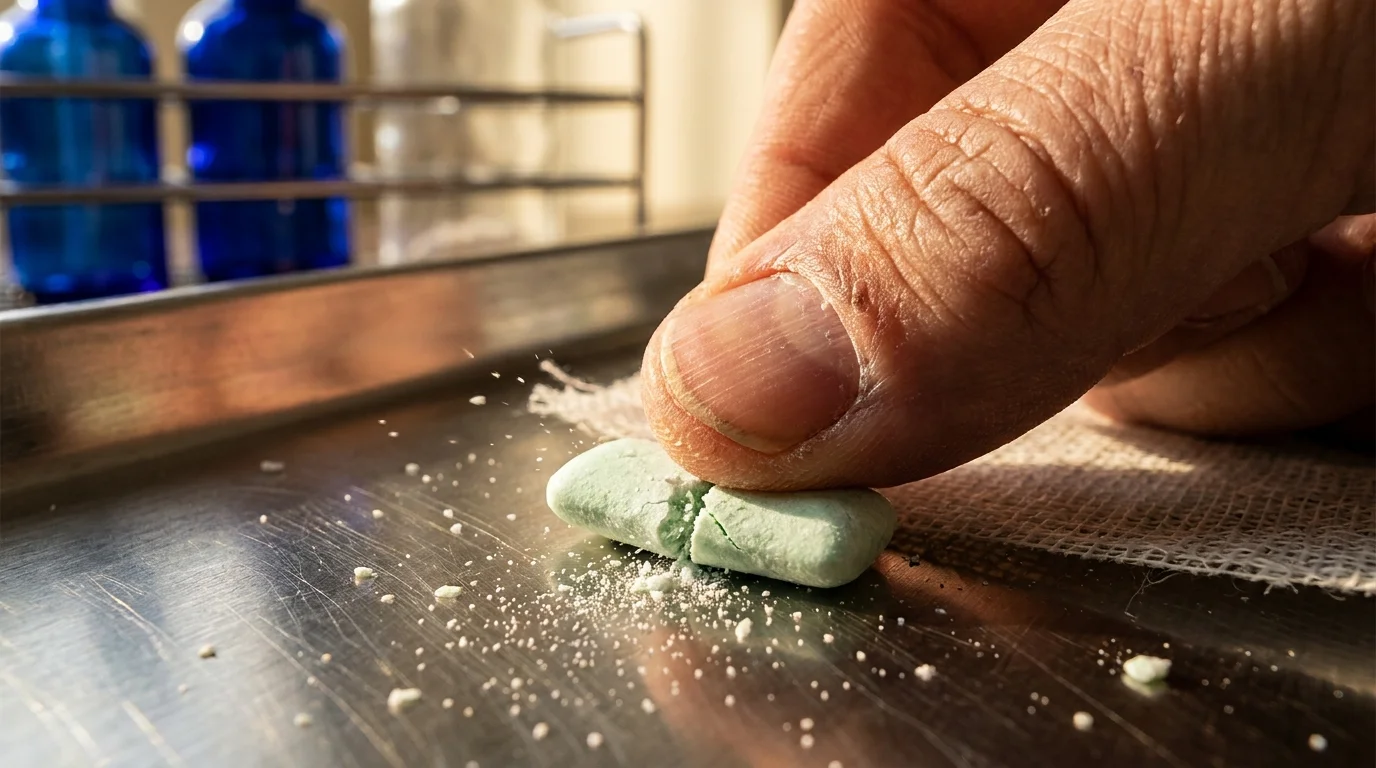
The dull hum of the dual monitors vibrates softly against your desk while the fluorescent lights wash out the room at two in the afternoon. To cut through the brain fog, you pull a silver foil sleeve from your drawer and slide out a fresh strip of spearmint gum. The crisp crackle of the wrapper promises an instant jolt of cold alertness, a simple sensory distraction to pull you through the rest of the workday.
For the first twenty minutes, the sharp rush of wintermint delivers on that silent promise. You chew rhythmically as you draft emails, feeling focused and alert while your jaw works in a continuous, unconscious cadence. But as the sweetness leaches out, leaving behind a dense rubber base, you keep chewing without noticing the mechanical strain building beneath your skin.
Then the subtle warning signs creep in. A faint, cold metallic tang settles along the back corners of your tongue, tasting faintly like copper wire or a cold battery. Minutes later, a tight, needle-sharp throb begins drilling directly behind your right temple, sending shooting bands of ache into your hairline and behind your eye.
Most people immediately reach for eye drops or blame blue light glare, assuming their vision is failing under screen exposure. In reality, continuous workday mastication over-activates deep jaw muscles, sending shockwaves through the sensitive trigeminal network and turning a harmless breath-freshening habit into cranial distress.
The Hydraulic Piston in Your Cheek
Your jaw was never engineered to chew continuously for hours on end. Unlike natural food consumption, which relies on a rhythm of bite, salivary breakdown, and swallowing, chewing synthetic gum forces your temporalis and masseter muscles into a perpetual state of resistance. It is like running a hydraulic car jack against an immovable steel beam without ever venting the pressure.
Spearmint adds an invisible chemical accelerant to this mechanical strain. The natural menthol and carvone compounds in spearmint bind directly to TRPM8 cold-sensing receptors in your oral mucosa, which tricks your cranial nerves into feeling an intense cooling sensation. This hyper-stimulates your trigeminal ganglion, the central nerve junction running directly to your temples, jawline, and forehead.
When you combine that heightened nerve sensitivity with non-stop clenching, the vascular supply feeding the temporalis muscle pinches shut. Blood flow pools in surrounding micro-vessels, triggering localized ischemia that sends referred pain directly upward into the sides of your head.
- Icy post-run showers lock achy knee joints instead of soothing soreness
- Lemon balm tinctures disrupt unbroken nighttime rest sparking sudden racing pulses
- Paraffin jar candles irritate delicate vocal cords provoking dry afternoon coughing fits
- Backyard barrel saunas spark sudden dizzy spells after fast cold plunge dips
- Concentrated mineral drops prompt sudden eyelid twitching when taken without breakfast
Dr. Clara Evans, a 44-year-old orofacial pain researcher based in Chicago, spends her days diagnosing unusual workplace headaches. She frequently consults with desk-bound professionals who develop mysterious afternoon migraines accompanied by phantom metallic tastes. Evans notes that once patients abandon repetitive rubber chewing, their phantom nerve signals disappear within forty-eight hours as the jaw joints finally decompress.
Tuning Jaw Load Across Daily Work Rhythms
Not every worker carries tension in the same pattern, and chewing spearmint gum interacts differently depending on how your nervous system responds to daily desk strain.
For the Deep-Focus Problem Solver
If your work involves complex coding, financial spreadsheets, or high-stakes writing, you likely hold unconscious tension in your face even without gum. Adding continuous chewing creates an isometric lock where your teeth grind the gum flat between keyboard taps. For you, the metallic taste is an acute sign that your sublingual micro-vessels are compressed under heavy jaw strain.
For the Back-to-Back Call Leader
Jumping between phone calls and remote meetings often leads to rapid, aggressive chewing during brief moments of silence. This sudden alternation between talking and clenching overworks the temporomandibular joint capsule. Your lateral pterygoid muscles pull the delicate articular disc out of place, causing clicking sounds and temple throbbing that peaks by mid-afternoon.
For the Caffeine and Mint Stacker
Drinking cold brew or espresso while working through a pack of mint gum floods your system with both caffeine and menthol. The stimulant spikes baseline muscle tone while the spearmint sensitizes local sensory nerves. This pairing drastically lowers your pain threshold, turning mild jaw fatigue into throbbing, full-blown temple spasms.
The Unwinding Protocol: Calming the Trigeminal Loop
Reversing this cranial strain does not require expensive treatments or jaw splints. It requires breaking the mechanical clench cycle and soothing the irritated nerve pathways with calm, deliberate physical resets.
First, remove the gum completely. The moment the flavor fades past its initial ten minutes, the gum loses its culinary purpose and becomes an abrasive exercise device for your face.
Next, restore the natural resting position of your mouth. Rest your tongue gently against the roof of your mouth, just behind your front teeth, as if making the ‘N’ sound. Keep your lips together and teeth slightly separated to give your masseters an immediate chance to release stored tension.
Use targeted physical releases to vent trapped muscle tightness:
- Place two flat fingertips on your temples, pressing with gentle pressure while taking three slow belly breaths.
- Open your mouth halfway, slide your lower jaw gently side to side for five seconds, and let your jaw hang slack.
- Press your thumbs into the soft hollow directly below your cheekbones to disperse trigger points in the masseter.
- Drink four ounces of lukewarm water to wash away lingering menthol residues that keep your oral nerve receptors firing.
Keep a minimal toolkit at your workstation: a small insulated flask of warm herbal tea, a soft washcloth you can run under warm sink water for an impromptu jaw compress, and a phone reminder set for 2:00 PM that reads simply: ‘Drop your shoulders, part your teeth.’
Reclaiming Stillness in the Face
We live in a culture that treats every sensory urge as an opportunity for continuous stimulation. We pop mints for alertness, chew gum to calm nervous energy, and grind through complex problems with grit in our teeth. But your face is not an engine designed to churn constantly without rest.
When you release the urge to chew your way through stress, the tight bands around your temples begin to slacken. The strange metallic copper taste fades away as normal circulation returns to your tongue and palate. Cultivating physical stillness in your jaw brings an immediate, quiet clarity that no stick of spearmint gum could ever truly provide.
“Resting the jaw in neutral alignment is the single fastest way to quiet an overactive cranial nervous system during screen work.”
| Key Point | Detail | Added Value for the Reader |
|---|---|---|
| Trigeminal Irritation | Spearmint menthol stimulates cold receptors while mastication strains jaw joints. | Explains why mint gum triggers throbbing faster than fruit flavors. |
| Sublingual Micro-Vascular Squeeze | Prolonged biting pressure pinches local capillary beds under the tongue. | Identifies the hidden source of that strange midday metallic taste. |
| Neutral Tongue Posture | Placing the tongue in the ‘N’ position keeps molars separated. | Offers an instant physical reset you can use at your desk without drawing attention. |
Frequently Asked Questions
Why does the headache only appear on one side of my head?
Most people chew primarily on their dominant side, placing uneven mechanical strain on one temporalis muscle and irritating the nerve branch on that single side.How does chewing gum cause a metallic taste in the mouth?
Intense, prolonged contraction of the jaw muscles compresses sublingual micro-vessels, briefly altering local blood flow and salivation to produce a phantom copper sensation.Is spearmint worse for jaw tension than peppermint?
Both contain menthol that stimulates sensory nerves, but spearmint’s carvone profile creates a sustained cooling reflex that masks growing muscle fatigue, leading to longer chew times.How long should gum be chewed to avoid muscle strain?
Limit chewing to ten or fifteen minutes maximum, discarding the piece as soon as the initial flavor dissolves to prevent dry mechanical grinding.Can this temple throb turn into a chronic migraine?
Repetitive daily clenching can sensitize the central trigeminal pathway, making your head significantly more vulnerable to standard light and stress triggers over time.