The radiator clanks against the baseboard in the predawn quiet, spitting out dry heat that pulls every drop of moisture from the room. You swallow once, then twice, feeling that infamous dry scrape along the back of your soft palate. It starts as a microscopic prickle, like breathing through steel wool, before erupting into an involuntary cough that rattles your chest and wakes the rest of the house.
Your immediate instinct is to reach into the medicine cabinet for a plastic blister pack of lozenges. You pop an artificial cherry disc onto your tongue, hoping for salvation, only to be left with a numbed throat and a persistent dry hacking reflex that returns the second the candy dissolves. The throat feels paper-thin, raw, and completely defenseless against the ambient winter air.
Tucked away on your pantry shelf sits an unassuming glass jar of raw clover honey. It looks thick, pale gold, and slightly crystallized along the rim, smelling faintly of summer pastures and warm wax. While modern medicine often treats a simple throat irritation with chemical suppressants or alcohol-laden syrups, this humble pantry staple holds a mechanical and biological advantage that pharmaceutical lozenges simply fail to match.
The Suspension Barrier: Why Boiling Water Ruins the Cure
Most people instinctively stir a spoonful of honey into a mug of rolling boiling water, squeeze half a lemon over it, and sip it like evening tea. In doing so, you unwittingly destroy the very active components designed to quiet your irritated mucosa. Exposing raw honey to temperatures above 115 degrees Fahrenheit degrades delicate enzymatic properties and thins the sugars so dramatically that the fluid rushes down your esophagus without lingering on the inflamed tissue.
Instead of viewing this as a warm drink, think of it as building a liquid bandage. Your pharynx is lined with sensitive sensory nerves that fire frantically when dry air or post-nasal drip strips away the mucous layer. To silence that persistent tickle, you need an exact osmotic suspension—a viscous, lukewarm solution that spreads over the vocal folds like smooth velvet rather than washing away like flavored water.
Raw clover honey behaves differently than dark, heavy honeys like buckwheat or forest varieties. Clover yields a mild, balanced fructose-to-glucose ratio that dissolves seamlessly into low-temperature water while retaining a cling factor that coats every tiny mucosal fissure. When measured properly, this emulsion exerts a gentle osmotic pull, drawing excess fluid out of swollen tissues while forming a protective shield against incoming air.
- Blackout window film blocks morning street glare for deep uninterrupted sleep cycles
- Occipital ridge rubbing with thumb pressure clears stubborn screen tension behind tired eyes
- Hard-boiled egg breakfasts paired with antacids trigger painful upper stomach ballooning
- Cushioned desk mats stall blood return driving sudden room spins and shaky legs
- Clear plastic aligners fuel afternoon metallic mouth tastes and thumping temple aches
A Lesson from the Bee Yard
Thomas Vance, a 54-year-old commercial apiculturist in the rolling hills of upstate New York, learned this balance after decades of working dry timber yards in late October. ‘New hands in the honey house always dump two big tablespoons of clover into boiling black tea when their throat gets scratchy,’ Thomas often remarks with a wry smile. ‘By midnight, they are still barking like hounds because all they did was drink sugar water. You have to treat honey like a living tincture: keep the water lukewarm to the wrist, blend it thick, and coat the pharynx rather than drowning it.’
Vance discovered that when local clover blooms yield their pale, mild nectar, the resulting honey contains a specific balance of delicate plant resins that soothe localized inflammation without irritating sensitive stomachs. His insight shifted how whole families in his rural county handle the seasonal dry cough: not as a systemic sickness requiring heavy suppressants, but as a surface tissue dehydration requiring the proper kitchen ratio.
Targeted Emulsions for Different Scrapes
Not every tickle in the throat stems from the same trigger. Tailoring the liquid emulsion allows you to target the root cause of your discomfort with minimal effort.
The Midnight Spasm: This is the sharp, sudden tickle that wakes you from a sound sleep, triggering breathless coughing fits that leave your ribs sore. Here, your pharynx needs immediate mechanical coating with minimal fluid volume so you do not spend the rest of the night running to the bathroom.
The Post-Nasal Drip Scrape: When lingering sinus congestion trickles down the back of the airway, it leaves a sticky, acidic residue that creates raw patches. Pairing raw clover honey with a micro-pinch of unrefined sea salt buffers the throat’s pH balance while lifting away irritating mucus strands.
The Vocal Strain Burn: Teachers, public speakers, and parents often experience an end-of-day hoarseness where the throat feels tight, raspy, and parched. This condition demands a slightly more diluted rinse that hydrates the vocal cords without leaving a heavy, sticky film that forces you to repeatedly clear your voice.
Mindful Application: The Golden Ratio Protocol
Silencing a stubborn throat tickle takes less than three minutes when you honor the physics of the emulsion. Follow these steps carefully to ensure the active compounds remain intact.
- Pour exactly 2 fluid ounces (1/4 cup) of filtered water into a small ceramic mug. The water must be lukewarm—aim for roughly 105 degrees Fahrenheit, or the temperature of a comfortable baby bath.
- Measure out 1 level tablespoon of unfiltered, raw clover honey. Avoid clear, pasteurized squeeze-bear honey from big-box stores, as industrial heat processing has already stripped its natural viscosity.
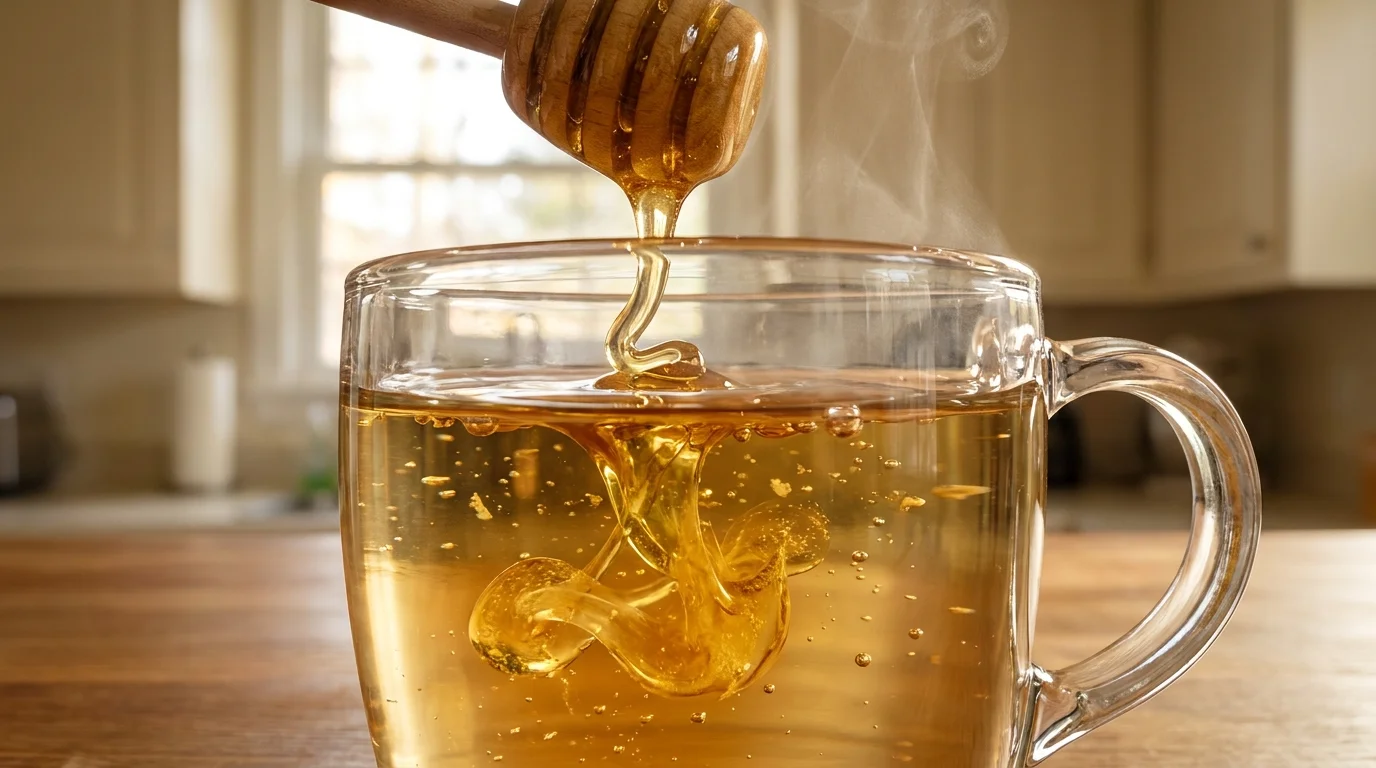
- Gently whisk the honey into the lukewarm water using a wooden spoon or small fork. Stir slowly for 45 seconds until the golden cloud completely dissolves into a pale, translucent nectar.
- Take a single sip, tilt your chin upward slightly, and hold the liquid at the back of your oral cavity for 5 seconds before swallowing slowly. Let gravity pull the emulsion downward without gulping.
- Repeat in slow, measured swallows until the 2 ounces are gone. Refrain from drinking cold water or eating for at least 15 minutes afterward to allow the protective layer to rest undisturbed over the irritated nerves.
Your Tactical Toolkit: Keep an electric kettle with variable temperature settings (set to 105°F), an airtight glass jar of certified raw clover honey, and a 2-ounce measuring glass ready on your countertop. This small setup removes all guesswork when you are half-asleep and desperate for fast relief.
The Quiet Return of Rest
There is a profound comfort in realizing that your body often responds best to the gentlest, least intrusive interventions. When you swap out synthetic, alcohol-heavy pharmacy syrups for a mindful kitchen emulsion, you step away from the cycle of artificial sedation and rebound dryness.
Your throat tissue is remarkably resilient when given the physical protection it needs to repair itself. As the smooth warmth of the clover honey settles over those exhausted vocal nerves, the urge to cough subsides into a deep, soothing stillness. You can finally lay your head back down against the pillow, draw a long, calm breath through your nose, and slip back into restful, uninterrupted sleep.
The gentlest physical shield on a raw throat is often far more restorative than the strongest synthetic cough suppressor.
| Key Point | Detail | Added Value for the Reader |
|---|---|---|
| Temperature Window | 100°F to 110°F (Lukewarm) | Preserves natural floral enzymes and maintains optimal syrup viscosity. |
| Fluid Ratio | 1 tbsp raw clover honey per 2 oz water | Creates a clinging suspension that coats tissue instead of rushing down the esophagus. |
| Coating Window | 15-minute fasting buffer post-sip | Allows osmotic fluid balancing across inflamed mucosal folds without disturbance. |
Frequently Asked Questions
Can I use grocery store clover honey in a plastic squeeze bottle?
Most commercial squeeze-bottle honeys have undergone ultra-filtration and high-heat pasteurization, which destroys natural pollen content and thins the natural viscosity needed to coat raw tissue. Look for raw, unfiltered clover honey that appears slightly cloudy or dense in a glass jar.Why shouldn’t I just swallow a spoonful of straight raw honey?
While raw honey by itself is soothing, its undiluted density can trigger an involuntary swallowing reflex and localized salivary rush that washes the honey down too quickly. Dissolving it into lukewarm water creates the ideal surface tension to coat the pharynx evenly.How often can I safely repeat this warm honey drink?
Because this is a whole-food soothing emulsion without active pharmaceuticals, you can safely prepare this 2-ounce cup three to four times throughout the day or night whenever a fresh coughing fit threatens to disrupt your rest.Is this remedy safe for small children?
Raw honey should never be given to infants under one year of age due to the risk of infant botulism. For children over one year old, this gentle warm blend serves as an exceptionally comforting alternative to commercial cough medicines.Will adding lemon juice make this remedy work even faster?
While lemon provides vitamin C, high acidity can irritate an already raw, scraped throat lining. If your tickle is driven by dry air or vocal strain, skip the citrus entirely and rely purely on the neutral coating power of clover honey and water.