It is two in the afternoon, and a dull, metallic tang settles beneath the back corners of your tongue. It tastes uncannily like a copper penny rolled in table salt. You pause your typing, take a sip of lukewarm water, and swallow hard, expecting the taste to wash away. It stays anchored there, stubborn and bitter.
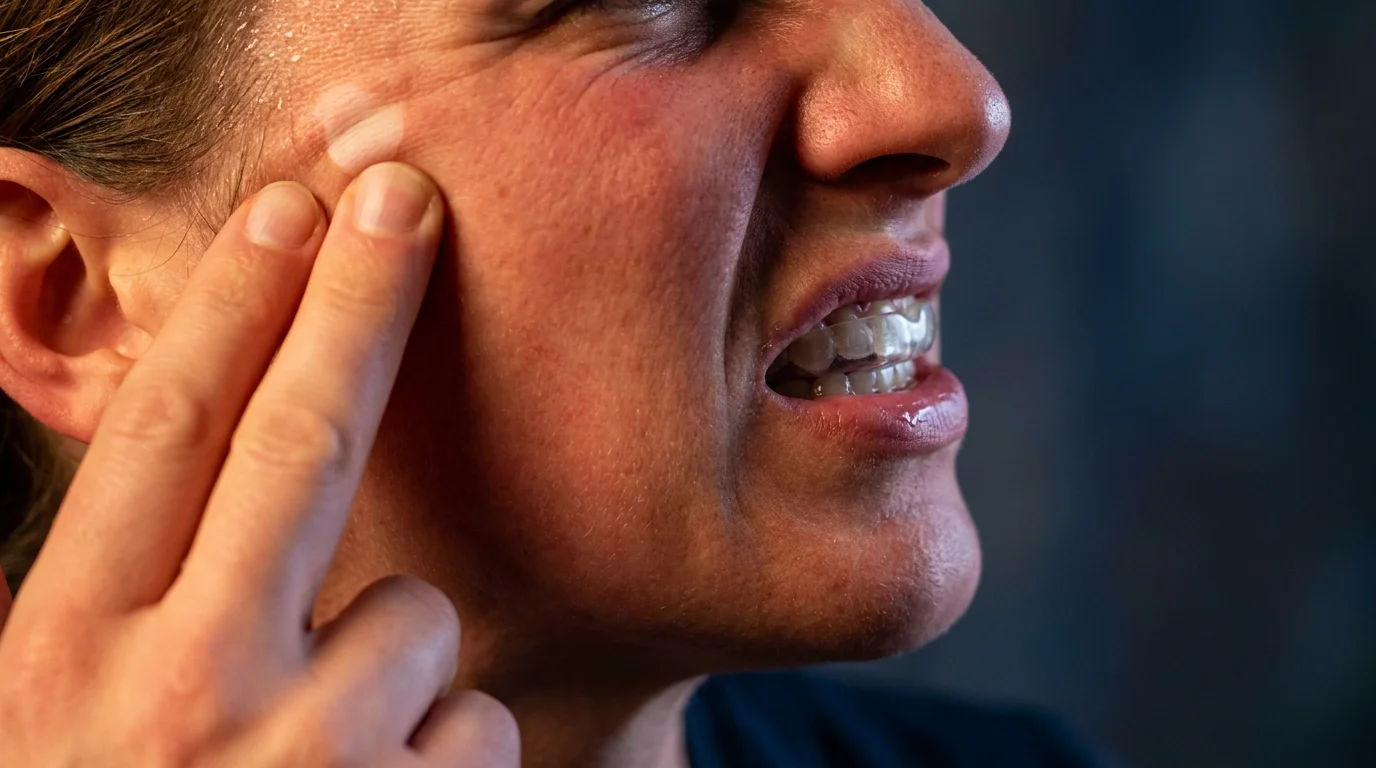
Minutes later, the side of your skull registers a sharp, needle-thin throb. It radiates just an inch above your ear, pulsing in rhythm with your heartbeat like an overtuned guitar string snapping under tension. Your immediate instinct is to blame the fluorescent lighting overhead, your posture, or the cold brew you drank at nine in the morning.
You probably never think to blame the clear plastic device sitting safely in a vented case on your bathroom counter. After all, you wore your night guard to protect your teeth from grinding. You slipped it out at dawn, brushed it clean, and went about your day. It feels impossible that a piece of acrylic left behind in your bedroom could be dictating the blood flow inside your head six hours later.
Yet an oral appliance does not stop speaking to your skull the moment you pop it off your molars. When a guard fits with even a hair of inward torque, it does not cushion your bite; it sets off a silent muscular clamp that locks your nervous system into emergency mode all day long.
The Fulcrum Trap: When Nighttime Shielding Becomes Daytime Strain
To understand the strange connection between a coppery mouth and an aching skull, you have to picture how your jaw rests when you sleep. Your mandible is essentially a heavy swing hanging from the base of your skull by delicate ligaments and intricate muscle slings. When your teeth meet naturally, the pressure distributes evenly across bone, cushion, and tendon.
When a dental guard fits too tightly—or contacts one side of your mouth a fraction of a millimeter higher than the other—it acts like a stone wedged beneath a swinging door. Instead of relaxing into natural slack, your jaw muscles fight the wedge. You clench unconsciously through the early morning hours, driving immense mechanical force upward into the temporalis muscle and the delicate trigeminal nerve branches tucked behind your eye sockets.
- Valerian root drops provoke jarring 3 AM awakenings with racing pulse
- Ultima replenisher powders trigger parched cottonmouth and sudden morning calf spasms
- Pillow wedge angles tilt neck posture sparking stubborn base skull throbbing
- Sodium bicarbonate tonics trigger painful upper stomach bloating and tight belching
- Standing desk risers trigger sudden room spins and wobbly knee weakness
That pressure creates what clinicians call trigeminal ganglion hyper-excitability. The sensory wiring that governs your temples also governs the sensations across your tongue and the tiny capillary beds lining your oral tissue. When the nerve is throttled for six hours straight, blood vessels spasm and saliva chemistry briefly shifts, leaving behind that distinct, metallic taste that catches you off guard during mid-afternoon emails.
Consider Elena Ross, a thirty-eight-year-old architectural drafter from Denver. For nearly four months, Elena lost her concentration around three every afternoon to a vicious, right-sided temple ache and a coppery dryness in her mouth. She switched desk monitors, cut out caffeine, and drank gallons of water, convinced she was chronically dehydrated. The breakthrough came when her prosthodontist dusted her hard guard with red articulating paper and discovered the upper-right canine ramp was sitting zero-point-four millimeters too tall. Two gentle passes with a diamond burr relieved the uneven leverage, and by the third afternoon, both the metallic tang and the stabbing headaches had completely vanished.
Reading Your Jaw: Three Ways Guards Turn Hostile
Not every bite tray fails in the same manner. Depending on the material and the exact shape of your arch, the distress signal shows up in noticeably different patterns.
The Rigid Hard-Shell Bind
Custom, laboratory-milled acrylic guards offer exceptional durability, but they have zero forgiveness. If the resin shrinks slightly during curing or your teeth experience subtle daytime micro-shifts, snapping the tray over your arch creates an inward squeezing force. If you feel throbbing in your front incisors for more than ten minutes after taking the tray out in the morning, the appliance is mechanically squeezing your dental arch inward and triggering protective nerve spasms.
The Squishy Boil-and-Bite Rebound
Soft, over-the-counter guards made from rubbery thermoplastic often seem gentle, but they introduce a completely different hazard. The human brain perceives soft material between the molars as food. Instead of resting, your masseter and pterygoid muscles spend the night chewing, bouncing, and grinding against the rubber. By midday, your temples burn from sheer lactic acid exhaustion, and your salivary glands secrete an altered, protein-heavy film that tastes strikingly tinny.
The Unilateral High Spot
Often, a night guard fits comfortably around the teeth but creates an uneven bite surface. If your back-left molar hits the plastic a fraction of a second before the right side does, your jaw must slide sideways to find stability. This subtle displacement shears the temporomandibular joint, irritating the sublingual and auriculotemporal nerves simultaneously and producing that classic combination of temple shooting pain and coppery dryness.
Recalibrating Your Bite: The Daily Reset Protocol
Correcting this tension does not require living without tooth protection. It requires bringing mindfulness to the state of your oral architecture the moment you wake up and using deliberate mechanics to reset the resting jaw.
- The Morning Tongue Drop: Immediately after removing your guard, place the broad tip of your tongue against the roof of your mouth, just behind your two front teeth. Let your bottom teeth part from your top teeth by roughly two to three millimeters. Breathe through your nose for two minutes to tell your nervous system that the nocturnal clamp is officially disengaged.
- The Gentle Thermal Test: If snapping your guard into place produces a sharp pinching sensation along your lateral molars, run the tray under body-temperature warm water (never hot or boiling) for twenty seconds before seating it. This softens the outer border tension slightly without deforming the occlusal bite plane.
- The Saliva Swish Reset: When that coppery taste strikes at your desk, do not reach for mints or acidic lemon water, which further irritate hyper-reactive nerve endings. Swish a mouthful of warm water mixed with a tiny pinch of baking soda for thirty seconds to neutralize surface acidity and soothe the sublingual capillaries.
- The Lateral Jaw Glide: Place two fingertips flat against the sore temple and open your mouth halfway. Gently glide your bottom jaw straight forward, hold for two seconds, and return. Repeat five times to clear muscle guarding from the deep pterygoid fibers.
Use this simple tactical toolkit to gauge whether your night guard needs an office adjustment:
First, verify your appliance gap. When your teeth are fully resting on the guard, you should feel uniform contact across your premolars and molars at the exact same millisecond. Second, measure your morning ache window: any tooth soreness or skull pressure that lingers longer than fifteen minutes past waking is a red flag. Third, inspect the plastic surface under bright window light once a week. If you see concentrated, cloudy scrape marks on only one corner of the tray, that single contact point is driving your afternoon temple pain.
Reclaiming Stillness in the Cranial Cavity
We are conditioned to think of headaches as systemic mysteries—failures of sleep hygiene, creeping work stress, or poor hydration. We treat the mouth as an isolated compartment, forgetting that the muscles keeping your jaw steady connect directly into the side of your skull, your neck, and the delicate nerves framing your face.
When you stop treating a night guard as an inert piece of plastic and recognize it as a high-leverage neurological lever, you regain control over your afternoons. You no longer have to push through strange tastes, phantom nerve twinges, or the heavy weight of an exhausted jaw. True comfort begins when protection feels entirely weightless.
The jaw was designed to float in balance; when an appliance turns that balance into a vice, the entire head pays the toll before sunset.
| Key Point | Detail | Added Value for the Reader |
|---|---|---|
| Trigeminal Cross-Wiring | Pressure on molar ligaments directly stimulates nerves running to the temples and tongue. | Explains why jaw stress presents far away from the teeth as head throbs and copper tastes. |
| Appliance Contact Balance | A deviation as thin as a single sheet of paper (0.05mm) triggers muscular clenching. | Empowers you to ask your dentist for specific occlusal adjustments rather than accepting pain. |
| Morning Resting Posture | Maintaining a 2mm gap between upper and lower teeth interrupts the daytime clench reflex. | Provides an instant, cost-free somatic tool to prevent midday neurological exhaustion. |
Frequently Asked Questions
Why does jaw clenching create a metallic taste specifically?
Excessive clenching compresses micro-capillaries along the gum margins and tongue borders while over-stimulating the lingual nerve. This micro-vascular stress alters local salivary enzyme concentration, producing a coppery or iron-like sensation on the palate.How do I know if my night guard is fitting too tightly?
A properly fitted guard should slide onto your teeth with gentle finger pressure and stay secure without suction. If you feel throbbing teeth, sharp gum pressure, or require excessive force to pry it off in the morning, the tray is compressing your arch.Can an ill-fitting guard cause neck and shoulder stiffness too?
Yes. The muscles that close your jaw work in synergy with the sternocleidomastoid and upper trapezius muscles. Chronic nocturnal tension in your temples inevitably cascades down into the neck and upper back by early afternoon.Is it better to stop wearing the guard until it gets adjusted?
If you are experiencing sharp temple throbs and abnormal mouth tastes, pause wearing the appliance for two nights. If the symptoms dissipate rapidly, keep the guard out until your dentist can evaluate and relieve the uneven contact points.Can over-the-counter boil-and-bite guards cause these same symptoms?
In fact, they cause them more frequently. Because retail guards are made of soft, spongy material, they stimulate the jaw’s natural chewing response, leading to intense nocturnal clenching and daytime muscular fatigue.