The dashboard casts an amber glow across your hands as the heater hums against a crisp 38-degree morning. You grip the top of the steering wheel at twelve o’clock, leaning an inch or two closer to the windshield while red taillights pulse along three lanes of highway gridlock. It feels like a defensive, focused posture—just leaning into the drive, shoulders slightly rounded, waiting for the brake lights ahead to clear.
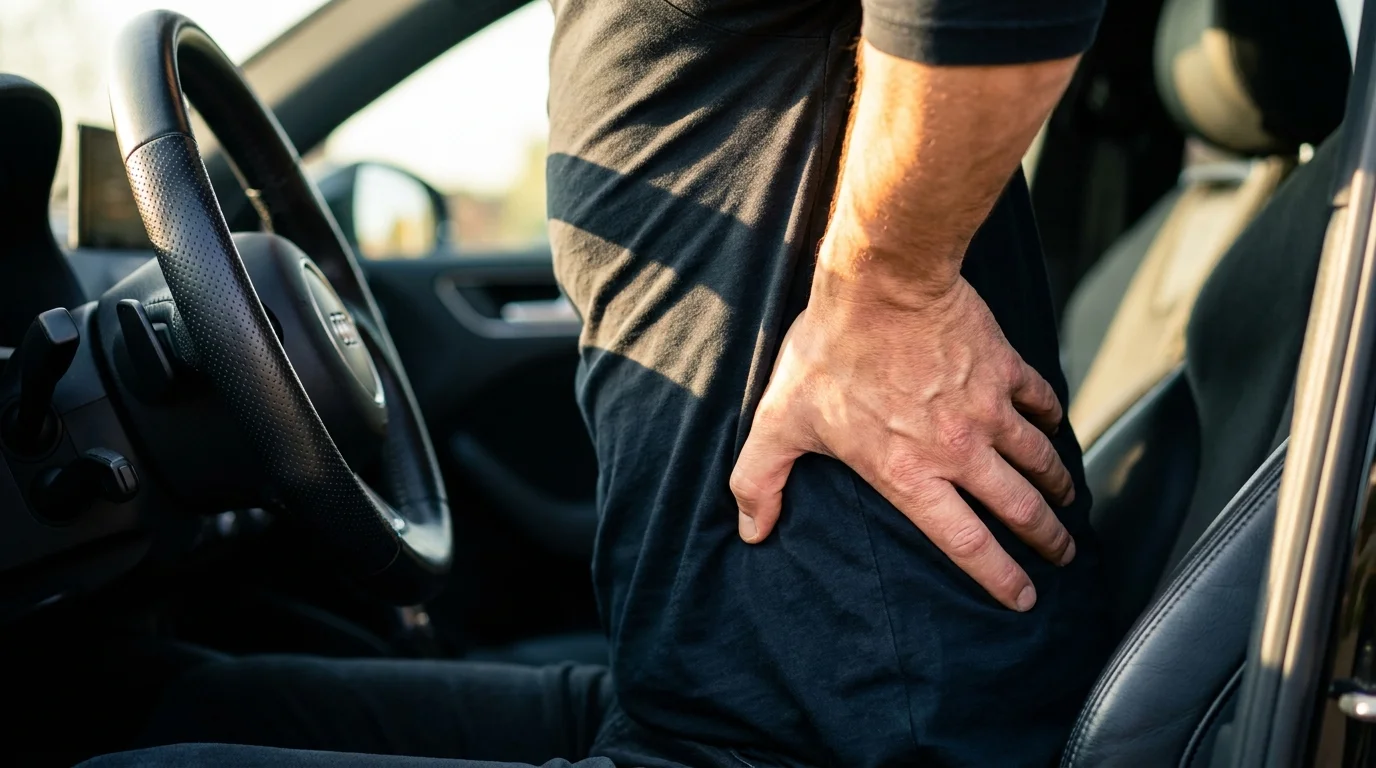
Then you hit a bridge expansion joint. A sharp, hot jolt radiates straight through the base of your beltline, locking your breath behind your teeth. Your lower lumbar vertebrae seize in direct defense against the impact, turning what should have been a routine forty-minute drive into a slow, grinding endurance test.
Most drivers assume this familiar commute ache stems from an unforgiving car seat, old athletic injuries, or simply getting older. We buy memory foam wedges, crank the lumbar dial until it pokes into our kidneys, or try to sit ramrod straight like a cadet on parade. Yet the real culprit is far more mechanical, quiet, and insidious: the steering wheel slouch.
When you reach forward to rest both hands on the wheel rim, your shoulder blades slide forward, pulling your upper thoracic cage with them. To balance that drift, your pelvis tucks backward into the bucket seat, flattening the natural inward hollow of your low back. In that single, unthinking transition, you turn your spine into an overstretched fishing rod, asking your gelatinous lumbar discs to absorb every ripple of road vibration with zero muscular protection.
The Bucket Seat Hammock: Why Modern Cabins Trap Your Discs
Automotive seats are engineered primarily to keep you securely planted during a collision, not to protect your discs from chronic axial loading. Most factory car seats slope backward toward the rear crease, placing your knees noticeably higher than your hip sockets. When your hips sink below your knees, your pelvis is physically forced into what biomechanists call a posterior pelvic tilt.
Think of your spine as a stack of wet bars of soap separated by tough rubber rings. When you maintain your back’s natural arch, road shocks distribute evenly across the bone surfaces and facet joints. But when you slouch toward the wheel, you pinch the front edges of those vertebral bones together. Spinal discs bulge backward toward the sensitive canal where your sciatic nerve roots pass, turning every bump on the asphalt into a direct hydraulic punch against fragile nerve tissue.
Dr. Elena Rostova, a 46-year-old occupational physical therapist in Detroit who spends her weeks assessing automotive assembly workers and long-haul couriers, sees this exact breakdown daily. She notes that drivers rarely hurt their backs while lifting heavy groceries from the trunk; the tear happens earlier, during the commute itself, when thirty consecutive minutes of low-vibration slouching drains the fluid from the discs and renders the surrounding tendons completely brittle before you even open the driver’s side door.
- Whole milk sips calm acidic stomach burning faster than chalky antacids
- Raw garlic cloves soothe scratchy throat irritation before bedtime
- Frozen grapefruit wedges shock morning brain fog faster than black coffee
- Tight dental guards trigger metallic mouth tastes and sharp temple throbbing
- Valerian root drops provoke jarring 3 AM awakenings with racing pulse
Commute Profiles: Finding Your Specific Cab Pressure Point
Not every vehicle forces the same spinal compensation. Identifying how your personal cab layout interacts with your driving habits is the first step toward stopping that sudden, breath-stealing spasm.
For the Sedan and Hatchback Commuter
Low-slung sedans force your legs out straight, exaggerating the stretch on your hamstrings. As your legs reach forward toward the pedals, tight hamstrings yank the bottom of your pelvis forward, flattening your lumbar curve before you even touch the wheel. Raise your seat height as far as your head clearance allows to open the hip angle and take tension off the sciatic tract.
For the High-Ride SUV and Truck Driver
While pickup trucks and crossovers offer an upright, chair-like hip position, drivers often push the seat too far back to stretch out their legs. This forces an exaggerated forward reach with the arms. Holding your hands at the top of the wheel without forearm support activates the latissimus dorsi and trapezius muscles, pulling the mid-back into a hunch and levering the lower lumbar spine away from the backrest.
The Three-Minute Cab Calibration: The 105-Degree Reset
Eliminating commute spasms does not require an aftermarket seat cushion or an expensive custom cabin. It requires dialing in three precise geometric angles that turn your car seat back into a load-bearing skeletal brace.
Set aside five minutes in your driveway before your next morning departure to configure these settings while your vehicle is parked:
- Set the backrest recline to exactly 100 to 110 degrees: A straight 90-degree angle increases disc pressure by forcing your hip flexors to work continuously, while a recline past 110 degrees causes your neck to crane forward to see the road. A slight 105-degree tilt transfers upper torso weight directly into the seat frame.
- Level the seat pan cushion: Adjust the bottom tilt so your hips sit level with or slightly higher than your knees. If your bucket seat has a deep rear trough that cannot tilt forward, place a firmly rolled hand towel (about two inches thick) under your sit-bones to lift your pelvis out of the bucket.
- Bring the steering wheel toward your sternum: Unlock the telescoping column and pull the wheel closer until your elbows rest at a relaxed 20-to-30-degree bend while your shoulder blades remain pinned flat against the seatback.
- Drop your grip to the lower rim: Abandon the outdated ten-and-two driving school grip. Resting your hands at eight-and-four or nine-and-three lets your forearms rest against your lap or armrests, instantly turning off the trapezius pull that drags your lumbar spine out of alignment.
Your tactical reference numbers for this adjustment:
Keep the backrest tilted between 100 and 110 degrees, position your chest 10 to 12 inches away from the airbag cover, and ensure your knees bend at approximately 120 degrees when depressing the brake pedal to the floor. These simple geometric margins cut lumbar hydraulic pressure by more than half.
The Micro-Decompression Routine at Red Lights
Even with your seat calibrated, vibration and sustained posture gradually cause muscles to brace. Use the natural rhythm of your commute to restore circulation to compressed nerve pathways without taking your attention off the road.
When paused at a long red light, slide your hips fully back until your tailbone meets the seat seam. Inhale deeply through your nose for four seconds, expanding your lower ribs sideways against the seat bolsters rather than puffing your chest upward. As you exhale slowly through pursed lips, press the back of your head firmly into the headrest for three seconds. This subtle chin-tuck reflex resets the postural chain from your atlas down to your sacrum, clearing the pinched sensation before it can erupt into a full spasm.
The Shift in How You Arrive
The daily commute is often treated as wasted, hostile time—a period of passive endurance between the peace of home and the demands of the workplace. We collapse into the driver’s seat, surrender our posture to exhaustion, and arrive at our destination physically bent, moving cautiously as we step onto the asphalt.
Treating your vehicle as an active workspace transforms that dynamic. When your pelvis is anchored, your discs cushioned by natural skeletal alignment, and your hands relaxed on the controls, the road stops battering your spine. You step out of the car standing at your full height, your back quiet and steady, ready to walk into your day rather than spend the morning recovering from the drive.
“Your spine was built to function as an arch, not a suspension cable; the moment you lean forward to steer, you surrender all natural shock absorption to the bare discs.”
| Key Point | Detail | Added Value for the Reader |
|---|---|---|
| Backrest Angle | 100° to 110° tilt from horizontal | Offloads up to 40% of torso weight from the L4-L5 disc space into the seat frame. |
| Pelvic Elevation | Hips level with or slightly higher than knees | Stops posterior pelvic tilt, preserving the natural inward lumbar curve without extra pads. |
| Hand Placement | 8-and-4 or 9-and-3 grip on wheel rim | Drops shoulder engagement and prevents upper-back pulling that destabilizes the lower back. |
| Wheel Reach | Elbows bent at 20° to 30° angles | Maintains shoulder contact with the backrest so the seat can absorb road vibration. |
Frequently Asked Questions
Why does my back hurt more during short city commutes than long highway trips?
Frequent braking and accelerating cause rapid shifts in pedal pressure, requiring your right leg and hip flexors to contract constantly while your pelvis is already tilted, rapidly fatiguing the stabilizing muscles of your lower back.Should I use an aftermarket lumbar roll or cushion?
Only if your car seat lacks built-in adjustment. Many commercial cushions are too thick, pushing your lumbar spine into an exaggerated arch that pinches the posterior facet joints. A rolled hand towel offers far more customizable support.Why do I feel a spasm only when stepping out of the car?
While sitting in a slouch, spinal ligaments creep and stretch while the disc fluid shifts backward. When you suddenly stand up, the stretched tissues cannot immediately stabilize the joint, causing surrounding muscles to violently seize to prevent injury.Is heated seating actually helpful for preventing commute spasms?
Yes, mild heat increases capillary blood flow to cold, stiff lumbar muscles and reduces protective spasm reflexes. However, use it on low to moderate settings; excessive heat can cause muscle relaxation that allows you to slouch even deeper.Does adjusting my mirrors help maintain good driving posture?
Adjust your rearview and side mirrors only after you have locked in your ideal 105-degree upright posture. If you begin to slouch during your commute, your sightlines will blur, acting as an automatic reminder to sit back into alignment.