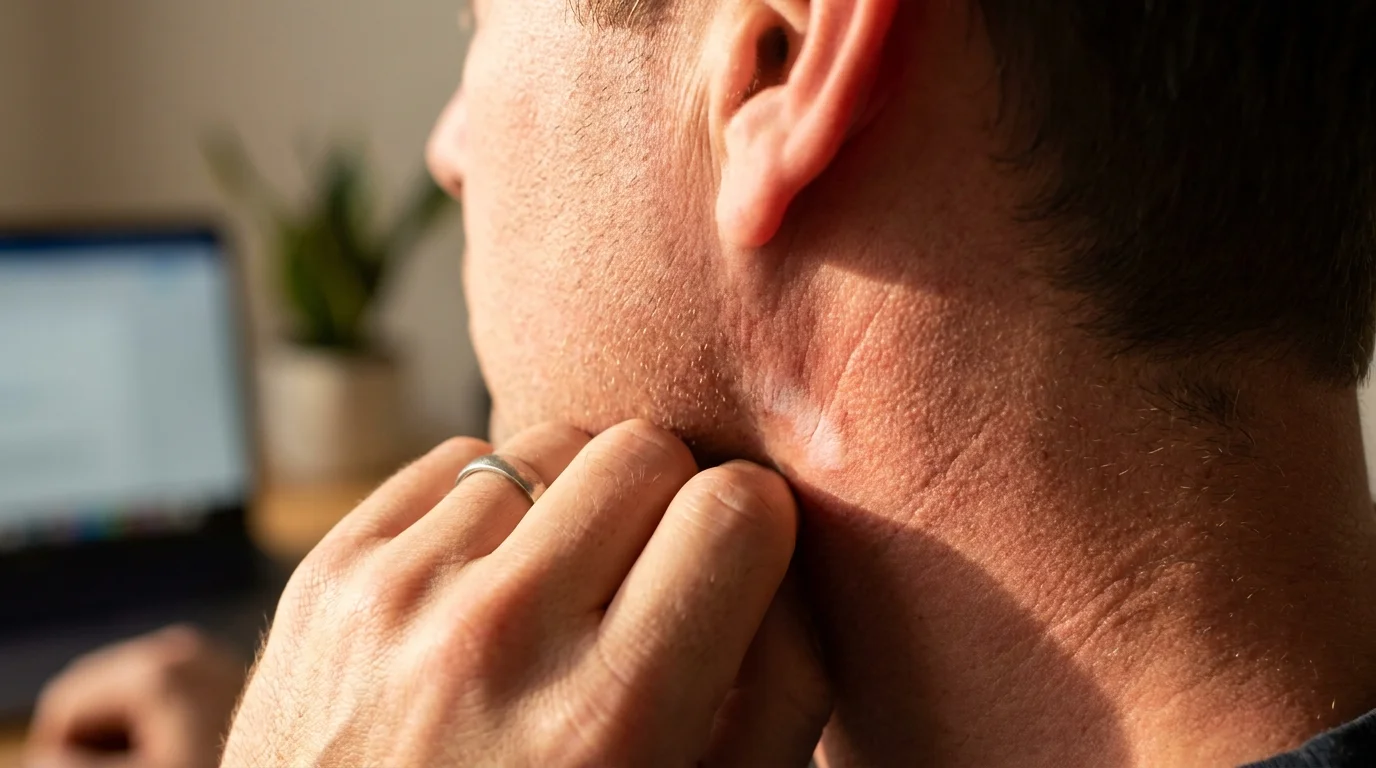
By four in the afternoon, the room takes on that stale, amber slant of late light, and the only sound left is the faint, dry whir of your laptop fan grinding through dozens of open browser tabs. You roll your shoulders, tip your chin toward your sternum, and wait for that familiar, satisfying pop that never quite clears the room. Instead, a dull, iron wire tightens right where your skull rests against the spine, pulling your attention away from your work and turning your forehead heavy.
We almost always treat this stiffness like a knotted shoelace, cranking our heads from shoulder to shoulder or digging our knuckles blindly into the meat of our upper traps. You assume the trouble lives in the broad slope between your neck and shoulder blades—the spot that burns whenever you lean forward to decode tiny spreadsheet cells. Yet stretching an exhausted muscle is often like yanking both ends of a wet rope; you simply draw the knot tighter.
Your neck muscles are not failing out of weakness; they are frantically firing to keep your ten-pound skull from tumbling onto your keyboard. When your eyes lock onto a display for hours, your head creeps forward by fractions of an inch, doubling the mechanical workload on the structural cords running along the side of your neck. The real control switch for that tension is not down in your back. It rests directly above, hidden within the smooth, rounded stone of bone nestled right behind your earlobe.
The Guy-Wire Deception: Why Pulling Never Heals
Imagine a tall transmission tower held upright by steel guy-wires anchored into concrete footings. If the tower leans slightly north, the southern cables must strain under massive tension to prevent a collapse. If you walk up to those strained southern cables with a wrench and loosen their tension coils, the entire structure tilts dangerously off-center. That is precisely what happens when you aggressively stretch your aching back and upper shoulders after six hours at a desk.
The two thick bands visible along the sides of your throat—the sternocleidomastoid muscles, or SCM—along with the deep rotators at the back of your head, anchor into the mastoid process. This bony knob sits directly behind your ear base, acting as the primary pivot lever for your entire cranium. Contracted neck cords refuse to yield to broad stretches because your brain perceives slackening them as a threat to your stability.
To persuade the nervous system to let go of that protective clamp, you cannot pull from the bottom. You have to speak directly to the anchor point at the top. By applying deliberate, quiet compression to the mastoid origin, you activate the mechanoreceptors embedded in the tendon, tricking the spinal cord into dialing back its emergency grip.
- Eli Lilly Verzenio approvals alter standard clinical oncology protocols across hospitals
- Vitruvias Therapeutics recalls trigger urgent thyroid medication warnings across regional clinics
- Opening hallway doors flushes heavy trapped bedroom heat for deeper sleep
- Steering wheel slouching triggers sharp lumbar spasms on daily car commutes
- Whole milk sips calm acidic stomach burning faster than chalky antacids
Marcus Vance, a 44-year-old structural bodyworker based outside Seattle, sees the results of screen fixation on his table every working day. He routinely meets software developers convinced they have degenerated cervical discs or permanent postural damage, only to watch their chronic headaches evaporate under the simplest touch. Marcus does not touch their shoulders until he checks the mastoid base; he views that tiny ledge of bone as the body’s secret circuit breaker, where sensory overload silently collects until someone manually turns the dial.
Calibrating the Touch: Three Screen Profiles
Not every desk worker gathers tension in the exact same pattern. The way your workstation is arranged dictates which tiny fibers around your mastoid are working overtime to steady your gaze.
The Single-Laptop Sloucher experiences a direct forward head migration. Because the screen sits low on the table, your chin naturally pokes forward while your skull tilts slightly upward to keep your eyes level with the glass. This creates severe suboccipital pinching along the back rim of the mastoid bone, leading to dull pressure behind the eyebrows and a sensation of breathing through a narrow straw.
The Dual-Monitor Pivoter suffers from asymmetric shearing. If you spend eighty percent of your workday tracking your primary screen and twenty percent glancing at a reference monitor to your left, the right mastoid base remains in continuous micro-rotation. This creates one-sided stiffness that feels like a pinched nerve whenever you try to check your blind spot while driving home.
The Prescription Lens Tilter faces a subtle, continuous strain. If you wear reading glasses or progressive bifocals while working at an elevated display, you constantly tilt your head back to look through the bottom third of the lens. Your upper neck cords lock in perpetual micro-contraction, leaving the tissue behind your ear lobes feeling tender, hot, and sensitive to light pressure.
The Thirty-Second Mastoid Release: Tactical Protocol
This technique does not require special equipment, gym clothes, or aggressive manipulation. You can perform it mid-meeting without anyone realizing you are resetting your autonomic nervous system.
Begin by locating the landmark. Slide your index and middle fingers directly behind your earlobe until you feel the firm, rounded bump of the mastoid process. Drop your fingertips just a millimeter off the bony ridge into the soft, slightly tender groove where the bone meets the neck musculature.
- Angle your elbows outward and let the weight of your arms provide the force, rather than pushing hard with your finger pads.
- Apply steady, stationary manual pressure straight inward and slightly upward toward the center of your skull.
- Do not knead, circle, or rub the skin; friction will only trigger the local nerve endings to guard against the intrusion.
- Hold the pressure point continuously for thirty seconds while letting your jaw fall slack, keeping your tongue resting gently on the floor of your mouth.
- Inhale softly through your nose for four seconds, allowing the belly to expand, and exhale through parted lips for six seconds.
As you cross the twenty-second threshold, you will often feel a sudden, warm flush across the side of your throat, accompanied by an involuntary swallow or a deep sigh. The stubborn muscle cords soften instantly, sinking back to their natural length as the neurological reflex finally stands down.
• Hold Duration: Exactly 30 seconds per side (or simultaneously).
• Target Depth: 4 out of 10 on a personal discomfort scale; never sharp or throbbing.
• Hand Position: Two finger pads placed in the post-auricular notch.
• Timing: Perform once mid-morning and once around 3:00 PM before screen fatigue solidifies.
Reclaiming the Space Between Your Thoughts
Physical tension is rarely just a mechanical inconvenience; it colors the way you experience your entire workday. When your neck muscles are clamped down in survival mode, your brain stays tethered to a low-grade alarm state, making routine emails feel urgent and minor interruptions feel unbearable.
Learning to slacken these cords through precise, quiet touch teaches you a broader truth about your physical frame: force rarely solves what sensitivity can untie. Releasing the base of the skull instantly restores room for your shoulders to drop away from your ears, clearing that heavy mental fog and returning your focus to where it belongs.
Small levers move the heaviest stones; quiet pressure behind the ear disarms tension that an hour of pulling could never touch.
| Key Point | Detail | Added Value for the Reader |
|---|---|---|
| Target Location | The soft hollow right behind and under the mastoid ridge. | Bypasses large defensive muscles to access primary neural anchors. |
| Application Style | Sustained static compression without rubbing or kneading. | Prevents skin irritation and avoids triggering protective tissue spasms. |
| Neurological Response | Inhibits the chronic firing loop of the spinal accessory nerve. | Yields immediate muscle slackening rather than temporary, forced flexibility. |
Frequently Asked Questions
Where exactly should I place my fingers for this release?
Locate the hard, rounded bone behind your earlobe, then allow your fingertips to slip just off its lower edge into the small soft groove where your neck connects to your head.How hard should I press behind my ear?
Use gentle to moderate pressure—about the firmness you would use to test the ripeness of a peach. It should feel like a satisfying, dull ache, never sharp or electric.Why shouldn’t I just stretch my neck to the side instead?
Aggressive lateral neck stretches often cause already overtaxed muscles to contract even harder to protect your cervical spine, worsening the underlying spasm.Can mastoid pressing help with screen-related tension headaches?
Yes. The nerves that supply sensation to your scalp pass directly around these muscle attachments, so relieving the tension loop often clears forehead and temple pressure.How often can I perform this during a long workday?
Two to three times a day is ideal. It works best as an intentional pause between tasks, especially when you feel your posture beginning to cave inward.