The steam rises off the bucket in faint, pale curls, carrying the sharp scent of cedarwood and Castile soap across the room. Sunlight slants across your oak floorboards, showing every stray ring, dog paw mark, and gritty patch of salt tracked in from the driveway. You wring out the mop head, press the damp microfiber flat against the grain, and push forward, sweeping the handle from side to side in long, rhythmic arcs.
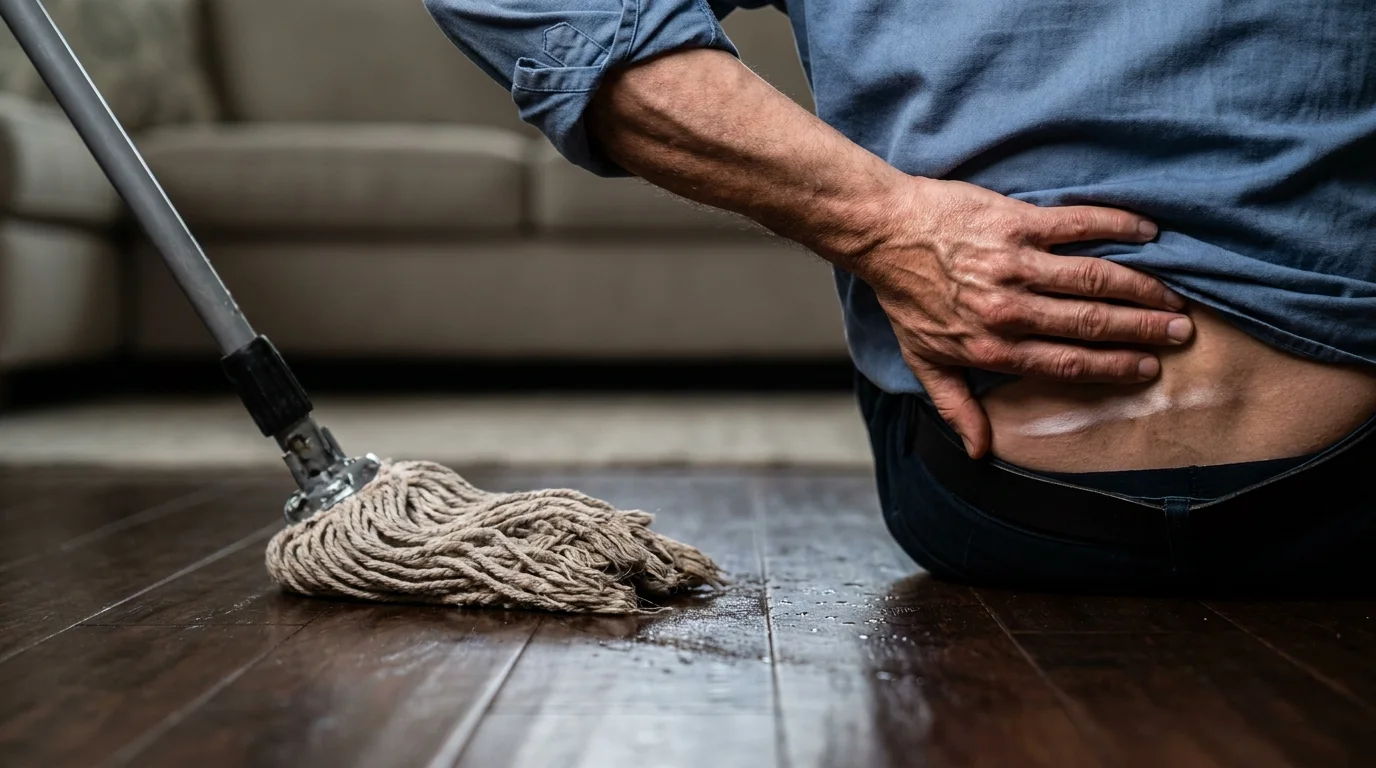
It feels like honest, satisfying work. Yet by the time you reach the hallway runner, a dull, thrumming heat begins to pool directly across your beltline. Your shoulders stiffen, your breath grows shallow, and standing completely upright requires a conscious, bracing clench of your stomach. You chalk it up to normal fatigue or another reminder of passing years, unaware that you have just spent forty minutes subjecting your spine to an unnatural biomechanical lever.
Mopping hardwood floors seems benign because the load in your hands weighs barely two pounds. But the human spine handles straight vertical compression far better than it tolerates rotational torque under an asymmetrical reach. When you lean your chest forward while pulling a damp mop sideways across raw grain, your lower vertebra acts like a wrench twisting a stubborn bolt.
The cushion between your lower lumbar vertebrae does not wear down from heavy, dramatic lifts alone. More often, it frays in the quiet margins of everyday domestic maintenance, where unconscious twisting silently grinds down the protective rings of your cartilage.
The Crankshaft Dilemma: Why Rotation Destroys Lumbar Discs
Consider your spine not as a bendable rubber rod, but as a balanced vertical suspension bridge. The vertebral bodies are sturdy concrete towers, and your lumbar discs are fluid-filled hydraulic cushions wrapped in tough, interwoven rings of collagen. When you hinge squarely at your hips, those cushions absorb force evenly across their surface area, dispersing the load into the dense bone of your pelvis.
The moment you plant both feet parallel and sweep a mop diagonally across your body, you turn your lumbar spine into an off-balance crankshaft. The twisting force, known mechanically as torsional shear, stretches one side of the fibrous disc ring while pinching the opposite side under intense pressure. Add the friction of wet fabric dragging across wood planks, and that tiny two-pound tool suddenly exerts dozens of foot-pounds of rotational drag directly through your fourth and fifth lumbar discs.
- Barebells protein bars trigger intense afternoon crashes behind hidden maltitol syrups
- Nodding during conflict drains nervous system stamina triggering sudden afternoon fatigue
- Mastoid bone pressing dissolves stubborn neck tightness from continuous laptop staring
- Eli Lilly Verzenio approvals alter standard clinical oncology protocols across hospitals
- Vitruvias Therapeutics recalls trigger urgent thyroid medication warnings across regional clinics
Worse, most of us mop on autopilot. We plant our sneakers on the slick surface, freeze our pelvis in place to keep our balance, and generate the entire cleaning motion using only our thoracic twist and lower back. Your discs are forced to do the kinetic work that your glutes, hamstrings, and hips were designed to manage.
The Shared Clinic Secret: Marcus Vance’s Monday Morning Pattern
Marcus Vance, a fifty-three-year-old physical therapist based outside Columbus, Ohio, knows the exact sound a patient makes when their lower back has surrendered to household chores. Every Monday morning, his clinic schedule fills with weekend warriors who did not pull a hamstring on a trail run or throw out their shoulder at the gym, but instead spent their Sunday deep-cleaning the house. Vance often points to a worn anatomical model of the sacrum sitting on his desk to explain how reaching under kitchen tables causes more micro-tears in the annular fibers than deadlifting a loaded barbell, simply because the stabilizing core musculature completely disengages during low-load, repetitive household reach.
Adapting Your Stride to Your Architecture
Your living space dictates the subtle physical traps you fall into while cleaning. Adapting your technique requires matching your movement pattern to the distinct layout of your home.
For Open Floor Plans and Wide Hallways
The danger here is the expansive sweep. In wide spaces, you naturally reach five feet out in front of yourself, rounding your shoulders and allowing your ribcage to collapse over your thighs. Dragging the mop back inward from this extended reach levers the lumbar spine under an extreme forward bend. Instead of long strokes, limit your sweep to a three-foot perimeter directly in front of your feet. Walk your body forward with the mop rather than throwing your upper torso outward to reach distant dirt.
For Tight Galley Kitchens and Under-Cabinet Kickplates
Cramped quarters force people into sudden, jerky torso twists. You keep your feet pointed toward the sink while flicking the mop head sideways beneath the dishwasher. This creates a severe rotational shear at the L5-S1 junction. When working along cabinets, turn your entire lower body to square your hips with the surface you are scrubbing. Let your knees soften, drop your center of gravity by two inches, and slide sideways like an infielder tracking a ground ball.
The Fencer’s Glide: A Step-by-Step Hip Mechanics Reset
You do not need to hire a professional cleaner or abandon gleaming floors to save your back. You simply need to replace rotational lumbar twisting with a dynamic, staggered hip hinge.
Instead of planting your feet side-by-side like tree trunks, adopt the stance of a fencer stepping onto the piste. This keeps your lumbar spine locked in its neutral resting curve while transferring the workload to your large hip and leg muscles.
- Step into a staggered stance: Place your non-dominant foot roughly twelve inches ahead of your dominant foot, with both sets of toes pointing in the direction of travel.
- Anchor the handle to your core: Hold the top of the mop handle against the side of your hip rather than swinging it out in space. Your hands should guide the mop, but your body weight should move it.
- Shift your weight front-to-back: Push the mop forward by gently shifting your weight onto your front heel; pull it back by rocking onto your rear foot. Your spine stays completely vertical and quiet.
- Pivot from the ankle: When changing cleaning direction, never twist your waist. Lift your heels and pivot your entire lower base to face the new angle squarely.
Treat this movement as a rhythmic, quiet glide. If your lower back feels hot or exhausted after ten minutes, you have slipped back into twisting from your waist rather than rocking from your hips.
The Tactical Home Toolkit
Minor equipment adjustments change the physics of floor cleaning immediately, lowering the drag friction that tears at spinal ligaments.
- Handle Height: Choose a mop pole that reaches your sternum when rested on the floor. Short handles force an involuntary forward hunch.
- Moisture Saturation: Wring microfiber heads out until they are merely damp. A sopping wet mop creates intense hydrodynamic surface tension that triples the pulling resistance on your back.
- Time Caps: Work in uninterrupted ten-minute segments, followed by two minutes of standing calf extensions to flush stagnant blood from the pelvic floor.
- Footwear Grip: Never clean bare-footed or in slick socks on wet hardwoods. Wear supportive indoor sneakers with rubber outsoles to anchor your hip base firmly against the floorboards.
The Rhythm of a Protected Home
Taking care of a living space should be a grounding ritual, not a physical penance that steals your comfort for the rest of the weekend. When you learn to move your frame with deliberate grace, the most mundane domestic routines transform into low-impact physical maintenance.
Reclaiming your spinal ease begins with recognizing that chores are physical events requiring biomechanical awareness. When you stop wrenching your spine against the floor and allow your hips to carry the load, your house stays pristine, and your body remains entirely your own.
Keep your belly button facing the mop head at all times, and your lower back will never have to pay for your clean floors.
| Key Point | Detail | Added Value for the Reader |
|---|---|---|
| Dynamic Hip Stance | Stagger feet 12 inches apart and rock body weight back and forth. | Eliminates 80% of rotational shear stress on L4-S1 lumbar discs. |
| Proper Pole Ergonomics | Select mop handles reaching the sternum rather than the chin or chest. | Prevents thoracic hunching and forward cervical strain while cleaning. |
| Friction Reduction | Dampen microfiber rather than soaking cotton strings. | Cuts the drag coefficient, slashing pull-force pressure across lower back muscles. |
Frequently Asked Questions
Why does my lower back hurt more after mopping than after vacuuming?
Vacuum cleaners roll on wheels that absorb surface friction, whereas damp mops create drag against the floor that must be overcome entirely by your upper body and lower spine.What is the best mop style for chronic lower back pain?
A lightweight flat-head microfiber mop with an adjustable telescoping handle offers the least drag resistance and allows you to set the height to your sternum.Should I wear a back brace while doing deep household cleaning?
A brace can offer a temporary reminder to brace your core, but relying on it often weakens stabilizing muscles. Learning the staggered hip hinge is far more protective over time.How do I safely reach underneath low furniture or kitchen tables?
Drop down onto one knee in a half-kneeling lunge rather than bending over from the waist. This keeps your spine upright and uses your quadriceps to lift you back up.Can mopping cause an acute disc herniation?
While rare from a single stroke, repetitive rotational twisting under load weakens the outer disc fibers over months, making them vulnerable to a sudden tear during ordinary tasks.