The midday sun slants across your desk, warming the corner of your keyboard while the low hum of the office air conditioner settles into the background. You reach for your lukewarm water glass, sit up straight to review a spreadsheet, and suddenly notice an uncomfortable squeeze across your midsection. It is not acute pain, but rather a quiet, persistent inability to pull down a full breath, as if you are trying to fill your lungs through an invisible band across your solar plexus.
You might suspect that second cup of coffee from ten o’clock or wonder if an impending deadline is stirring up unprovoked workplace dread. Yet your pulse is relatively steady, and your schedule is manageable. What feels like an inexplicable wave of subconscious suffocation panic is actually purely mechanical, waiting quietly at the edge of your hip bone.
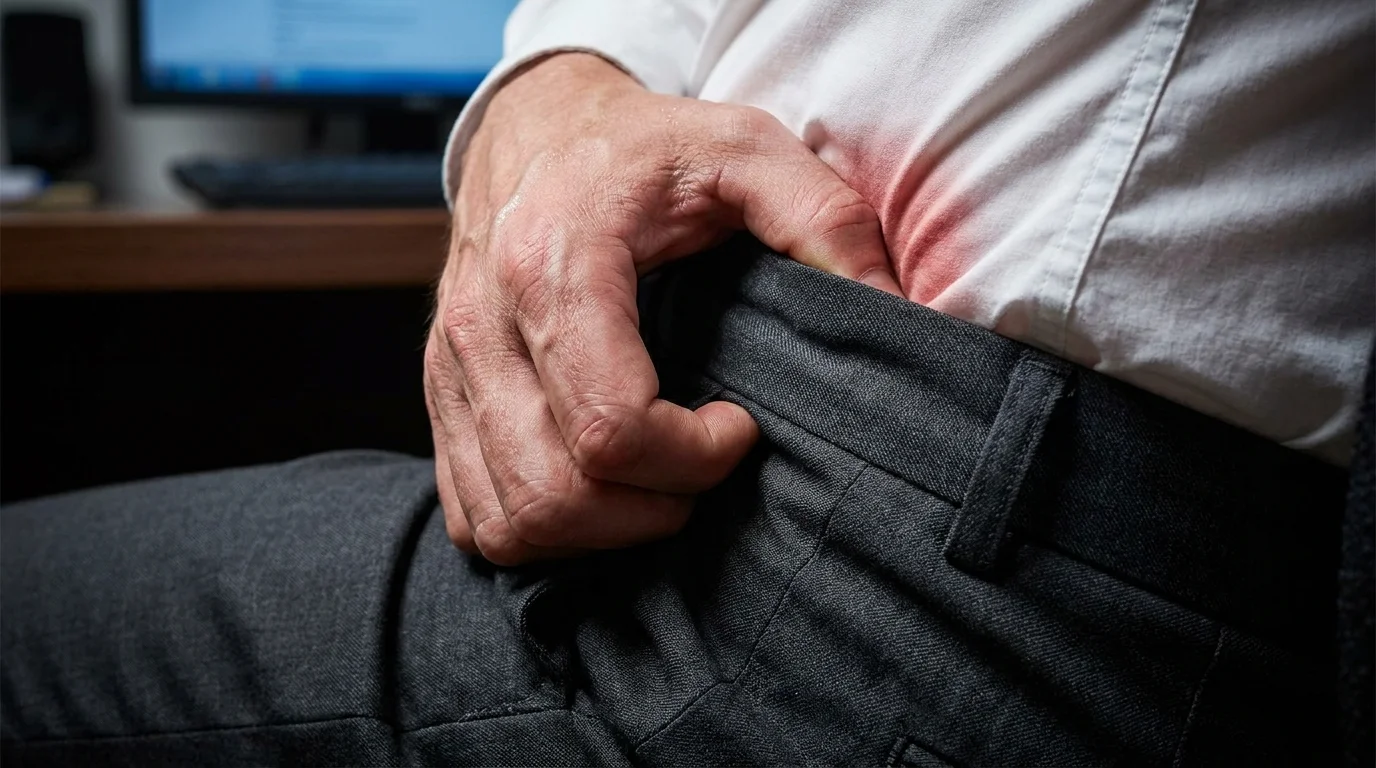
When you stand, tailored wool or rigid raw denim settles gracefully against your pelvis. But when you sit down at an office chair, your femur bones flex upward, rotating the pelvis backward and driving stiff fabric directly into the base of your floating ribs. The lower margins of your lungs have nowhere to expand.
The Diaphragmatic Splinting Mechanism
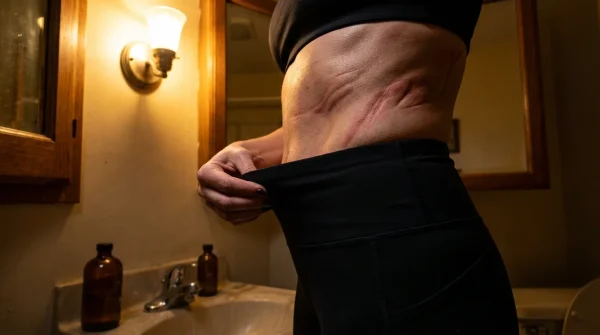
Consider your thoracic cavity not as a rigid barrel, but as an old-fashioned leather bellows. For the bellows to draw fresh air, the bottom chamber must expand outward in all directions. When tight trouser waistbands clamp down across your upper abdomen and lower ribcage, that bellows meets an immovable wall.
To compensate, your body performs an unconscious workaround known as diaphragmatic splinting. Unable to drop your diaphragm downward against the resistance of stiff denim or tailored seams, you recruit the delicate scalene muscles in your neck and the pectoralis minor in your chest to yank your collarbones upward. This high-chest breathing pattern sends an immediate distress signal to the phrenic nerve, which runs from your neck straight down to your diaphragm. The brain translates this subtle ribcage restriction as low-grade oxygen starvation, quietly sparking an anxious fight-or-flight cascade while you are merely editing an email.
The Observation from the Cutting Table
Julian Vance, a 52-year-old bespoke tailor and patternmaker in Philadelphia, spends his days fitting suits for executives who routinely complain of afternoon exhaustion. “Clients come back for alterations convinced they have developed digestive problems or sudden midlife anxiety,” Julian observes as he chalks a seam line. “They insist the waistband fit perfectly in the fitting room mirror. But they forget they live their actual working lives bent at a ninety-degree angle, where a structured waistband cuts the lower ribcage circumference by up to two full inches.”
- Cold water gargling overrides racing pulse spikes during lonely moments of panic
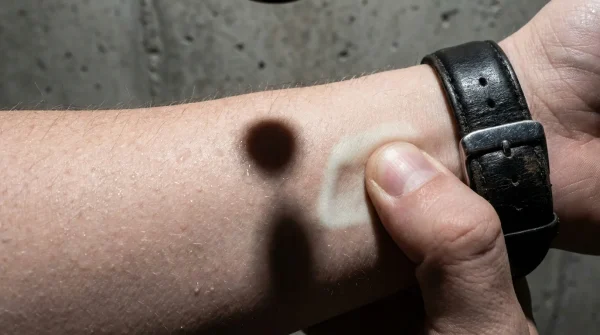
- Textured watch bands ground sudden workplace anxiety spikes without drawing room attention
- Peanut cooking oil searing releases harsh fumes that trigger sudden afternoon brain fog
- Reverse osmosis water strips daily mineral balance triggering stubborn afternoon exhaustion
- Pushing rolling carts speeds up core muscle fade in older adults
Julian often asks his clients to sit down in his fitting chair and take a deep breath before he marks the buttonhole. Nine times out of ten, the stiff waistband acts like a miniature tourniquet on the lower ribs, forcing the upper chest to heave unnaturally just to secure basic ventilation.
Adjustment Layers for Daily Wardrobes
Solving this friction does not mean abandoning structured garments for sweatpants, but rather understanding how different fabrics interact with seated geometry.
For the Office Professional
If you wear structured trousers or pencil skirts to an office, seek out garments with hidden internal elastic side-tabs or Hollywood waistbands that sit higher on the true waist rather than across the soft lower ribs. A high-rise trouser distributes pressure across the broader surface of the lower abdomen, leaving the tenth, eleventh, and twelfth floating ribs completely free to flare outward during natural breathing cycles.
For the Raw Denim Enthusiast
Heavyweight cotton twill possesses almost zero lateral give when folded against a seated torso. If you spend eight hours daily at a computer in rigid selvedge denim, size the waist up by one full inch and rely on suspenders or leave the top button unlatched beneath an untucked knit while seated. This eliminates the stiff mechanical roadblock against your lower epigastric nerve bundle.
For the Remote Desk Worker
Working from home creates a false sense of comfort where people often sit in structured casual pants rather than true loungewear. Notice whether your waistband folds in half against your belly button when you lean forward toward your laptop. If the fabric creases into a sharp horizontal edge, it acts as a rigid wedge, splinting your diaphragm every time you reach for your mouse.
Mindful Steps to Free Your Lower Ribcage
Restoring natural respiration during a seated workday requires both physical space and sensory recalibration. Practice these quiet, unhurried adjustments whenever that sudden midday band of chest tightness appears.
- The Button Test: Discreetly slip the button or clasp of your trousers loose while seated at your desk. If your belly instantly drops forward and your chest immediately drops with an involuntary sigh, your clothing was mechanically choking your breath.
- The Three-Rib Expansion: Place your palms against the bottom sides of your ribcage, just above your waist. Breathe in slowly through your nose for four seconds, focusing on pushing your hands outward laterally rather than lifting your shoulders upward.
- Pelvic Tilt Realignment: Slide your hips forward on your seat by two inches and recline your backrest slightly to 105 degrees. This opens the hip angle, dropping the trouser waistband below the sensitive phrenic nerve crossing point.
Keep your immediate environment calibrated for ease. A simple desk setup change can yield an instant physical dividend: ensure your chair seat pan tilts slightly downward to reduce abdominal compression, and keep a discrete elastic waist extender in your top desk drawer for days that require heavy sedentary focus.
The Freedom of Unbound Breathing
We often carry a hidden guilt about afternoon tension, assuming our bodies are failing under the weight of mental stress or poor physical conditioning. We buy mindfulness apps and swallow magnesium supplements to quiet an uneasy chest, rarely considering that our tailored clothing is simply binding the mechanics of life itself.
When you give your lower ribcage room to expand, the world softens. Your shoulders melt away from your ears, your throat unclasps, and that phantom midday panic dissolves into simple, generous oxygen. True comfort is not an aesthetic compromise; it is the quiet, essential luxury of letting your lungs do the work they were designed to do.
The diaphragm demands space, not discipline; give the floating ribs room to flare, and the mind will follow with stillness.
| Key Point | Detail | Added Value for the Reader |
|---|---|---|
| Physical Mechanism | Waistband splints lower floating ribs when seated. | Distinguishes clothing pressure from true cardiopulmonary panic. |
| Nervous System Feedback | Shallow breathing activates phrenic distress signals. | Explains why physical tightness feels like unprompted midday anxiety. |
| Garment Geometry | High-rise waistbands bypass the rib margin entirely. | Provides a clear shopping criteria for comfortable workday tailoring. |
| Desk Posture Angle | Opening the hip angle to 105 degrees drops waistline pinch. | Offers an immediate, zero-cost physical fix without changing clothes. |
Frequently Asked Questions
Can tight waistbands cause symptoms that mimic an anxiety attack?
Yes. By preventing the diaphragm from descending, tight clothing forces rapid upper-chest breathing. This shallow respiration mimics hyperventilation, triggering an involuntary nervous system alarm that feels identical to sudden stress or dread.Why does this tightness only happen while sitting down?
When standing, your torso is elongated and clothing hangs freely. Sitting closes your hip angle to ninety degrees, bunching stiff fabrics directly into the soft space below your ribs where diaphragmatic movement occurs.How loose should my trousers actually be at my desk?
You should be able to slide two flat fingers comfortably between your waistband and your skin while fully seated, without the fabric digging into your abdomen when you exhale deeply.Does this affect digestion as well as breathing?
Constricting the lower ribcage and upper abdomen increases intra-abdominal pressure, which can slow natural gastric emptying and push stomach acid upward, compounding chest discomfort with mild heartburn.What is the best immediate counter-stretch during desk work?
Loosen the top fastening of your trousers, stand up tall, interlace your fingers behind your head, and inhale deeply while gently arching your upper back to fully stretch the abdominal fascia and intercostal muscles.