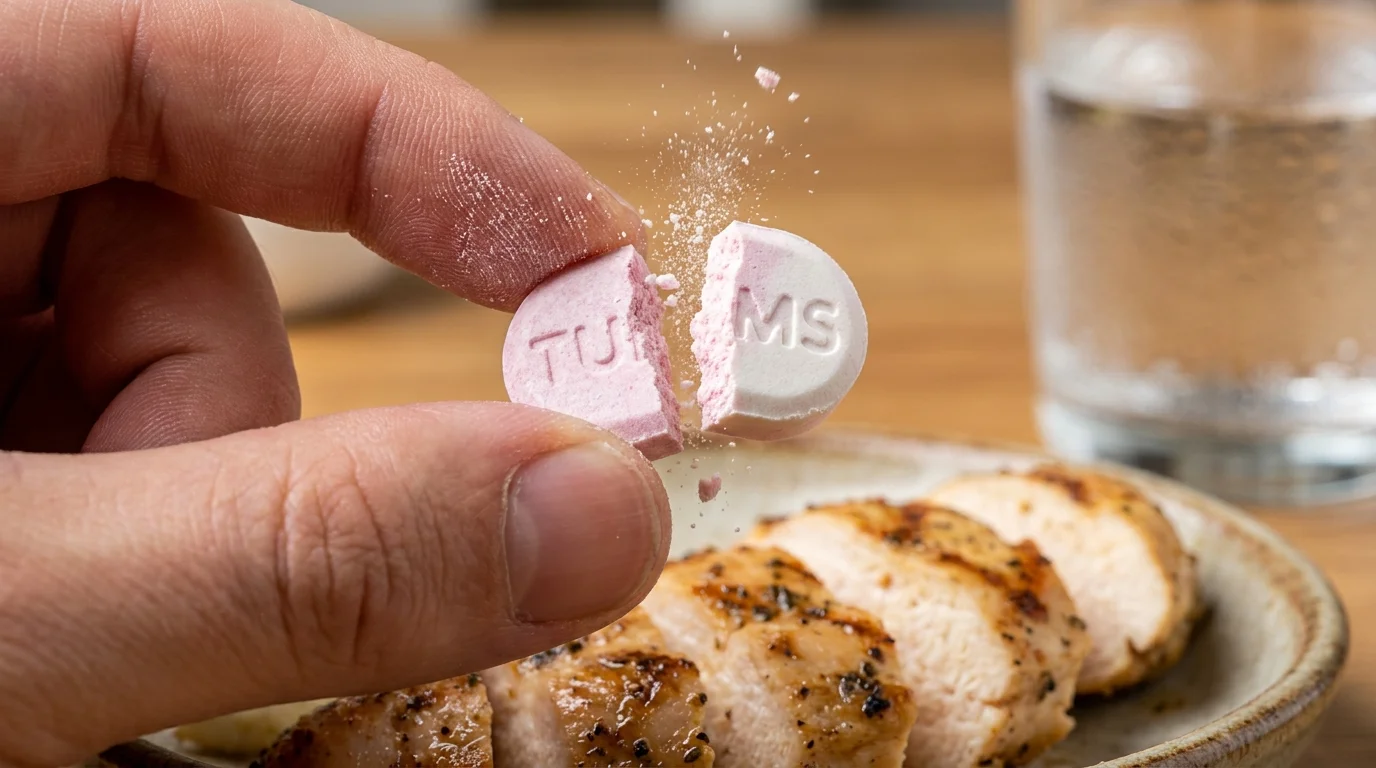
It starts with a dull, creeping warmth behind your breastbone twenty minutes after a hurried midday turkey club. Instinctively, your hand slides across the grain of your desk toward the plastic cylinder, flipping open the lid with a familiar snap. You pop two pastel-colored discs into your mouth, grinding down the chalky, artificial berry powder between your back molars and swallowing the gritty paste with a quick swig of water.
You expect the gentle cooling tide that television ads promised since childhood, the quiet extinguishing of an internal flare-up. Instead, within fifteen minutes, something inside your upper abdomen shifts from a localized burn into a rigid, drum-tight inflation. Your waistband suddenly feels two sizes too small, and taking a full breath feels like pressing against an overfilled inner tube lodged right below your solar plexus.
That sensation is not your lunch misbehaving; it is an engineered chemical traffic jam. By seeking instantaneous peace from minor heartburn, you inadvertently poured wet sand straight into an active combustion engine during the single most demanding phase of your digestive day.
The Chemical Trap: When Relief Snuffs the Fire
Think of your stomach not as a fragile holding tank prone to accidental irritation, but as an aggressive, pressurized forge. When you ingest dense animal proteins like turkey, steak, or eggs, your parietal cells pump hydrochloric acid into the gastric pool to drop the internal pH down toward a biting 1.5 to 2.0. This violent bath is necessary because the enzyme pepsin, your body’s primary molecular scalpel for slicing tough protein chains into digestible peptides, refuses to activate in any environment less harsh than battery acid.
When you chew down a blast of calcium carbonate—the active backbone of Tums chewable tablets—you trigger a fierce chemical collision. The basic calcium compound acts like a chemical fire extinguisher dropped into the forge, snapping the acidity upward toward a benign, neutral pH in a matter of seconds. While the burning sensation at your lower esophageal sphincter vanishes, the molecular protein scalpel drops dead.
Deprived of the acidic fire needed to uncoil complex proteins, your stomach contents sit motionless, suspended in a warm alkaline soup. Worse, the chemical neutralization reaction between calcium carbonate and stomach acid produces an immediate, copious volume of carbon dioxide gas. Trapped beneath an esophageal valve that remains tightly shut, that carbon dioxide has nowhere to escape, puffing your upper gut out like a basketball while undigested food begins to ferment in place.
- Progressive reading glasses tilt your chin backward triggering stubborn base skull throbbing
- Titanium dioxide coatings in daily capsules resist stomach breakdown sparking chronic belly bloat
- Tight trouser waistbands compress lower ribcage space triggering sudden midday chest tightness
- Cold water gargling overrides racing pulse spikes during lonely moments of panic
- Textured watch bands ground sudden workplace anxiety spikes without drawing room attention
Dr. Marcus Rowe, a 48-year-old integrative gastroenterologist practicing in Denver, spends his afternoons reviewing endoscopic scans of adults who swear they have developed sudden food intolerances in their forties. “Almost three times a week, I meet patients who describe an agonizing, stone-like bloating that hits like clockwork by two in the afternoon,” Dr. Rowe notes. “When we trace their habits, nearly every single one keeps a family-sized bottle of chewable antacids right beside their keyboard, chewing two tablets the moment they swallow their final bite of chicken wrap. They are chemically freezing their gastric juices mid-stride.”
Adjustment Layers: Matching Your Biology to Your Plate
Not every digestive flare-up requires an antacid hammer, and your reaction depends heavily on what you just ate.
The Fast Desk Lunch
Eating cold deli cuts, rotisserie chicken, or dense protein salads while typing creates an automatic posture slump that pushes gastric contents upward. Popping a chewable tablet here creates instant misery because cold fats and dense poultry demand intense acid churning. If you feel that familiar warmth after a desk meal, stand up, pace your hallway for five minutes, and let gravity anchor your stomach juices instead of reaching for chalky calcium.
The High-Fat Evening Feast
Rich dinners involving butter, red meat, or heavy garlic slow gastric emptying naturally, keeping food in the stomach far longer than usual. When you load chewable calcium over a fatty meal, you trigger hypochlorhydric stagnation: dense fats coat the stomach lining, the acid is neutralized, and the resulting carbon dioxide bubbles get trapped in viscous lipid emulsions, provoking hours of stubborn, non-productive pressure.
The Empty-Stomach Habit
Many chew antacids between meals out of pure sensory reflex or mild nervous tension. Without solid protein to absorb or buffer the sudden calcium load, your gastric lining senses the abrupt disappearance of acid and triggers a panicked neuro-hormonal rebound, ordering parietal cells to flood the chamber with an even larger wave of acid forty minutes later.
Mindful Relief: The Tactical Upper-Gut Reset
Recovering from trapped gas and stalled gastric breakdown requires stepping away from instantaneous chemical erasers. Your goal is to guide digestion, not paralyze it.
- Keep your spine elongated for forty-five minutes post-meal to give your natural esophageal flap gravity assistance.
- If you must use calcium carbonate chewables, delay them until at least ninety minutes after your final bite of dense protein.
- Sip warm ginger-infused water to stimulate gastric motility rather than neutralizing your stomach’s natural chemistry.
- Engage your diaphragm with slow, nasal breaths that gently massage the vagus nerve and encourage downward gut peristalsis.
Your immediate recovery toolkit requires precision. Set a timer for ninety minutes after dense meals before considering any antacid tablet. Ensure your fluid intake during meals stays under six ounces, and maintain an upright seating angle of at least one hundred degrees rather than slouching over your keyboard.
Listening to the Internal Engine
Living comfortably inside your body is rarely about silencing every transient physical sensation with an over-the-counter fix. That sharp warmth behind your ribs is an informative dashboard light, signaling that your stomach is working overtime to dismantle a complex meal under hurried, high-stress conditions. By learning to support the acidic fire rather than immediately smothering it with chalky tablets, you protect your digestive integrity, flatten that agonizing afternoon belly bulge, and restore quiet ease to your working hours.
“Stomach acid is not an accidental design flaw to be erased, but the primary engine of your digestive furnace.”
| Key Point | Detail | Added Value for the Reader |
|---|---|---|
| Immediate Neutralization | Calcium carbonate shifts gastric pH from 1.5 to above 4.5 instantly. | Explains why protein breakdown stalls completely when tablets are taken mid-meal. |
| Carbon Dioxide Release | The acid-base neutralization creates rapid CO2 gas expansion. | Identifies the exact scientific mechanism behind painful upper-belly bloating. |
| Delayed Administration | Waiting 90 minutes allows pepsin to complete primary protein digestion. | Provides an actionable timeline that protects digestion while still soothing late reflux. |
Frequently Asked Questions
Why do Tums cause gas if they are meant to soothe the stomach?
Calcium carbonate chemically reacts with hydrochloric acid to produce calcium chloride, water, and carbon dioxide gas, which rapidly inflates the upper stomach cavity.How long should I wait after eating before taking an antacid?
Wait at least 60 to 90 minutes after eating dense protein meals so your natural stomach acid can complete primary enzymatic breakdown.Does drinking water help relieve antacid bloating?
Sipping warm, room-temperature water can help relax the esophageal sphincter, whereas chugging cold water slows stomach motility and worsens distension.Can chewing fewer tablets prevent trapped gas?
Yes, taking a single tablet rather than two or three reduces the total volume of carbon dioxide generated by the chemical neutralization reaction.What is a better alternative for immediate heartburn relief after lunch?
Standing upright, loosening tight waistbands, and sipping a small amount of warm ginger tea encourages gastric emptying without neutralizing vital stomach acid.