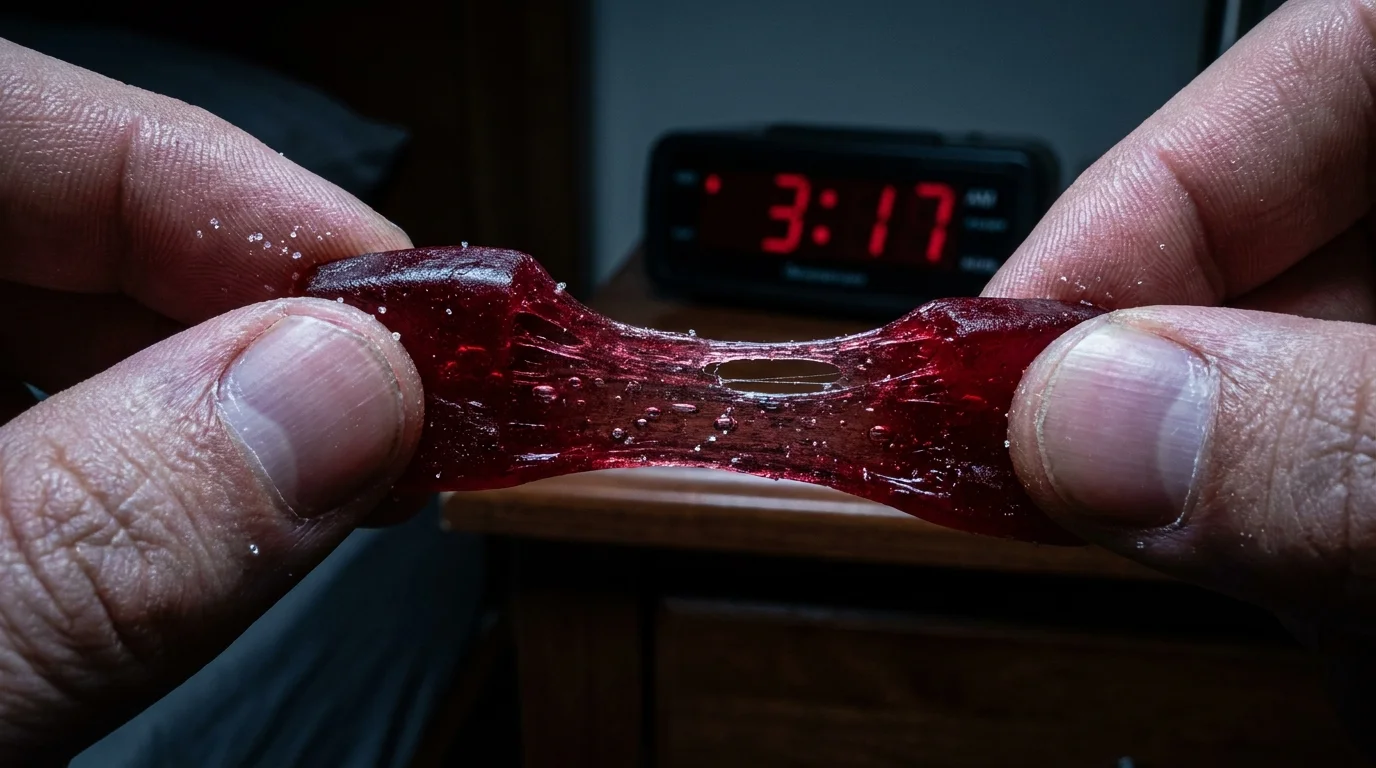
The bedroom is quiet, cold, and dark. The white noise machine hums its low, steady frequency against the baseboards, and your sheets feel crisp against your skin. You did everything right before climbing under the covers: dim lights two hours prior, no late emails, and two ruby-red, sugar-dusted tart cherry gummies chewed slowly while reading on the sofa. You slipped into sleep within twenty minutes, drifting off into a smooth, effortless descent.
Then, the snap happens. It is exactly 3:14 AM. Your eyes fly open in the pitch black as if an alarm bell clanged inches from your ear. There is no lingering grogginess, no soft slide toward morning, just an instantaneous, cold wakefulness that feels startlingly sharp. Your covers feel suffocating, the room seems suddenly airless, and your ribs vibrate with an aggressive, rhythmic thump.
You press two fingers against your neck and feel your pulse skipping forward like a startled horse. Your mind races through tomorrow’s calendar, yesterday’s conversations, and invisible domestic emergencies. You are not just awake; you are chemically primed for confrontation, staring at the ceiling fan while wondering why a natural fruit extract intended to soothe you has left you stranded in neurological hyperdrive.
The Metabolic Cliff: Why Evening Concentrates Turn Against the Clock
When you eat a concentrated sleep gummy, you are not simply taking in a whisper of plant medicine. You are introducing a potent biochemical combination: exogenous melatonin precursors, intense anthocyanin pigments, and a rapid hit of cane sugar or tapioca syrup. Your body absorbs this cocktail with remarkable speed, leading to a swift drop in core body temperature and an immediate dip into slow-wave rest. But what feels like a gentle lullaby is actually a steep physiological curve.
Think of it like throwing a dry pine log onto a dying campfire. It catches instantly, throwing off an intense, crackling heat that warms the clearing for forty minutes, only to burn down to cold ash while the midnight wind is still blowing. Whole foods digest slowly, metering out their nutrients as the digestive tract works through fiber, pulp, and complex structures. In contrast, gelatin-bound botanical extracts burn through your hepatic clearance pathways in a fast, front-loaded surge.
As your liver clears the concentrated compounds midway through your sleep cycles, the artificial sedation abruptly vanishes. Your autonomic nervous system experiences this rapid drop-off not as a peaceful transition back to baseline, but as an emergency withdrawal. Sensing the sudden drop in circulatory support, your adrenal glands release a compensatory pulse of cortisol and epinephrine to keep blood pressure stable. The result is visceral: your vascular walls tighten, your heart rate jumps twenty beats per minute, and you snap awake with your sympathetic nervous system fully engaged.
- Ultrasonic mist diffusers trigger sudden raspy coughing fits during afternoon calls
- Evening calcium supplements stall restful sleep by clashing with natural overnight clearance
- Freezing cold showers after workouts spark stubborn next-day morning joint stiffness
- Infrared sauna cabins trigger sudden midday dizzy spells and chest tightness
- Liquid I.V. packets trigger sudden morning dry mouth and muscle twitches
The Case of the Night-Shift Architect
Elena Vance, a 42-year-old architectural drafter from Denver, spent six months caught in this exact midnight loop. Straining under the pressure of tight commercial deadlines and dry high-altitude air, she turned to tart cherry gummies after hearing wellness creators praise their natural anti-inflammatory qualities and rich melatonin profile. Every evening at 9:30 PM, she took two extra-strength chews, falling asleep effortlessly by 10:15 PM, only to bolt upright at 2:45 AM every single night without fail.
“I thought my anxiety was finally catching up with me,” Elena explained during an informal sleep tracking trial. “I would wake up drenched in a light sweat, with my chest hammering like I had sprinted across the street. I kept increasing my gummy dose from two to three, thinking my insomnia was worsening, which only made the 3:00 AM panic surge hit twice as hard.” When lab analysis of her midnight metabolic clearance revealed rapid glucose plummeting paired with early-phase clearance spikes, the remedy became clear: her evening ritual was triggering an acute rebound shock.
Dialing in the System: Who Rebounds and Why
Not every body handles concentrated botanical gummies the same way. Your unique metabolic clearance rate, liver enzyme expression, and daily carb intake dictate whether these ruby chews act as a tranquilizer or an internal tripwire.
For the Fast Metabolizer
If you routinely process caffeine within three hours or find yourself ravenous ninety minutes after a carb-heavy breakfast, concentrated gummies are your worst nighttime match. Your liver processes the active polyphenols and sugar binding agents before your second sleep cycle finishes, leaving you metabolically abandoned by 2:30 AM. Switching to whole-fat buffers alongside any evening supplement prevents this sudden clearance drop.
For the Glucose-Sensitive Sleeper
Many adults over thirty-five experience nocturnal reactive hypoglycemia without realizing it. Even the modest three to five grams of sugar in a pair of bedtime gummies can spark a rapid insulin response during the first hour of sleep. When circulating blood sugar crashes around the three-hour mark, your brain demands glucose immediately, prompting the liver to trigger glycogen release through an adrenaline dump that sets your heart racing.
For the Histamine-Prone System
Tart cherries are naturally rich in amines and can provoke mild histamine responses in sensitive guts, particularly when concentrated into dense chews. Nocturnal histamine release peaks naturally around 3:00 AM; piling supplemental dietary amines on top of that natural wave often manifests not as hives, but as unexplained internal heat, nasal stuffiness, and sudden, restless waking.
The Mindful Nighttime Reset: Rebuilding Sustained Rest
Reclaiming smooth, unbroken sleep does not mean you must discard tart cherry entirely. It means moving away from fast-absorbing confections and creating a sustained metabolic runway that supports your physiology through the entire night.
- Shift the timing: Consume any cherry-based support ninety minutes before dinner rather than thirty minutes before bed, allowing your system to integrate the polyphenols while active digestion is still underway.
- Anchor with healthy fat: If using a botanical aid late in the evening, pair it with a spoonful of raw almond butter or unsweetened coconut cream to slow gastric emptying and smooth out hepatic absorption.
- Ditch the chewable sugar: Replace gummy preparations with cold-pressed, unsweetened tart cherry juice diluted into eight ounces of room-temperature sparkling mineral water.
- Track the heart rate curve: Use an analog pulse check or a basic wearable to observe whether your resting heart rate spikes two to four hours after your evening routine.
By treating evening nutrition as a slow burn rather than a quick biochemical switch, you eliminate the sudden cliff that jolts your heart into your throat.
The Bigger Picture: Trusting the Body’s Natural Rhythms
Modern wellness culture often encourages us to treat sleep like an electronic device that can be toggled off with a chewable treat. We look for immediate sensory feedback—a sudden heaviness in the eyelids, a sweet bedtime candy, a quick descent into unconsciousness. Yet real, restorative rest is an organic tide, not an electrical switch. It relies on a delicate balance of blood sugar stability, gentle thermal regulation, and steady neurotransmitter shifts that unfold over seven or eight continuous hours.
When you stop reaching for concentrated quick fixes that shock your system halfway through the night, you give your liver and adrenals permission to stay quiet. True sleep security comes not from knocking yourself out, but from setting the conditions that allow your body to glide smoothly across the midnight divide without setting off internal alarms.
The goal of evening nourishment is not to force unconsciousness, but to provide a quiet, steady fuel that lets the nervous system remain invisible until dawn.
| Key Point | Detail | Added Value for the Reader |
|---|---|---|
| Clearance Latency | Concentrated chews metabolize completely within 180 to 240 minutes. | Helps you identify that midnight waking is a biological clearance event, not anxiety. |
| Glycemic Rebound | Binder sugars cause an early insulin spike followed by a mid-sleep glucose dip. | Explains why your heart pounds as cortisol mobilizes backup glycogen stores. |
| Whole-Form Buffering | Diluted juice paired with dietary fats slows gastrointestinal transit time. | Maintains continuous micro-nutrient delivery across all non-REM cycles. |
Frequently Asked Questions
Why does my heart beat so fast when I wake up at 3:00 AM?
When concentrated supplements wear off abruptly, your blood sugar and blood pressure drop slightly, prompting your adrenals to release a compensatory surge of cortisol and adrenaline to keep you stable.Are tart cherry gummies worse than regular melatonin pills?
They present unique challenges because they combine fast-clearing exogenous compounds with simple sugars, creating both a chemical drop-off and a glycemic dip simultaneously.Can I take tart cherry gummies during the day instead?
Yes, taking them with an afternoon meal allows you to benefit from the anti-inflammatory anthocyanins without triggering mid-sleep clearance spikes.How long does it take for rebound awakenings to stop after quitting gummies?
Most people find their midnight heart rate stabilizes and sleep continuity returns within two to three nights of removing rapid-release evening chews.What is the best alternative if I still want the joint benefits of tart cherry?
Opt for unsweetened, freeze-dried whole tart cherry skins or two ounces of pure juice taken with dinner, surrounded by fiber, protein, and healthy fats.