The bedroom clock glows 2:14 AM with a pale, cold luminescence. The house is dead quiet, your blankets are warm, and you have finally drifted into that restorative, heavy phase of slumber where your breathing slows to a crawl. Then, without an instant of warning, a lightning strike rips through your lower leg. Your toes curl violently backward toward your shin, the calf muscle bunches into a rock-hard fist under your skin, and you sit bolt upright in bed, clutching your leg while trying not to cry out loud into the dark.
You instinctively reach for the tall glass of plain tap water resting on your nightstand, downing half of it in desperate gulps. You have been told your entire life that muscle knots are simply dehydration, a signal that you failed to drink enough pure water between sunrise and sunset. Yet five minutes later, as you gingerly try to stretch your heel against the floorboards, the dull, electric flutter remains coiled deep inside the muscle belly, waiting to seize the moment your head touches the pillow again.
Here lies the quiet contradiction that frustrates millions of light sleepers and athletes alike: chugging large volumes of plain, filtered water right before bed does not halt nocturnal cramps. In truth, flooding an already depleted cellular system with unmineralized fluid often makes the twitching worse. When your calf fibers seize in the dead of night, they are not starving for volume; they are suffocating in an electrical blackout.
The Cellular Lock: Why Your Muscles Clench in Plain Water
To understand why a nocturnal spasm occurs, think of your muscle tissue not as a dry sponge waiting for a soak, but as a finely tuned wet battery. Every single time your calf contracts and relaxes, microscopic gates along the cellular wall open and shut, trading electrical charges between sodium, potassium, and magnesium. This microscopic exchange is known as the sodium-potassium pump, and it runs entirely on balanced osmotic pressure.
When you spend your day drinking purified municipal water or reverse-osmosis water, you flush your kidneys while gradually thinning out the mineral density of your bloodstream. By the time you kick off your slippers and lie flat, gravity shifts pooled fluids from your lower extremities back toward your core. If your blood serum lacks sufficient ionic salts, the motor nerve terminals in your calves become hyper-excitable. They fire frantic, repetitive misfire signals. Without the mineral ions needed to disengage the contraction, the muscle locks down in a painful, sustained cramp.
This is where unrefined sea salt changes the equation completely. Unlike industrial table salt, which has been stripped of its companion minerals, bleached, and dusted with anti-caking chemicals, raw unrefined salt harvested from ocean beds retains a damp, gray, or soft pink hue. It carries a complete spectrum of sixty-plus trace elements, including natural magnesium, potassium, and calcium bound in a crystalline lattice that your body recognizes immediately.
The Field Secret: Lessons from an Arizona Trail Coach
Clara Hayes, a 48-year-old walking coach and former rehabilitation assistant in Flagstaff, Arizona, spent years watching her endurance walkers suffer through midnight charley horses despite carrying three-liter hydration bladders. Her clients drank water constantly, yet they spent their nights pacing hardwood floors with throbbing calves and arch spasms. The turning point arrived when Clara consulted with a veteran desert physiologist who pointed out that the walkers were literally washing the conductile salts out of their interstitial fluid. Clara instructed her walkers to keep a small lidded dish of coarse, damp Celtic sea salt beside their beds, instructing them to take a measured pinch dissolved in a few sips of warm water before blowing out the light. Within three nights, over ninety percent of her clients reported unbroken sleep without a single involuntary contraction.
- Crushed fennel seeds steeped in warm water switch on sharp morning focus
- Plain filtered water triggers sudden dizzy room spins when standing from desks
- Zinc cold lozenges trigger sudden afternoon temple throbbing and metallic mouth tastes
- Tart cherry gummies spark jarring midnight wakeups with sudden racing pulses
- Ultrasonic mist diffusers trigger sudden raspy coughing fits during afternoon calls
Targeted Solutions: Matching Mineral Ratios to Your Daily Strain
No two pairs of legs endure the same daily stress, meaning your bedtime mineral reset should reflect how you spent your daylight hours.
For the Office Worker Bound to a Desk
If you spend seven to nine hours seated in an office chair, circulation through your femoral veins slows dramatically, causing fluid to settle around your ankles while your hip flexors remain shortened. When you lie down, this fluid redistributes quickly, diluting local electrolyte concentrations in the calf and arch. You do not need large quantities of sodium; you need rapid mucosal absorption to balance resting membrane potential.
Dissolve a micro-pinch of unrefined gray salt—roughly the size of two sesame seeds—into just three ounces of warm water. Sip it slowly thirty minutes before lying down, allowing your mouth tissues to absorb the trace minerals before the fluid even reaches your stomach.
For the Evening Exerciser and Sauna User
Those who lift weights, run, or take hot showers late in the day sweat out substantial amounts of sodium and chloride, leaving their nervous systems in an agitated state of post-exercise dehydration. Replenishing pure ionic minerals before bed prevents the delayed-onset nocturnal seizing that typically strikes around 3:00 AM.
Use a slightly more robust measure: one-sixteenth of a teaspoon of unrefined pink or gray salt dissolved in four ounces of room-temperature water, paired with a small squeeze of fresh lemon juice. The natural trace citric acid aids mineral transport across the gut barrier without triggering nighttime bladder urgency.
For the Mature Sleeper Prone to Cold Feet
As we age, peripheral capillary circulation becomes less elastic, meaning cooler night air can provoke mild vasoconstriction in the toes and lower calves. Cold tissue combined with low mineral concentration is the premier recipe for agonizing arch spasms. In this situation, drinking cold water is counterproductive, as it shocks the stomach and prompts further vascular narrowing.
Prepare your salt water with warm, near-tea-temperature water. Hold each mouthful for five seconds under the tongue before swallowing to let the rich sublingual vascular bed take up the trace minerals immediately.
Mindful Application: The Bedside Saline Protocol
Executing this technique requires precision. Dumping half a teaspoon of table salt into a pint of water will simply upset your stomach and send you running to the bathroom at midnight. The goal is isotonic gentleness, not heavy brine.
Keep a small, airtight amber glass jar of coarse unrefined sea salt on your nightstand alongside a small ceramic drinking cup.
- Measure exactly 4 ounces of clean, room-temperature or lukewarm water (ideally around 70°F to 75°F). Never use ice-cold water, which slows gastric emptying.
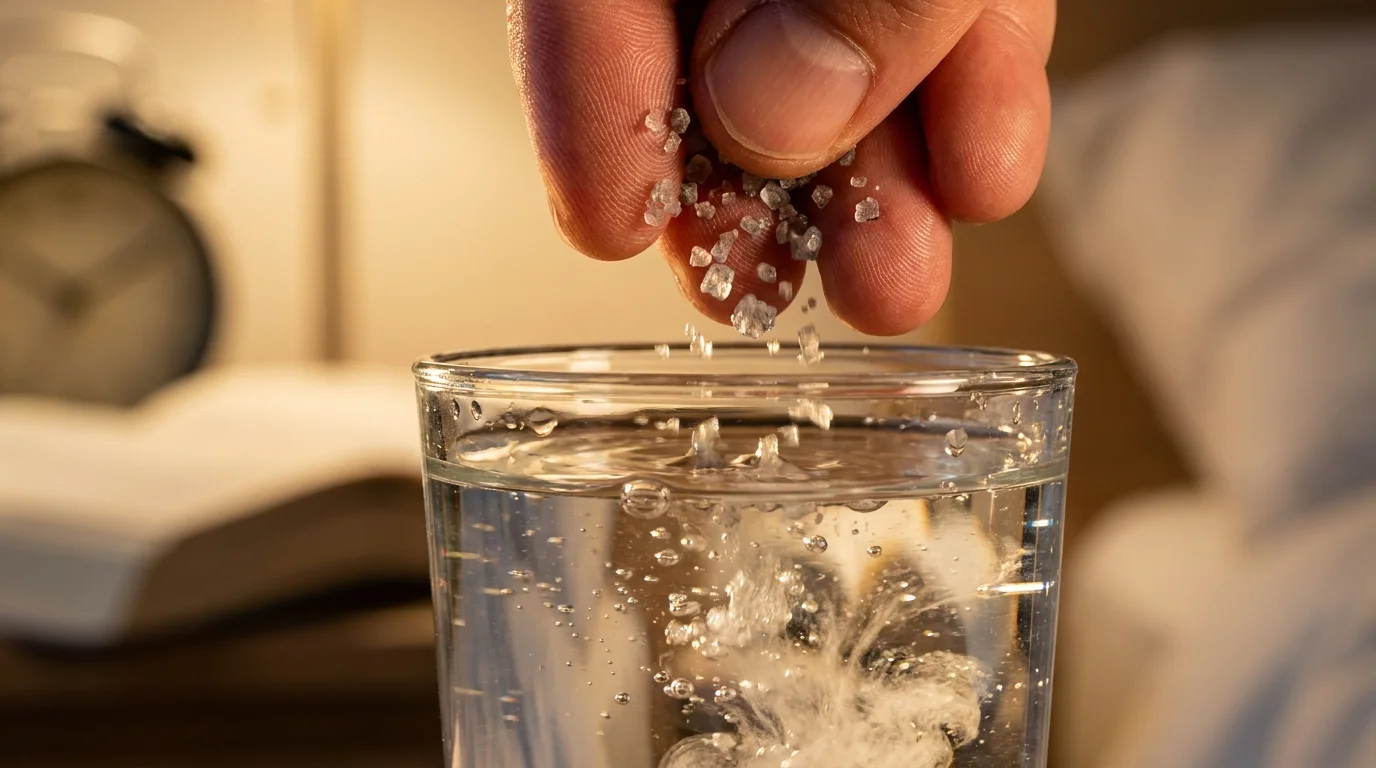
- Pinch unrefined sea salt between your thumb and forefinger—aiming for roughly 1/16 teaspoon (about 0.35 grams of damp, mineral-rich salt).
- Drop the crystals into the water and stir for 20 seconds with a small spoon until the water turns faintly cloudy and the salt mostly dissolves.
- Drink the solution forty-five minutes to one hour before turning out your bedside lamp, taking deliberate, measured sips.
- If a sudden spasm strikes in the middle of the night, keep a second pre-measured pinch handy: dissolve it under your tongue directly with just two tablespoons of bedside water for rapid relief within three minutes.
By keeping the water volume low, you avoid interrupting your sleep architecture with bathroom trips while delivering the exact ionic charge your leg muscles need to remain loose and calm until dawn.
The Bigger Picture: Reclaiming Restful Autonomy
There is profound peace of mind in knowing you hold a simple, pantry-born solution to an intensely painful physical problem. Waking up to agonizing muscle knots leaves an invisible psychological residue; you begin going to bed with an undercurrent of dread, waiting for your limbs to betray you the moment you relax. By understanding that a cramp is merely an electrical conversation between salt and muscle fiber, you step out of helplessness and into calm control. With nothing more than a tiny pinch of clean ocean mineral and a teacup of water, you give your nervous system the baseline quiet it needs, ensuring your nights belong entirely to deep, unbroken stillness.
The muscle does not seize because it lacks plain water; it locks when the electrical spark that commands it to let go dissolves into dilute silence.
| Key Point | Detail | Added Value for the Reader |
|---|---|---|
| Mineral Composition | Unrefined sea salt retains 60+ trace minerals like magnesium and potassium. | Restores the sodium-potassium electrical pump rather than just flooding tissues with fluid. |
| Optimal Volume Ratio | 1/16 tsp (0.35g) dissolved in 4 oz of lukewarm water. | Calms twitching fibers within minutes without waking you up to use the bathroom. |
| Temperature Strategy | Lukewarm water (70°F to 75°F) rather than ice-chilled water. | Prevents gastric shock and micro-vascular constriction, speeding sublingual absorption. |
Frequently Asked Questions
Will drinking salt water before bed spike my blood pressure overnight?
A micro-pinch of unrefined sea salt contains approximately 120 to 140 milligrams of sodium, which is a fraction of a standard meal and well within safe limits for most adults. Because it is bound with trace potassium and magnesium, it supports gentle cellular balance rather than acute fluid retention.Why can I not simply use regular table salt from the kitchen shaker?
Standard table salt is heavily processed sodium chloride stripped of its natural trace mineral lattice, often coated with chemical anti-caking agents that do not provide the ionic diversity required to relax tense muscle fibers.How quickly does this bedtime salt solution work on an active cramp?
When taken sublingually or in a few warm sips, trace mineral absorption begins immediately through the mucous membranes of the mouth and upper stomach, typically easing involuntary twitches within three to five minutes.Can I combine this sea salt pinch with my nightly magnesium supplement?
Yes, unrefined sea salt works synergistically with magnesium. The sodium ions act as co-transporters, helping your intestinal lining absorb oral magnesium forms like glycinate or malate more effectively.What should I look for on the label when buying unrefined sea salt?
Look for salts that appear slightly damp, gray, or mineral-flecked, labeled as raw, unrefined, or hand-harvested Celtic or Himalayan sea salt, with zero anti-caking additives or bleaching agents listed in the ingredients.