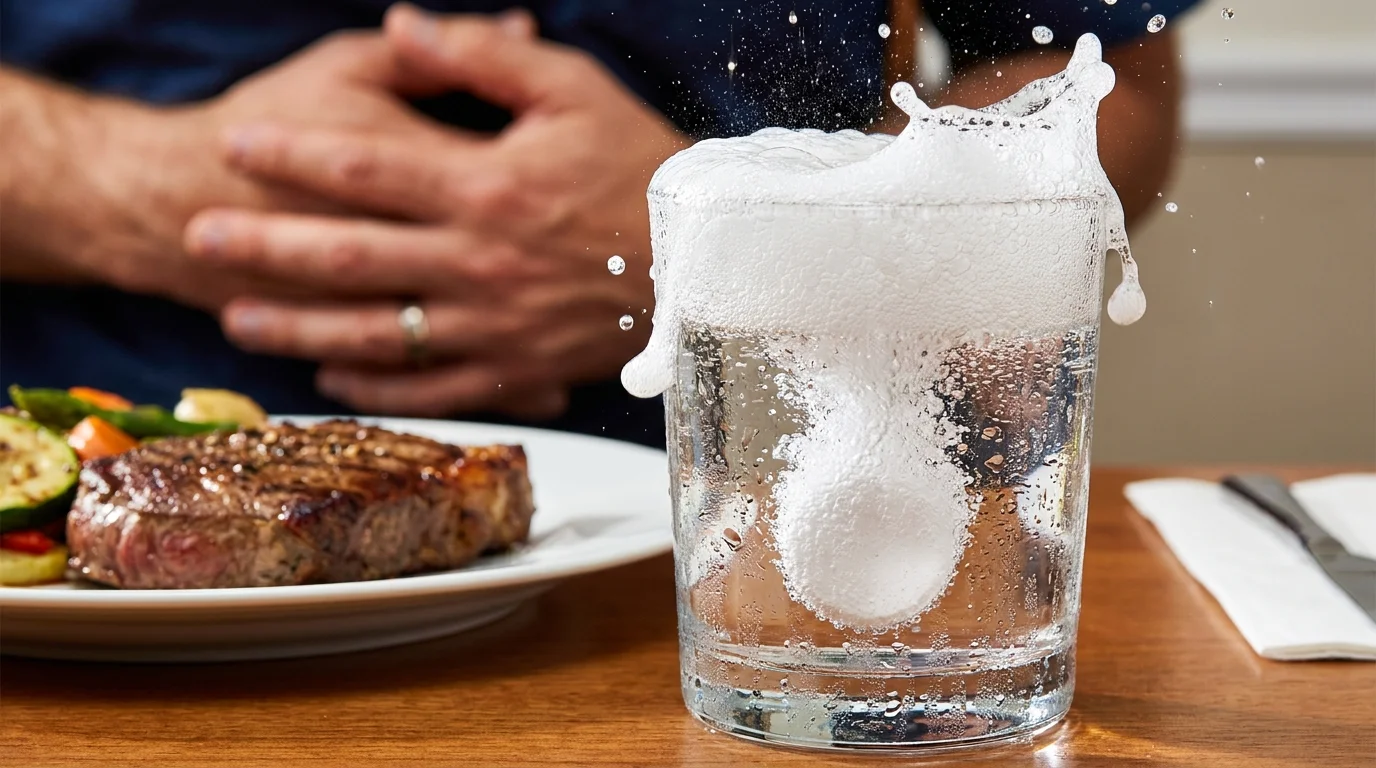
The fizz begins with a sharp hiss against the water glass, dropping tiny white pinpricks of foam that swirl and dissolve within seconds. You reach for it right after scraping your dinner plate clean, feeling that telltale warmth rising in your throat after a rich, seared steak or a heavy bowl of garlic pasta. The glass hits the counter empty, the sharp tang of artificial citrus leaves your tongue, and you wait for the immediate hush that standard drugstore packaging promises.
Instead, twenty minutes later, your ribs feel as though someone wedged a bike tire beneath your sternum and slowly pumped it full of compressed air. Your stomach sits heavy, dense, and immovable, hovering just under your chest bone like an unworked lump of cold dough. You did what millions of people across the country do every single evening, reaching for effervescent antacid tablets to put out the fire before it spread, yet your midsection feels tighter, larger, and more tender than it did when you finished your meal.
What felt like quick relief on paper has quietly hijacked the most delicate chemical cascade in your torso. When you drop those twin white rounds into cool water, you are drinking a fast-acting chemistry set designed to wipe out hydrochloric acid on contact. But stomach acid was never your enemy; it is the violent, protective kiln your body relies on to tear apart dense protein strands and protect your gut from unwanted bacterial chaos.
By flooding your digestive chamber with dissolved bicarbonates while it is trying to process a dense dinner, you shut off protein breakdown and ignite an immediate pressure trap that pushes upward against your diaphragm.
The Quenched Kiln: Why Neutrality Is a Trap
Think of your stomach during an evening meal as an active, charcoal-fired furnace. The thick muscular walls churn rhythmically, bathed in concentrated hydrochloric acid with a razor-thin pH between 1.5 and 2.0. This biting acidity does not exist to punish you; it activates pepsin, the specialized biological shear that cleaves tough meat fibers, beans, and melted cheese into microscopic building blocks before they pass down into your small intestine.
When you drop effervescent antacid tablets into that churning crucible, the sodium bicarbonate immediately absorbs free hydrogen ions to neutralize the acidity. The thermometer drops to room temperature, figuratively speaking, and your enzyme shears go completely dull within ninety seconds. The digestive kiln goes out cold, leaving your half-chewed steak sitting in an inert pool of cloudy fluid with nowhere to go.
At the exact same instant, the neutralization reaction produces an enormous volume of trapped carbon dioxide gas deep within your stomach chamber. In an empty stomach, that gas might escape with a simple, quiet burp. But when sealed beneath a heavy cap of warm dinner fats and half-dissolved food, that expanding gas creates sudden mechanical backpressure, ballooning against your lower esophageal sphincter and mimicking the very heartburn you tried to erase.
- Zero-sugar sports drinks delay standing blood flow sparking sudden dizzy room spins
- Silicone jaw exercisers trigger sharp temple throbbing and strange metallic mouth tastes
- California poppy tinctures trigger jarring 3:00 AM awakenings and racing nighttime pulses
- Clip-on reading lenses tilt neck angles triggering sharp dull skull throbbing
- Pressed multivitamin fillers resist stomach breakdown sparking heavy afternoon belly bloat
The Line Cook’s Sudden Epiphany
Marcus Vance, a forty-two-year-old banquet cook from Denver, lived this nightly ballooning cycle for nearly three years. After twelve-hour shifts spent plating roasted short ribs and buttered polenta, Marcus would sit down around 10:30 PM to eat his only substantial plate of the day. Within fifteen minutes of wiping his fork clean, the sour flutter in his throat would appear, and he would dissolve two effervescent tablets into a tumbler of iced water, downing it before pulling off his boots.
“By midnight, my chest was so tight I couldn’t lean back against my pillows without feeling like my ribs were splitting apart,” Marcus shared during a metabolic review. He assumed his evening reflux had progressed into an aggressive ulcer, but his endoscopic scans consistently showed unblemished, intact tissue. The culprit was not an excess of acid eroding his tissue, but rather a nightly mechanical stall: Marcus was freezing his protein digestion mid-stride, forcing pounds of dense food to sit fermenting under a sealed dome of sodium bicarbonate gas.
Once Marcus stopped treating natural stomach acid like an accidental biological error, his midnight chest tightness vanished inside a week. He did not need stronger pharmaceutical shields; he simply needed to let his internal furnace burn long enough to finish the work he gave it.
The Two Sides of the Glass: Mapping Your Upper-Gut Strain
Not everyone experiences the sudden shock of effervescent tablets in the exact same manner. Your body’s response depends largely on what you just consumed, how fast you drank the dissolved solution, and the baseline strength of your natural digestive secretions.
For the Heavy Protein Diner
If your meal centered around beef, poultry, eggs, or dense legumes, your stomach requires maximum acid output to unfold those complex peptide coils. Gulping effervescent tablets within an hour of these dinners causes immediate enzyme paralysis. The undigested protein sits dormant in the neutral bath, drawing opportunistic microbes from the upper small intestine that feast on the stranded meal, releasing secondary foul gases that trigger stubborn, agonizing epigastric distension long after midnight.
For the Late-Night Grazing Worker
Those who eat smaller, carbohydrate-heavy snacks late at night face a different physical mechanical trap. The rapid carbonation from the effervescing tablets hits a lightly filled stomach and rapidly distends the stomach fundus—the flexible dome at the top of the organ. This sudden, violent stretch triggers the vagus nerve to signal false fullness while physically pushing the lower esophageal flap open, allowing neutral but irritating enzymatic froth to spill upward into the throat.
Mindful Steps to Free Your Digestive Furnace
Reclaiming your post-dinner comfort does not require suffering through genuine sour flares. It simply requires working in rhythm with your biology rather than throwing cold water onto the stove while dinner is still cooking. Use these practical, deliberate adjustments to handle fullness without triggering an upper-stomach pressure lock.
First, implement a thirty-minute grace period before reaching for any intervention. Allow your natural gastric secretions to complete their primary acid bath around your meal. If you feel warmth building, do not immediately extinguish it with foaming bicarbonates.
- Stand and lengthen your torso: Walk at an easy, unhurried pace for seven minutes. Gentle locomotion assists natural gastric peristalsis, keeping your meal moving toward the pyloric valve rather than sitting against your ribs.
- Sip room-temperature bitters: If you feel bloated, mix four drops of gentian root extract or unflavored digestive bitters into two ounces of warm water. Bitters stimulate your own natural bile flow and encourage down-gut motility without chemically wiping out your protective acid.
- Adopt the Left-Lateral Recline: If you must rest, lay exclusively on your left side with your torso propped up at a thirty-degree angle. This anatomical position keeps the stomach’s natural reservoir lower than the esophageal junction, using gravity to trap stomach contents naturally.
- The Warm Ceramic Compress: Place a warm, dry heating pad or hot water bottle across the solar plexus for ten minutes. The ambient heat draws micro-vascular blood flow back toward the stomach wall, easing digestive smooth muscle spasms.
Keep your emergency toolkit minimal and realistic. Discard the tall tumblers of foaming water. If you must use calcium or bicarbonate remedies for occasional acute distress, restrict their use to at least two full hours after your final bite, when the kiln has already broken down the bulk of your evening meal.
The Bigger Picture: Trusting the Body’s Fire
We live in a culture that treats every bodily sensation as an immediate manufacturing defect that demands chemical silencing. We feel the furnace doing its fiery, energetic work inside our chest cavity and immediately reach for an over-the-counter fire hose to put out the blaze. But true comfort does not come from forcing your body into artificial neutrality.
When you stop choking your digestion with premature effervescence, your meals stop lingering like lead weights in your upper abdomen. You sleep flatter, your breath stays quiet and easy through the night, and you wake up with an appetite that feels clean, clear, and ready for the day ahead. Listening to your internal fire instead of flooding it out transforms digestion from an anxious struggle into the effortless, silent background rhythm it was always meant to be.
“True digestive ease is never found by extinguishing your stomach’s natural fire, but by allowing that fire to finish its work unimpeded.”
| Key Point | Detail | Added Value for the Reader |
|---|---|---|
| Immediate Chemical Stall | Bicarbonates drop gastric acidity below the threshold where pepsin can cleave protein chains. | Prevents you from unintentionally stopping meat and dairy breakdown mid-digestion. |
| Trapped Gas Phenomenon | Neutralization yields high-volume carbon dioxide under a dense cap of dinner fats. | Explains why your ribs feel painfully swollen after drinking fizzy indigestion remedies. |
| Natural Digestive Recovery | Allowing a thirty-minute window restores baseline gastric churning and enzyme release. | Gives you an actionable, zero-cost routine that settles meals without medicine cabinet dependency. |
Frequently Asked Questions
Why do effervescent antacids make my stomach feel like an inflated balloon?
The active sodium bicarbonate in the tablets reacts violently with your stomach’s hydrochloric acid, producing substantial quantities of carbon dioxide gas. When this occurs directly after a meal, the gas is trapped beneath the weight of your food, creating intense mechanical tension against your upper abdomen and diaphragm.How long should I wait after eating dinner before taking an antacid?
You should wait at least ninety minutes to two hours following a meal before taking an acid-neutralizing agent. This crucial grace period allows your natural gastric acids and pepsin enzymes to thoroughly dissolve dense proteins and fats before the chemical environment is altered.Does drinking fizzy antacids cause food to rot in the stomach?
While food does not technically “rot” in the classical sense, neutralizing acid stalls normal enzymatic breakdown. This allows stranded carbohydrates and proteins to undergo hypochlorhydric fermentation by upper-gut bacteria, generating unpleasant secondary gases, sour burps, and prolonged abdominal heaviness.What can I do for immediate relief if I’ve already triggered this pressure?
Stand up and walk slowly around your living space to encourage gas transit, avoid lying flat on your back, and sip two ounces of warm, uncarbonated peppermint or ginger tea. Gentle heat applied to your midsection will also help relax the tight gastrointestinal smooth muscles holding the gas in place.Are chewable calcium antacids safer than effervescent tablets after heavy meals?
Chewable calcium tablets produce far less instantaneous carbon dioxide gas than effervescent liquids, but they still neutralize stomach acid and halt protein digestion if taken right after dinner. The best practice remains waiting for the initial digestive wave to pass before introducing any alkaline remedy.