The house settles into silence around midnight, but the air against your neck feels thick, stubbornly refusing to yield. You run your hand across the cotton sheet, hunting for a dry patch of fabric, while the digital readout on the thermostat downstairs insists the house sits at an ideal sixty-eight degrees. Yet in your bedroom, the atmosphere is heavy and stagnant, lingering like breath held too long inside an attic.
You kick a foot out from beneath the duvet, seeking the cool draft that usually hugs the baseboards, only to find a dull, tepid stillness. Most people assume the problem lies with their mattress materials, their thread count, or an aging condenser unit rattling outside the window. They adjust the ceiling fan, spin the blades faster, and wind up merely recirculating the same warm blanket of air over their face.
The real culprit is far quieter, built right into the perimeter of your walls. Just three feet from your head, behind painted hollow-core wood, a massive volume of daytime heat sits sealed in the dark, silently radiating outward long after dusk.
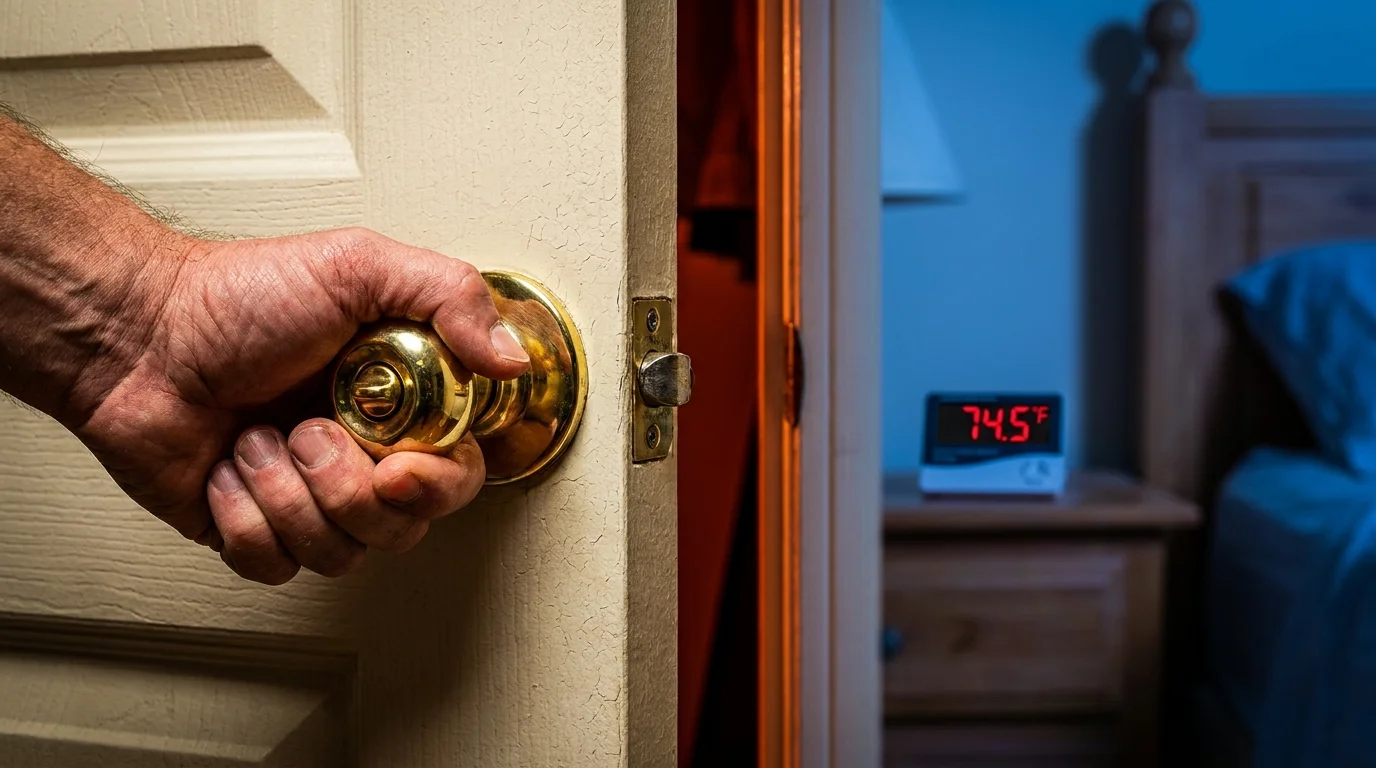
When you shut your bedroom closet doors before turning out the lamp, you are not tidying up your sanctuary. You are turning a cavernous storage hollow into an insulated heat battery that slowly discharges thermal energy right into your breathing zone until morning arrives.
The Thermal Vault: Why Your Wardrobe Is a Secret Radiator
Homes breathe in rhythm with the sun, expanding under midday radiance and contracting as evening chill settles over the roofline. Walls absorb this solar load, transferring kinetic thermal energy directly into the interior cavities of the structure. While your central air conditioning scrubs heat from open, flowing spaces where supply vents churn, dead zones receive zero circulation.
Your closet is the largest dead zone in the sleeping quarters. Packed tight with hanging denim, woolen sweaters, stacked shoe bins, and fiberboard shelving, this enclosed space acts as an enormous sponge for ambient daytime heat. Fabrics possess an exceptionally high thermal mass; they trap warmth slowly throughout the daylight hours and surrender it with agonizing reluctance.
By sealing those doors shut at bedtime, you create an inadvertent thermal pressure cooker. The air conditioning chills the exposed center of your bedroom, satisfying the wall sensor and shutting down the compressor. Meanwhile, the confined air inside the wardrobe stays trapped at seventy-four or seventy-six degrees. The thin wooden doors cannot stop the transfer. They warm up, turning into low-temperature radiant heating panels that leak convective warmth across your carpet precisely when your core body temperature needs to drop.
- High counter stools strain pelvic alignment sparking throbbing lower back stiffness
- CDC meningitis directives overhaul college dormitory screening standards after sudden regional infection clusters
- Warm oatmeal compresses calm angry itchy eczema flares without harsh steroid creams
- Baking soda pastes draw out deep wood splinters without painful tweezers
- Effervescent antacid tablets halt meal breakdown triggering painful upper stomach pressure
Cracking those panels breaks the seal, allowing the microclimate to equalize while the central cooling cycle is still active. Instead of suffering an invisible radiator next to your pillow, you allow that dense air to slip out, mix with circulating airflow, and get drawn into the return duct before you ever close your eyes.
The Austin Architectural Discovery
Dan Myers, a 44-year-old architectural thermal auditor based in Austin, Texas, spends his workdays peering through high-resolution infrared lenses at homes struggling with soaring electric bills. Last July, while diagnosing persistent upper-floor sleep complaints for clients whose thermostats read cool despite sweltering master suites, he noticed an unmistakable pattern on his monitor.
Behind closed six-panel sliding doors, closets routinely registered six to eight degrees warmer than the adjoining bed frames at midnight. The heavy garments acted like brick fire-hearths, storing solar energy that seeped through exterior uninsulated studs. By coaching homeowners to leave their interior utility and wardrobe passages cracked four to six inches during the evening cool-down phase, Myers recorded an immediate 1.8-degree drop in ambient bedside air temperature within forty-five minutes, without touching the thermostat dial.
Calibrating Airflow Across Common Bedroom Layouts
Not every bedroom shares the same architecture, meaning the exchange between your living area and storage perimeter demands a subtle touch tailored to your floor plan.
For the Deep Walk-In Suite
Walk-in closets frequently share an exterior wall or an unconditioned ceiling plane tied directly to the attic crawlspace. These spaces accumulate tremendous thermal mass by late afternoon. If you keep the door shut all evening and only crack it when you slip between the sheets, you will dump a pocket of stale warmth into the room just as you attempt to drift off. Open the door wide at sundown, around seven in the evening, ensuring your room’s return register pulls that latent heat out hours before your head hits the pillow.
For the Sliding Track Reach-In
Standard reach-in closets with bypass or bifold doors present a different dynamic. These thin wooden or composite panels sit directly parallel to your mattress footprint. Leaving them shut creates a continuous sheet of warm surface area facing your bed. Slide one panel open roughly eight inches on the side closest to your ceiling fan’s down-draft. This creates an intake siphon, allowing the moving room air to wash out the pocket without creating visual clutter from your bed.
For the Pre-War Plaster Alcove
Older homes feature dense lath-and-plaster closets that hold onto humidity alongside heat. In these historic rooms, stale air feels swampy rather than dry. A slight two-inch gap supported by a weighted doorstop allows the heavier, cooler bedroom air to settle along the wardrobe floorboards, displacing the warm, damp air trapped near the upper shelves where coats hang.
The Nightfall Vent Protocol
Transforming your wardrobe from a thermal trap into an open circulation loop requires nothing more than gentle intention and mindful timing. Follow this simple mechanical flow to flush stagnant air without disrupting your bedroom aesthetic:
- The Sunset Opening: At roughly 7:00 PM, unlatch your wardrobe doors. You do not need them flung wide; a deliberate four-to-six-inch opening breaks the vacuum and allows passive convection to begin.
- The Fan Angle Check: Set your overhead ceiling fan to spin counter-clockwise, pushing air downward. Ensure the cone of descending air does not blow straight into the wardrobe opening, but rather sweeps past it to create a low-pressure pull.
- The Perimeter Buffer: Clear a path along the closet floor. Pull gym bags, hampers, and stray boots three inches back from the threshold so floor-level cool drafts can slide underneath hanging fabrics unobstructed.
- The Midnight Check: When turning in, leave the panels cracked the width of an open hand. This maintains continuous thermal balance while you cycle through deep non-REM stages.
Tactical Toolkit: Maintain an interior bedroom delta-T target of 65°F to 67°F for deep restorative sleep. Use a simple 4-inch rubber wedge doorstop to keep lightweight hollow doors from swinging shut when drafts shift, and aim for a minimum closet gap of 30 square inches to guarantee passive air displacement.
Reclaiming Rest Through Passive Geometry
True comfort inside your home is rarely a matter of raw mechanical force. We tend to fight restless nights by cranking compressors harder, buying complicated cooling mattress pads, or downing supplements when our eyes refuse to stay shut. Yet our biology remains deeply tethered to the physical geography of the rooms we inhabit.
Your body naturally sheds internal heat through your palms, feet, and face during the first ninety minutes of slumber, lowering its core temperature to trigger cellular recovery. When surrounding walls and hidden door panels push radiant heat back against your skin, that delicate hormonal cascade stumbles. You toss, turn, and surface into wakefulness with a dry mouth and a foggy mind.
By understanding how simple spaces store and release energy, you strip away the invisible obstacles to genuine rest. Reaching out to nudge a door open before extinguishing the light is a quiet, zero-cost adjustment that restores balance between your architecture and your biology, welcoming the long, cool stillness you need.
The secret to a restorative bedroom is not manufacturing artificial cold, but removing the hidden reservoirs of heat we unknowingly lock inside our walls.
| Key Point | Detail | Added Value for the Reader |
|---|---|---|
| Fabric Thermal Mass | Dense garments hold heat accumulated during the warmest daylight hours. | Identifies why running air conditioning fails to immediately cool the room. |
| The Door Barrier | Closed doors transform storage space into an active radiant heating panel. | Pinpoints the hidden source of midnight wakefulness and nighttime sweating. |
| The 4-Inch Siphon | Cracking doors allows passive convective mixing with active AC currents. | Lowers ambient sleeping zone temperatures up to 2 degrees with zero added energy cost. |
Frequently Asked Questions
Will leaving my bedroom closet doors open make my room smell musty?
No, it prevents mustiness. Closed closets restrict ventilation, allowing humidity to collect in dark corners; cracking the doors introduces active air movement that keeps fabrics smelling fresher.How wide do I need to keep the closet doors cracked to feel a difference?
A simple gap of four to six inches is plenty to equalize the temperature without requiring you to look at clutter from your bed.Does this method still work during winter months when the heater is on?
Yes, because it prevents extreme heat pockets from baking your clothing and helps keep humidity distributed evenly throughout the entire bedroom.Should I keep the closet lights off while venting?
Always. Incandescent and older halogen closet bulbs generate significant surface heat within minutes, which directly undermines your passive cooling effort.What if my closet has an exterior window inside it?
Keep that window’s blinds fully drawn during daytime sun to block direct solar gain, then crack both the interior closet door and the window screen slightly at night if outdoor temperatures drop below sixty-five degrees.