You know that sudden, suffocating squeeze behind your sternum before it shoots upward toward your ears. The room around you doesn’t change, but your pulse jumps into a sprint, leaving you feeling as though you are breathing through a heavy pillow. You have probably been told a hundred times to sit still, close your eyes, and count your breaths—yet when an internal alarm goes off, forcing yourself to sit quietly in the dark often feels like locking yourself in an engine room with the siren blaring.
Your brain is caught in an electrical cascade. In that state, rational self-talk bounces off your prefrontal cortex like rain off slate. Trying to think your way out of a nervous system spike is an uphill battle because the cognitive brain has temporarily yielded control to the ancient survival centers running the show.
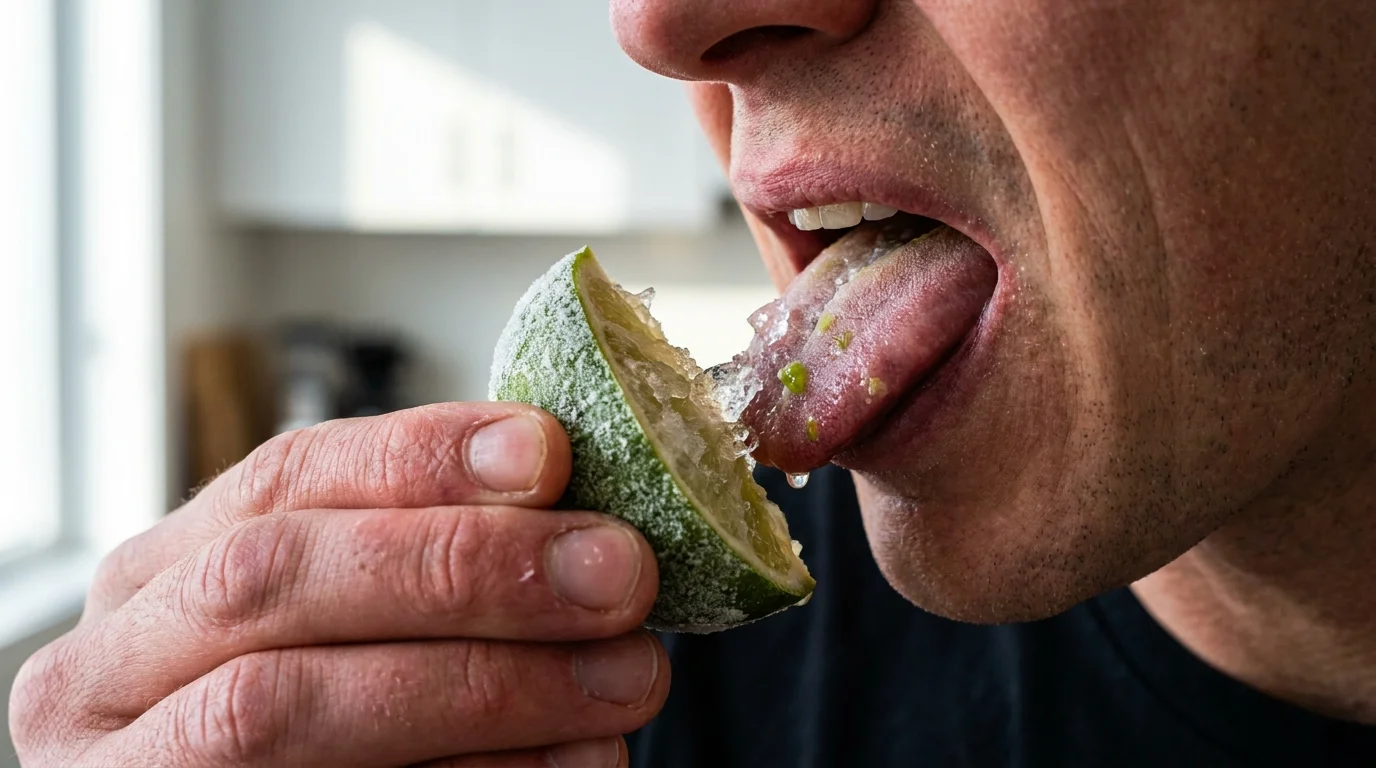
Reach instead for the freezer handle. Inside, resting in a glass jar, are paper-thin wheels of lime, frozen solid until the green rind is crusted with a delicate layer of frost. When you place one directly onto the center of your tongue, something unexpected happens: the racing panic abruptly stops.
It is not a placebo, and it is not a gentle suggestion. It is an immediate, involuntary physiological reset triggered by the convergence of sub-zero ice and intense citric acid hitting your primary sensory receptors at the exact same moment.
The Circuit Breaker on Your Tongue
When panic strikes, your sympathetic nervous system behaves like a runaway locomotive. It sends blood away from your digestion toward your limbs, dilates your pupils, and loops identical catastrophic thoughts through your head. Most grounding exercises fail because they ask an overstimulated brain to do complex work—like naming five blue objects or remembering a calming affirmation.
Your physiology does not care about affirmations when it believes survival is at stake. To break that loop, you must trip the physiological circuit breaker before the wiring burns out. Placing a frozen citrus wedge against your tongue bypasses conscious thought entirely by targeting two immediate biological systems: the trigeminal-vagal reflex arc and the salivary-gustatory shock.
The extreme cold shocks the sensitive mucosal tissues of the mouth, triggering a localized dive reflex that commands your heart rate to drop. Simultaneously, the piercing acidity of the lime forces an aggressive surge of saliva, demanding instant, total processing power from the glossopharyngeal nerve. Your brain cannot actively construct panic loops while simultaneously navigating an intense sour-thermal crisis on the tongue.
- Omega-3 fish oil capsules demand evening dinner pairing to stop sluggish metabolic clearance
- Nonstick teflon skillets heated past medium release airborne irritants sparking heavy post-meal head pressure
- Scrubbing low bathtubs strains delicate knee joints sparking sharp next-morning lower back aches
- Clif energy bars trigger sudden sluggish crashes and spark intense evening sweet cravings
- Back neck hollow pressing eases burning desk stiffness and resets tight shoulder traps
The Secret Shared in the Tower
Elena Vance, 38, an air-traffic controller handling approach corridors near Chicago, knows the exact texture of an acute autonomic spike. During a high-density weather diversion three years ago, her heart locked into an unexpected 140-beat-per-minute loop at the console. It was a seasoned flight surgeon who quietly pulled her aside during her break and showed her the stainless-steel thermos in his locker.
Inside were quartered lime wedges kept on dry ice. The surgeon explained that while junior staff were taught slow diaphragmatic resets, frontline veterans in high-stakes environments needed an immediate neuro-distraction that demanded zero mental computation. For Elena, keeping a stash of frozen citrus became a quiet ritual—a guaranteed physical anchor that pulled her consciousness out of the clouds and planted it firmly back in her boots within ten seconds flat.
Layering the Reset for Your Routine
Not every nervous system flare looks identical. Depending on how your tension manifests, you can calibrate this sensory shock to match the specific way your body locks up.
For the Sudden Adrenaline Spike
This is the acute, heart-in-throat surge that hits without warning during meetings or quiet transit. Your body is dumping adrenaline, your palms turn clammy, and your throat feels dry. For this rapid-onset wave, use a quarter-inch frozen wheel directly between the upper palate and the flat of the tongue. The dual contact points amplify the cold shock, commanding your vagal tone to step on the autonomic brakes immediately.
For the Dissociative Afternoon Fog
Sometimes panic does not arrive with a pounding chest; it arrives as a slow, floaty detachment where your surroundings feel two-dimensional and unreal. In this state, your system is shutting down rather than revving up. Instead of letting the lime sit flat, bite gently into the pulp while it is still frosted. The crunch of the frozen juice vesicles combined with the sour spray acts like smelling salts, forcefully re-orienting your spatial awareness.
For the Commuter’s High-Stress Buffer
If your nervous system routinely flares while you are away from home—such as during gridlock traffic or crowded train commutes—a standard kitchen container will not hold up. Prep your frozen wedges in an insulated wide-mouth travel flask lined with parchment paper. The wedges will remain solid for up to eight hours, offering you a discreet, portable emergency intervention whenever public transit triggers sudden claustrophobia.
Mindful Application: The Citrus Shock Protocol
Preparation is everything. When an acute wave hits, you should not be slicing fruit or searching through messy freezer bins. Keep this remedy ready to execute with zero friction.
Begin by washing three organic Persian limes thoroughly under cold water. Slice them into consistent wheels roughly one-quarter of an inch thick. Lay them flat on a parchment-lined baking sheet for two hours so they freeze individually, then transfer them to an airtight glass container.
- Retrieve one slice: Do not let it thaw on the counter; you need the frosty rind intact.
- Position flat: Press the center of the wedge firmly against the middle third of your tongue.
- Close your mouth: Allow the bitter cold to penetrate the roof of your mouth while the sour juices melt down your throat.
- Hold for twenty seconds: Focus entirely on the intense, almost unbearable brightness of the taste rather than your thoughts.
- Exhale through your nose: Notice how your shoulders drop as your saliva flows freely again.
The beauty of this method lies in its mechanical nature. You do not need to believe that it will work for the cold receptors to fire. The body leads, and the mind is forced to follow.
The Tactical Toolkit
To get the strongest physiological response, precision matters. Your freezer should be set between -2°F and 0°F (-19°C to -18°C) to ensure the lime crystals remain dense and crisp. Aim for slices cut to precisely 1/4 inch; thinner slices thaw too fast, while thicker wedges are too bulky to comfortably press against the roof of the mouth. Hold the frozen slice in place for a minimum of 15 to 30 seconds before chewing or discarding.
Reclaiming the Ground Beneath Your Feet
Experiencing sudden nervous system surges can make you feel like a stranger in your own skin. It is easy to develop a secondary anxiety—a fear of the fear itself—wondering when your body might suddenly betray you in a quiet grocery aisle or during an important presentation. But your body is not your enemy; it is simply responding to misread signals using ancient survival programming.
When you discover a physical mechanism that interrupts that cascade in real time, the entire dynamic shifts. You are no longer helpless against the rising tide. Keeping a jar of frozen limes in the back of your freezer is more than a wellness trick; it is a tangible promise to yourself that no matter how loud the internal storm gets, you possess a quiet, unshakeable switch to bring yourself back to earth.
The fastest way to quiet an overstimulated mind is to give the senses an undeniable physical truth to deal with.
| Key Point | Detail | Added Value for the Reader |
|---|---|---|
| Trigger Mechanism | Trigeminal-vagal stimulation via intense cold and citric acid | Bypasses mental reasoning to drop heart rate mechanically within seconds |
| Optimal Cut | 1/4-inch frozen circular wheels | Maximizes surface area contact against the tongue and hard palate without melting too fast |
| Storage Method | Flash-frozen on parchment, stored in airtight glass jars | Prevents slices from clumping together so you can grab a single slice in an emergency |
| Action Window | 15 to 30 seconds of continuous oral contact | Provides sufficient duration to activate the salivary-gustatory reset without tissue irritation |
Frequently Asked Questions
Can I use frozen lemons instead of limes?
Yes, frozen lemons work very well. Limes contain a slightly higher concentration of bitter limonoid compounds in their rind, which adds an extra sensory punch, but lemons provide the exact same thermal and acidic shock to the nervous system.Will the intense acidity harm my tooth enamel?
Because this is an occasional emergency intervention rather than an hourly snack, the risk is minimal. However, to protect your teeth, rinse your mouth thoroughly with plain water five minutes after using the slice, and avoid brushing your teeth for at least thirty minutes afterward.How does this differ from the mammalian dive reflex with ice water?
Plunging your face into ice water activates the same vagal pathways, but it is messy, inconvenient, and impossible to do during a workday or social event. A frozen lime slice is clean, discreet, and pairs thermal shock with intense gustatory stimulation for a doubled reset effect.What if I am out in public without access to a freezer?
You can keep a small thermos with a few frozen slices in your car or bag. Alternatively, carrying intensely sour, unsweetened citrus candies can provide a similar gustatory jolt, though you will sacrifice the crucial thermal shock component.Is this safe for people with sensitive palates or mouth ulcers?
If you have open canker sores or a severely sensitive geographic tongue, the direct acid may cause sharp localized discomfort. In that scenario, holding a plain ice cube wrapped in a damp paper towel against the roof of the mouth delivers the cold shock without the stinging acid.