The mid-afternoon light cuts across your desk, catching the faint steam from a lukewarm mug you forgot to finish. You have been sitting in the same ergonomic swivel chair since eight in the morning, clicking through spreadsheets and typing answers to messages that never seem to slow down. Then, somewhere around two o’clock, an unsettling sensation creeps into your upper body: your breath suddenly feels thin, clipped, and incomplete, like you are trying to fill your lungs through a pinched paper straw.
You instinctively roll your shoulders back, pull in a sharp gasp, and try to force air deep into your belly, but the chest tightness refuses to budge. Your mind immediately scrambles for reasons. Is this an unprovoked panic attack? Did that second cup of drip coffee send your heart into overdrive? Or are you simply running on fumes?
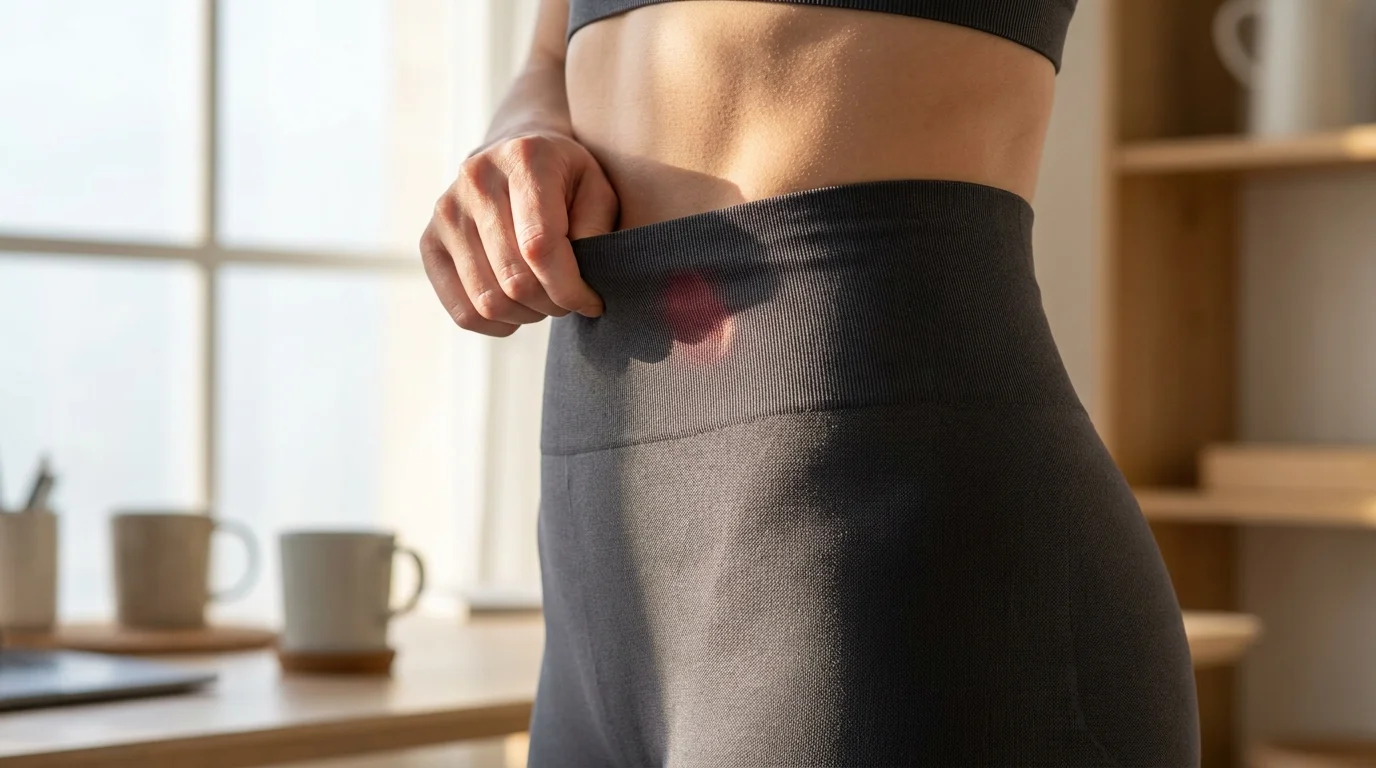
Before you spiral into an audit of your mental health, look down at your waistline. That thick, bonded waistband of your favorite high-waisted compression leggings is sitting snug against your lower ribcage, digging directly into your floating ribs every time you hinge forward toward your monitor.
Without realizing it, you have spent six consecutive hours mechanically clamping your own breathing engine. What feels like sudden, mysterious midday anxiety is often nothing more than subconscious diaphragmatic splinting caused by athletic wear engineered to squeeze your middle without giving an inch.
The Corset Effect: How Seated Compression Traps the Breath
Modern activewear is marvelously constructed for upright, high-impact movement. When you sprint, lunge, or jump, firm abdominal compression stabilizes your pelvic ring and holds tissue securely in place. But the biomechanics of seated desk work are entirely different. When you sit, your hips flex to ninety degrees, shortening the distance between your pelvis and your sternum. This folds your lower abdomen inward and forces that reinforced, double-layered elastic waistband straight into your lower ribs.
Your diaphragm is shaped like a parachute, anchored along the inner borders of your lower six ribs. To take an effortless, calming breath, that muscular parachute must drop downward while your lower ribs expand sideways like bucket handles. Constricting your lower rib cage completely locks those bucket handles in place. The diaphragm tries to contract, hits an immovable wall of high-gauge elastane, and immediately halts its downward stroke.
When your primary breathing muscle hits an artificial ceiling, your body does not just give up on oxygen. Instead, it recruits emergency backup movers: the scalene muscles along the sides of your neck, the sternocleidomastoid, and the upper pectorals. You shift instantly into upper-chest breathing. This rapid, shallow ventilation activates your sympathetic nervous system, tricking your brain into believing you are fleeing a predator when you are simply reading an email.
- Ice cube clenching soothes sudden trembling spells and drops racing heart rates
- Sour apple candies interrupt racing panic attacks by shocking overstimulated brain circuits
- Evening statin doses trigger morning muscle sluggishness and involuntary daytime metabolic stalls
- Avocado cooking oil pan searing triggers stinging sinus pressure and sudden afternoon brain fog
- Pushing off armrests accelerates leg muscle loss and triggers wobbly standing balance
The Pattern Break: Elena’s Six-Month Mystery
Consider Elena Shaw, a thirty-four-year-old architectural draftsperson from Denver who spent nearly half a year logging mysterious episodes of late-day chest pressure. Like millions of remote professionals, Elena loved the seamless convenience of high-end activewear. She would slip into ultra-firm compression leggings at seven in the morning, work a full shift bent over computer-aided designs, and head straight to an evening spin class.
By three every afternoon, she felt an unmistakable sense of air hunger. Her pulse would quicken, her throat would feel dry, and a heavy ache would set across her lower sternum. Standard medical screenings revealed pristine cardiovascular health and clear lungs. It was only when a physical therapist watched her breathe in her usual seated posture that the mechanical culprit appeared: Elena’s leggings had an eleven-inch rise reinforced with internal silicone grip tape, resting directly over her tenth ribs. In a seated hunch, that band was exerting nearly twenty millimeters of mercury of pressure against her rib margin.
She unrolled the waistband down to her hip bones right there in the office. Within three long exhales, her chest tightness melted away, proving that mechanical restrictions often mimic panic with startling accuracy.
Reading Your Fit: Three Desk-Bound Tension Profiles
Not every body experiences compression the same way. The interaction between your torso length, desk setup, and fabric density determines how quickly shallow breathing sets in.
The Short-Torso Worker: If the distance between the top of your hip bone and the bottom of your ribcage is less than four fingers wide, high-rise leggings have nowhere to sit except directly over your ribs. When seated, the waistband acts as an external clamp on your floating ribs, provoking air hunger within sixty minutes of desk work.
The Leaning Forward Typer: When you tilt your upper body forward toward a screen, you fold your belly like an accordion. This position pushes your visceral organs up against the underside of your diaphragm while the waistband pinches from the outside. Compounding external and internal pressure leaves your lungs struggling to clear stale carbon dioxide.
The Post-Meal Trapper: After lunch, your stomach naturally expands to accommodate digestion. If you are strapped into heavy athletic panels, your digestive tract has no room to push forward. It pushes upward against the diaphragm instead, causing a sudden wave of heart-pounding shortness of breath within twenty minutes of finishing your meal.
The 90-Second Ribcage Release Protocol
You do not need to discard your favorite leggings, but you must stop treating heavy athletic compression as casual desk wear. If you find yourself catching a shallow breath or sensing sudden chest tightness at your desk, walk through these immediate mechanical adjustments.
- The Double Fold-Down: Peel the top edge of your waistband down toward your hip crests. Fold it twice so the thickest seam sits well below your belly button, freeing your tenth and eleventh ribs to flare naturally.
- The 360-Degree Hand Check: Place your hands flat on the sides of your lower ribs, with your thumbs pointing toward your spine and fingers pointing forward. Inhale through your nose and verify that your ribs push your hands outward, not just forward into your chest.
- The Pursed-Lip Decompression: Take a gentle, silent breath in through your nose for three seconds. Purse your lips as if blowing through a straw and exhale smoothly for six seconds. This slow backpressure encourages the clamped diaphragm to reset its resting tone.
- The Hinge and Reach: Stand up, soften your knees, and hinge at your hips. Reach your fingertips toward the floor while letting your head hang heavy, taking two deep breaths directly into your mid-back to release the posterior rib joints.
Use this physical reset whenever you notice your shoulders lifting toward your ears during typing tasks.
Reclaiming the Quiet Mechanics of the Body
We often carry a hidden assumption that physical discomfort must originate from some complex, internal failure—an emotional flaw, unchecked stress, or an undiagnosed illness. We analyze our schedules, track our caffeine intake, and scour our thoughts for unresolved tension, entirely overlooking the simple physics of what we wrap around our frames.
Your breath is your nervous system’s most sensitive gauge. When your clothes silently forbid your ribs from moving, your body reads that tightness as a genuine emergency. Learning to loosen the mechanical grip around your middle is an act of real self-preservation. When you give your lower ribcage room to move, quiet ease naturally returns unforced, letting your focus settle back where it belongs.
“Before assuming your mind is generating midday panic, confirm that your clothes are giving your diaphragm permission to descend.”
| Key Point | Detail | Added Value for the Reader |
|---|---|---|
| Compression Rise Height | Bands measuring over 9 inches often bridge the pelvic-rib gap while seated. | Allows you to measure leggings specifically for desk work versus standing gym workouts. |
| Breathing Muscle Recruitment | Rib restriction forces secondary neck muscles (scalenes) to lift the chest. | Explains why afternoon neck and shoulder knots often accompany shallow chest tightness. |
| Vagal Feedback Loop | Restricted exhale depth limits parasympathetic vagal stimulation. | Helps you distinguish between situational emotional stress and simple mechanical oxygen starvation. |
Frequently Asked Questions
Can compression leggings cause permanent breathing problems?
No. The restriction is strictly mechanical and temporary. As soon as you unroll or remove the tight band, your ribcage and diaphragm regain their full range of motion immediately.Why do I feel fine in the gym but short of breath at my desk?
Standing and moving extends your torso, giving the waistband room to sit flat without pinching ribs. Sitting down folds your midsection, forcing the band into your rib margin and doubling localized pressure.Is this sensation related to acid reflux or heartburn?
Yes, heavy abdominal compression pushes stomach acid upward into the esophagus while sitting, which can cause both throat tightness and chest pressure that closely mimics breathing difficulties.How do I know if my leggings are too tight for sitting?
Slide two fingers under the top band while seated. If you cannot comfortably slip your fingers between your skin and the fabric without forcing them, the garment is too tight for desk work.What style of activewear is best for long days at a computer?
Look for cross-waist designs, low-compression lifestyle leggings, or fold-over waistbands that rest on the iliac crest rather than climbing toward the lower sternum.