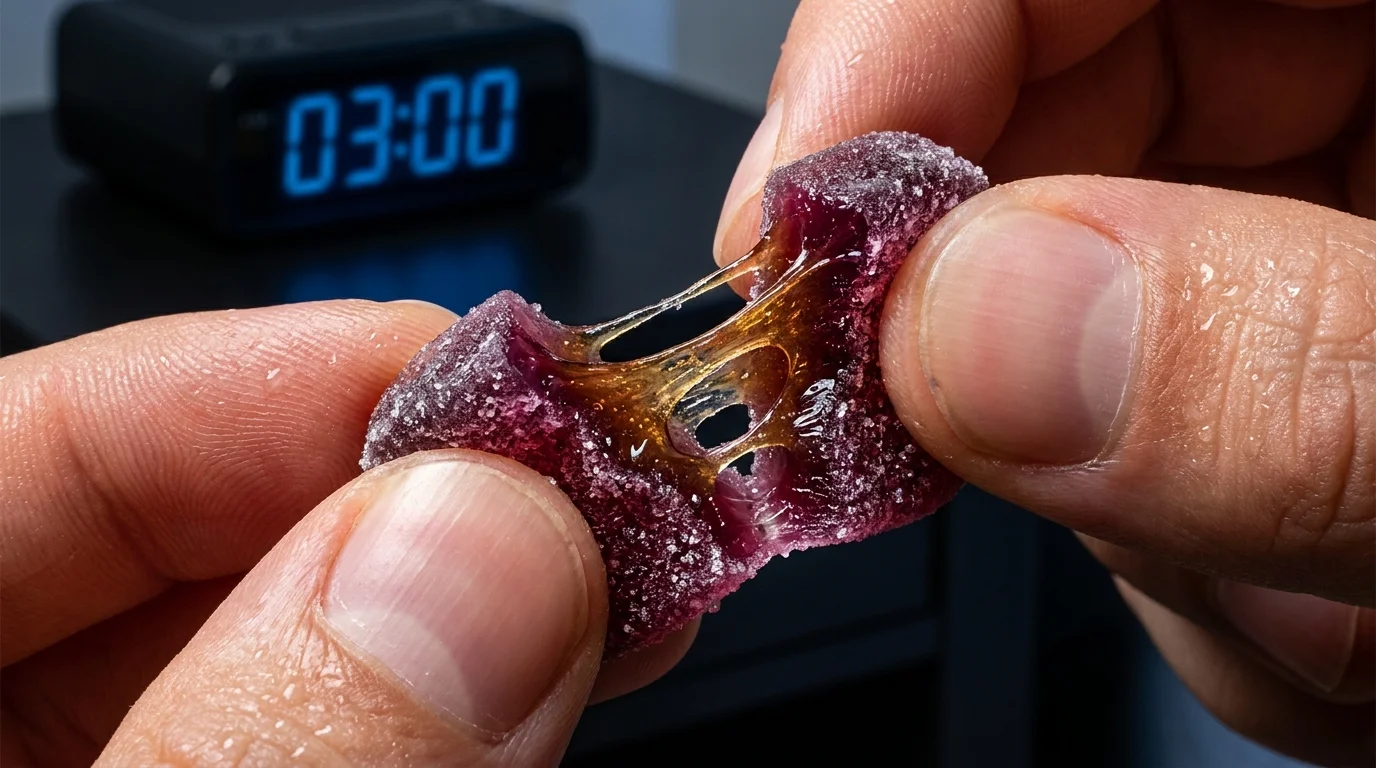
The bedroom is pitch-black, cool, and still, with the window cracked just enough to let in the sixty-five-degree night air. You did everything by the book: dimmed the lamps, set your phone aside an hour before bed, and chewed two soft, sugar-dusted berry gummies from the bottle on your nightstand. Sleep came quickly, pulling you down into a heavy, leaden stupor within twenty minutes.
Then, the snap happens. At precisely 3:17 AM, your eyes fly open as if tripped by a wire, your heart thudding violently against your ribs like a moth trapped inside a paper lantern. Your sheets feel instantly damp and suffocating, and your chest tightens under a sudden wave of unprovoked panic.
Your mind does not ease into waking; it catches fire. Thoughts scramble across forgotten emails, tomorrow’s traffic, and unresolved conversations from five years ago with jarring clarity. The synthetic sweetness of the gummy still faintly coats your teeth, but the promised rest has vanished into thin air, leaving you stranded in an adrenaline-soaked room.
This sudden, sweat-drenched vigilance is neither an anxiety disorder nor a failure of willpower. It is the predictable biological recoil of an endocrine system hit with a sledgehammer when it only asked for a whisper.
The Clearance Crash: Why More Is an Alarm Bell
Our culture operates on an industrial assumption: if a tiny drop heals, an entire bucket must cure. When applied to melatonin sleep gummies, this logic breaks down completely. Your brain’s pineal gland naturally releases tiny fractions of a milligram—roughly 0.1 to 0.3 milligrams—to signal the onset of darkness. It is an ambient conductor tapping a baton, not a sedative knocking you cold.
Commercial gummies, by contrast, routinely pack five, ten, or even twelve milligrams per serving. When you ingest this mountain of synthetic hormone through a chewable delivery system, your liver processes the compound rapidly. Your receptors are instantly flooded, bludgeoning the central nervous system into immediate sedation.
However, melatonin has an elimination half-life of roughly forty minutes. Within four hours, that artificial chemical tidal wave retreats as quickly as it arrived. When blood concentrations drop precipitously off this biological cliff in the dead of night, your brain registers the sudden absence of the hormone as an emergency state.
- Dual computer screens strain delicate neck muscles triggering dull throbbing skull base tension
- Compressed prenatal tablets leave undissolved chalky residue triggering stubborn lower belly bloating
- High-waisted compression leggings pinch lower ribcages triggering sudden shallow chest tightness
- Ice cube clenching soothes sudden trembling spells and drops racing heart rates
- Sour apple candies interrupt racing panic attacks by shocking overstimulated brain circuits
In response to this rapid clearance vacuum, your adrenal glands release a counter-regulatory surge of cortisol and epinephrine. The result is the classic midnight shock: a pounding pulse, clammy palms, and a racing mind thrown into survival mode while the rest of the world sleeps.
Julian Vance, a 48-year-old chronobiology technician in Portland, sees this pattern constantly among clients desperate to fix broken sleep schedules. Vance often recalls the case of a logistics coordinator who chewed ten-milligram bedtime candies every night for months, convinced her 3:00 AM panic attacks were proof she had incurable chronic insomnia. Vance simply had her inspect the label: the massive dose, combined with simple glucose syrups, created an endocrine rebound that jolted her awake the moment the compound cleared her bloodstream.
Adjustment Layers: Tuning Your Nightly Rhythm
Not every body metabolizes chewable sleep aids at the same rate. Understanding how your daily habits interact with supplemental hormones is the first step toward reclaiming unbroken nights.
For the High-Sensitivity Rebounder
If you routinely wake up around 3:00 AM with a racing pulse after taking a chewable aid, your hepatic clearance is exceptionally fast. Your body purges high doses before you can cycle through your deep restorative slow-wave sleep. High-potency chews act on you like an alarm clock set for four hours after bedtime. For this group, micro-dosing or abandoning isolated hormone supplementation entirely is the only way to avoid midnight panic spikes.
For the Screen-Fatigued Professional
When blue light from laptops suppresses natural pineal production, reaching for a gummy feels like a quick fix. However, flooding tired eyes with massive doses does not repair the underlying circadian desynchrony; it merely masks it with heavy drowsiness. When the crash arrives mid-sleep, your blue-light-depleted system lacks the natural neurochemical rhythm needed to smooth over the transition between sleep cycles.
For the Sugar-Sensitive Sleeper
Most commercial chewables rely on tapioca syrup, cane sugar, or sugar alcohols to mask the bitter taste of raw active ingredients. Ingesting three to five grams of fast-acting sugar right before lying motionless creates an immediate insulin spike followed by a nocturnal blood glucose dip. Combined with rapid hormone clearance, this double rebound guarantees a physical jolt in the middle of the night.
Rebuilding Sleep Architecture Without the Chemical Shock
Restoring quiet, full-night rest requires treating your sleep architecture like fine woodwork: gentle, patient alignment rather than forced blunt force.
The goal is to invite sleep to settle naturally across your limbs rather than forcing your nervous system into artificial submission. True recovery requires subtle biological cues that coax your endocrine system into doing its own work.
- Step down your dose: If you use chewables, divide them into quarters or switch to a sub-milligram liquid dropper delivering no more than 0.3 milligrams ninety minutes before bed.
- Introduce bitter pantry teas: Replace sugary bedtime gummies with a warm cup of unsweetened chamomile or lemon balm to relax the gastric lining without triggering insulin fluctuations.
- Anchor your morning photons: Step outside within twenty minutes of waking to let direct sunlight hit your retinas, locking in your natural pineal countdown for sixteen hours later.
- Protect the foot-cooling reflex: Keep your bedroom at sixty-six degrees Fahrenheit and wear loose wool socks; warming the extremities dilates surface capillaries, naturally dropping your core body temperature to match nocturnal rhythms.
The Tactical Toolkit
Keep your interventions lean and intentional. Timing matters far more than volume.
- Target dosage: 0.3 mg (300 micrograms) maximum, taken 90 minutes before your intended sleep window.
- Darkness protocol: Transition from overhead lighting to amber, floor-level lamps at 8:30 PM.
- Thermostat target: Set the room temperature between 65°F and 67°F to prevent overheating during natural early-morning cortisol rises.
True Rest Lives in the Fading Light, Not the Sugar Jar
Waking up in a cold sweat with a racing pulse is a terrifying sensation, but recognizing it as a physical clearance crash disarms its power. Your body is not broken; it is simply reacting to an unnaturally steep chemical drop.
When we surrender the search for an instant off-switch, we make room for real restoration. Sleep is not a prize to be seized with heavy doses and candy-coated supplements; it is an innate tide that rises on its own when we stop getting in its way.
The nervous system does not crave sedation; it craves the quiet safety of an unbroken natural rhythm.
| Key Point | Detail | Added Value for the Reader |
|---|---|---|
| Dosage Mismatch | Gummies deliver 5-10 mg; pineal output is roughly 0.1-0.3 mg. | Explains why commercial supplements cause morning grogginess and sleep fragmentation. |
| Clearance Rebound | Melatonin half-life is 40 minutes, causing a steep drop at 3:00 AM. | Identifies the biological root of unexplained early-morning wakefulness. |
| Adrenaline Trigger | Rapid drop in blood concentration prompts compensatory cortisol surge. | Removes personal anxiety by reframing the racing pulse as a physical reaction. |
| Excipient Interference | Gummy bases introduce glucose or sugar alcohols right before bed. | Helps you eliminate hidden sugar crashes that mimic night terrors. |
Frequently Asked Questions
Why do melatonin sleep gummies make my heart race at night?
Massive doses clear your bloodstream rapidly within three to four hours. This sudden drop triggers a survival reflex, causing your adrenal glands to release adrenaline and cortisol that spike your heart rate.Is 5 mg or 10 mg of melatonin dangerous?
While rarely toxic in an acute sense, these super-physiological doses overwhelm brain receptors, disrupt your body’s natural production, and almost universally trigger vivid nightmares, midnight awakenings, or morning brain fog.What is the ideal dose of melatonin for healthy sleep?
Clinical chronobiology studies show that 0.3 mg (300 micrograms) matches natural pineal secretion, aiding sleep onset without inducing midnight rebound spikes or grogginess.Why do gummies cause more awakenings than traditional pressed pills?
Gummies contain simple sugars that cause a blood sugar rise and subsequent crash. They also absorb and clear more erratically than low-dose, sustained-release micro-tablets.How do I stop taking melatonin gummies without suffering insomnia?
Taper your dose gradually over five days while increasing direct morning sunlight exposure and dimming evening lights two hours before bedtime to jump-start your natural melatonin production.