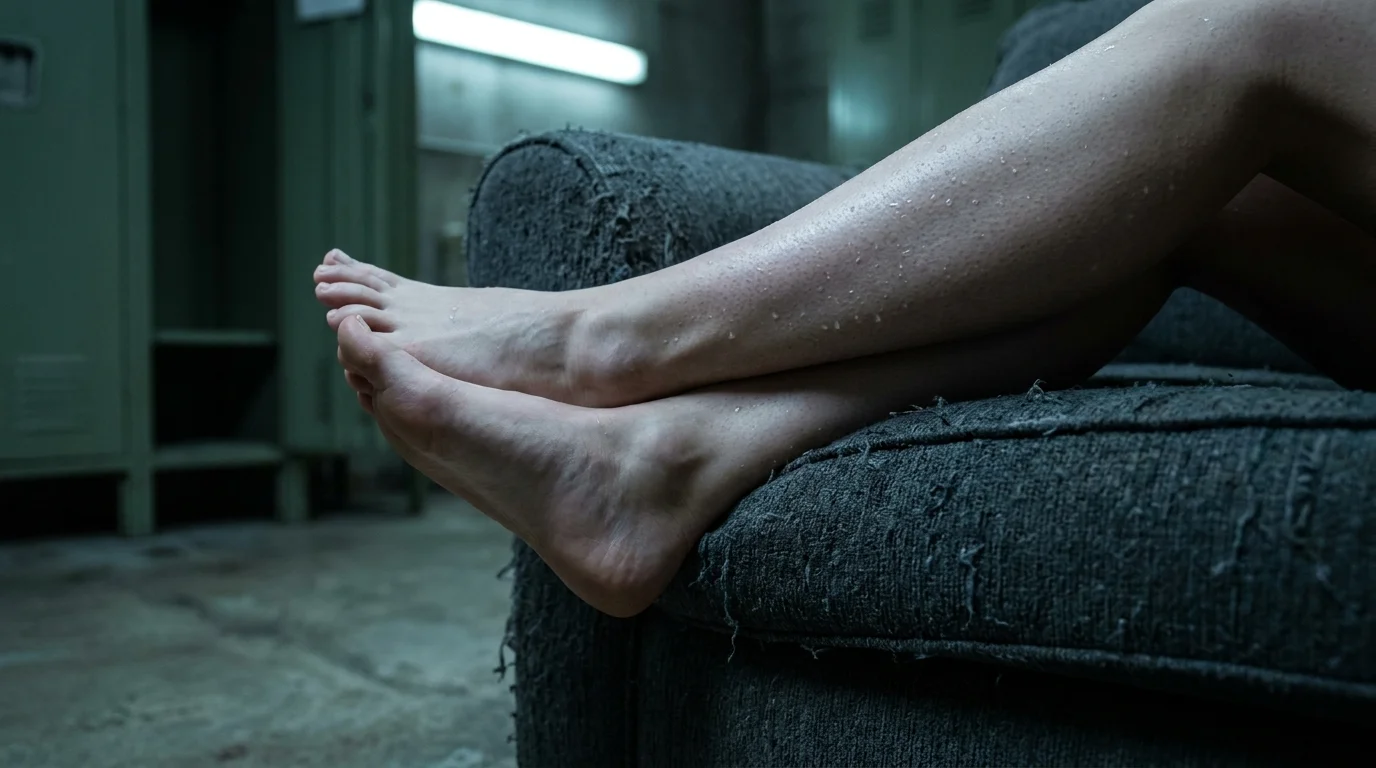
A pair of crossed ankles resting heavily on the edge of a faded fabric couch. The afternoon light angles across your living room, catching dust motes hovering over your laptop screen. To you, this feels like absolute comfort. Your hips are tucked deep into the cushions, your knees are bent, and your spine has folded into what feels like a cozy, protective shell against the demands of the day.
But beneath the soft surface of your favorite sofa, a silent, structural compromise is taking place. While your brain registers relaxation, your muscles are engaged in a quiet, asymmetrical tug-of-war. The weight of your entire upper torso is shifting, settling onto a foundation that is no longer level. Every minute spent in this state slowly reshapes the muscle memory of your lower back.
We have been conditioned to believe that sitting on the floor or a plush sofa is a natural alternative to the rigid, artificial discipline of an office chair. Yet, this unstructured freedom introduces a subtle hazard. The physical ease you feel in this moment is actually a sensory trick, hiding a slow-motion structural shift that happens millimeter by millimeter, pulling your pelvic bowl out of alignment.
The Hidden Asymmetric Pivot of the Pelvis
Think of your pelvis as the stone foundation of a house. When you sit with one leg crossed over the other, or pull one knee higher than its partner while lounging, you are essentially pouring a sloped concrete slab. One side of your hip structure is forced upward, while the opposite side drops to absorb the weight. This uneven distribution acts like a wedge driven beneath your spinal column.
To keep your head level and your eyes focused straight ahead, your lumbar spine has to perform an emergency correction. It curves toward the high hip, creating a lateral tilt that eventually hardens into connective tissue memory. Your body adapts to your habits, meaning your ligaments slowly remodel themselves to support this crooked architecture. What began as a temporary comfort position becomes your body’s new, permanent baseline.
Consider Marcus Vance, a 34-year-old freelance graphic designer who traded his office cubicle for a low-slung sectional sofa during the remote-work boom. For two years, Marcus spent his afternoons with his right ankle tucked firmly under his left thigh, typing comfortably while leaning to one side. When he began experiencing a persistent, dull ache in his lower left back that made standing up straight feel like pulling tight leather, his physical therapist quickly pointed out that his right hip flexor had shortened by nearly an inch, locking his pelvis into a permanent, defensive twist.
- Organic oat milk floods your morning routine with processed liquid starches
- Beef tallow cooking fats provide the exact fat complex your aging brain needs
- Raw manuka honey completely heals minor cooking burns overnight without a scar
- Chewing raw ginger root builds sharper mental focus than a double espresso
- Grocery delivery apps silently drain your natural grip strength and shoulder tone
The Anatomy of the Lean: Three Profiles of Misalignment
Not everyone sits the same way, but almost everyone who works outside a traditional office chair falls into one of three postural patterns. Understanding your specific style is the first step toward reclaiming your natural alignment and easing the strain on your joints.
The Sofa Squatter
This profile involves tucking one leg completely underneath your glutes while the other knee bends outward. This posture forces the pelvis to tilt backward and rotate simultaneously. Over time, this dual-action twist stretches the pelvic ligaments of your sacroiliac joint, leading to a deep, localized ache in the back pocket area.
The Floor-Dweller
Sitting cross-legged on the floor seems ancestral and healthy, but without adequate hip mobility, it is highly destructive. Your lower back collapses completely, forcing your lumbar spine into a deep, continuous curve. This posture puts immense pressure on the front edges of your spinal discs, pushing the soft inner gel backward toward your sensitive nerves.
The Desk-Side Leg Crosser
Even at a standard workstation, many people habitually loop one knee over the other at the thigh. This completely cuts off blood circulation to the lower leg while forcing the pelvis into a sharp, lateral angle. If you always cross the same leg over, you are systematically tightening the inner thigh muscles on one side while overstretching the outer hip stabilizer on the other.
Reclaiming Your Center: The Symmetrical Reset
Correcting a permanent pelvic tilt does not require buying expensive ergonomic gadgets. It requires small, intentional physical boundaries that restore balance to your hips. You must re-train your nervous system to recognize symmetry as safety.
- Implement the ninety-degree rule: Keep both knees bent at a right angle with your soles resting flat on the floor or a solid footrest.
- Introduce an active wedge: Place a firm, angled foam cushion under your sit bones to tilt your pelvis slightly forward when sitting on soft surfaces.
- Switch sides systematically: If you absolutely must cross your legs, swap positions every fifteen minutes to distribute the structural strain evenly.
- The pelvic bowl visualization: Imagine your pelvis is a shallow bowl filled to the brim with water; your goal throughout the day is to prevent it from spilling left or right.
Your Tactical Toolkit
To support your structural recovery, keep these specific parameters in mind during your working hours:
- Sitting Duration Limit: Maximum of 45 minutes before standing to reset pelvic alignment.
- Cushion Density: High-density EVA foam (avoid soft memory foam that allows your hips to sink).
- Daily Stretch Target: 3 minutes of half-kneeling hip flexor stretches per side to release the tight pelvic pull.
The Long-Term Economics of Spinal Balance
The way we carry ourselves when we think no one is watching defines our physical future. We tend to view posture as a superficial concern, a matter of looking presentable or standing tall. In reality, your posture is the silent narrator of your physical freedom, dictating how easily you will move a decade from now.
When you choose to keep both feet planted on the floor, you are protecting your long-term mobility. Reclaiming your alignment is an act of quiet self-respect that keeps your joints moving fluidly through the years, proving that small corrections today prevent chronic pain tomorrow.
“The human pelvis is a master balance-wheel; when we force it to sit crookedly, we demand that every joint up to the neck bend itself to compensate.” — Dr. Helen Avery, Chiropractic Kinematicist
| Key Point | Detail | Added Value for the Reader |
|---|---|---|
| Pelvic Rotation | One knee elevated higher than the other twists the hip socket outward. | Explains why your lower back feels tight on only one side. |
| Disc Compression | Slouching while cross-legged pinches the anterior spinal discs. | Prevents long-term disc bulges and nerve irritation. |
| Muscle Asymmetry | Tightens the inner thigh of the dominant leg while weakening the glutes. | Reveals the root cause of chronic, unexplained hip clicking. |
Frequently Asked Questions
Is sitting cross-legged always bad for my spine? No, but doing it habitually on one dominant side for hours creates muscular imbalances that lead to permanent structural adaptation.
How can I tell if my pelvis is already tilted? Stand in front of a mirror and place your hands on your hip bones; if one hand sits noticeably higher than the other, your pelvis is holding a lateral tilt.
Does sitting on the floor heal back pain? Only if your hips are flexible enough to keep your lower back from rounding; otherwise, it intensifies disc pressure.
Can yoga reverse a pelvic tilt caused by sitting? Yes, consistent focus on hip openers like the pigeon pose can release the tight connective tissues pulling your hips out of alignment.
Why do I feel the urge to always cross my legs? Your nervous system seeks stability; when your deep core muscles are weak, crossing your legs mechanically locks your joints together for artificial support.