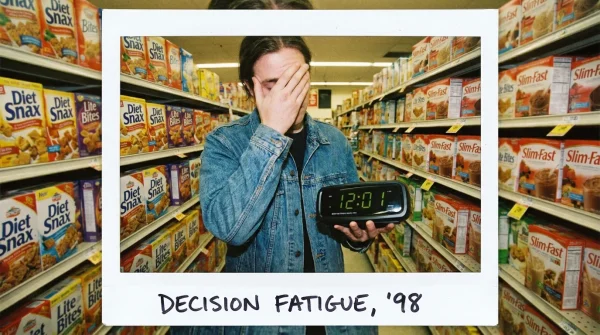
A dim kitchen counter at seven in the morning has a quiet, almost sacred weight. The soft, rhythmic hum of the refrigerator is the only sound breaking the early silence. On the marble surface sits a digital kitchen scale covered in tiny specks of protein powder and faint rings of dried oat milk. You stand directly over it, smartphone clutched in your palm, staring at the bright screen of a food database, frozen in place.
To anyone else, this is the very picture of health and modern discipline. You are managing your physical chemistry, matching every bite to precise data targets. But as you scroll through four conflicting entries for a raw almond, a heavy, quiet exhaustion begins to settle directly behind your eyes. Your cognitive battery is draining before your working day has even begun.
The standard expectation promises that tracking every gram of your diet is a simple, friction-free act of self-improvement. But the professional reality—known well by performance psychologists—is that this constant digital bookkeeping treats your mind like a poorly optimized machine. By outsourcing your somatic signals to a software algorithm, you trade valuable cognitive RAM for green progress bars.
The Silent Overload of Digital Nutritional Bookkeeping
Think of your prefrontal cortex—the area of your brain responsible for willpower, complex decision-making, and emotional resilience—as a physical reservoir. Every single time you weigh, calculate, or log a meal, you are dipping a bucket into this limited water supply. It is not just about the food; it is about the constant state of micro-loss aversion. Your brain interprets every single gram over your target as a failure, triggering a subtle, survival-driven stress response.
This calculation loop operates like a hidden program running on your laptop, chewing through processing power without your knowledge. Cognitive load theory teaches us that making dozens of micro-decisions in the morning depletes our executive capacity by the afternoon. The sudden afternoon brain fog you feel isn’t a lack of discipline; it is your executive system shutting down because it spent its entire resource budget on decimal points.
- Cold pressed juices completely cancel out the calories you just burned
- Weighted vest walking spikes cortisol and traps stubborn belly water weight
- Liquid dinner cleanses force your body into survival mode stopping weight loss
- Keto protein bars trigger massive afternoon sugar cravings and ruin your progress
- Coworker venting sessions secretly drain your immune system and ruin sleep
Dr. Marcus Vance, a forty-two-year-old clinical neuroscientist specializing in occupational burnout, observed this dynamic in high-achieving professionals. Patients would arrive at his practice complaining of severe cognitive fatigue, unable to make strategic executive decisions by mid-afternoon. When he analyzed their morning routines, he found that those utilizing complex macro tracking apps experienced a rapid depletion of mental stamina. Treating their biology like an interactive spreadsheet forced their minds into a state of perpetual vigilance, erasing their creative energy before noon.
Tailored Strategies for Your Cognitive Capacity
For the High-Stress Professional
If your daily work involves constant negotiation, problem-solving, and emotional labor, your prefrontal cortex is already working at its absolute limit. Adding the cognitive task of parsing food databases during a short lunch break is a recipe for decision paralysis. For you, the psychological cost of tracking far outweighs the physical utility; your mind needs a sanctuary, not another metric to manage.
For the Active Goal-Seeker
If you are training for a specific physical goal where targeted nutrition is necessary, complete omission of data isn’t always practical. However, your brain requires structural buffers to prevent burnout. Keeping your daily mental reserve intact means shifting from dynamic daily tracking to structured, pre-calculated templates that only require a one-time cognitive investment.
Reclaiming Your Cognitive Reserve
Stepping away from the digital kitchen scale does not mean abandoning your health goals. It means moving from a system of constant digital surveillance to one of sustainable structure. By simplifying the physical volume of your food, you free your prefrontal cortex from the burden of constant mathematical calculations.
The transition should be slow and deliberate, allowing your nervous system to adjust to the absence of constant digital confirmation. Trusting your internal biology over a mobile interface is the ultimate form of sustainable health. Use the following minimalist steps to rebuild your focus without losing your physical progress.
To implement this transition smoothly, focus on these tactical actions:
- Establish a Monotoned Breakfast: Consume the exact same whole-food meal every morning to eliminate your first three nutritional decisions of the day.
- Utilize the Hand-Measure Method: Swap the digital scale for visual palm sizes (proteins), fists (vegetables), and cupped hands (carbs).
- Batch and Block: Prepare three clean protein sources on Sunday, removing the need to calculate complex recipes during the busy week.
- The Digital Sunset: Delete tracking applications for forty-eight hours over the weekend to let your nervous system recalibrate.
- The Visual Margin: Allow yourself a fifteen percent portion variance without guilt; this has zero metabolic impact but saves massive cognitive energy.
The True Currency of Sustainable Health
True health is not an arithmetic equation to be solved; it is an ecological balance to be preserved. When we outsource our internal appetite cues to a database, we systematically mute the delicate neurological pathway between the gut and the brain. We trade our natural somatic wisdom for a streak of green rings on a cold mobile display.
By stepping away from the daily surveillance of your plate, you reclaim far more than just time. You restore the mental capacity required to create, to think clearly, and to engage with your family without irritability. Your mind is far too valuable to spend its prime processing power measuring the weight of an almond on a dusty scale.
“The brain cannot distinguish between the stress of a high-stakes business merger and the stress of trying to fit a piece of cheese into a digital macro budget; to your nervous system, threat is threat.” — Dr. Marcus Vance
| Key Point | Detail | Added Value for the Reader |
|---|---|---|
| Prefrontal Conservation | Reduces decision points by automating meal structures. | Eliminates afternoon brain fog and midday decision fatigue. |
| Somatic Realignment | Replaces digital databases with intuitive physical portion cues. | Rebuilds natural hunger and satiety signaling inside your gut. |
| Loss Aversion Reset | Removes the psychological guilt of missing daily decimal targets. | Lowers baseline cortisol levels and improves long-term diet consistency. |
Is it possible to maintain my weight without daily macro tracking apps?
Absolutely. By shifting to a consistent, whole-food-based meal template and using visual hand-portion measurements, you maintain steady caloric control without the constant mental depletion of logging every single ingredient.
How long does it take for my brain to recover from tracking burnout?
Most individuals report a noticeable reduction in decision fatigue and a return of midday mental clarity within forty-eight to seventy-two hours of deleting their tracking applications.
Will abandoning my scale lead to accidental overeating?
Not if you replace the scale with structure. Preparing clean, nutrient-dense foods in advance prevents the impulsive, hunger-driven decision-making that actually causes overeating.
Why do tracking apps make me feel anxious about small food variations?
These applications leverage loss aversion. By framing any divergence from your target as a negative metric, they trick your brain’s threat-detection system into viewing minor food changes as a failure.
Can I track temporarily without harming my cognitive function?
Yes. Short-term tracking for three to five days can be a useful educational tool to understand portion sizes, but it should be used as a temporary calibration, not a permanent lifestyle.