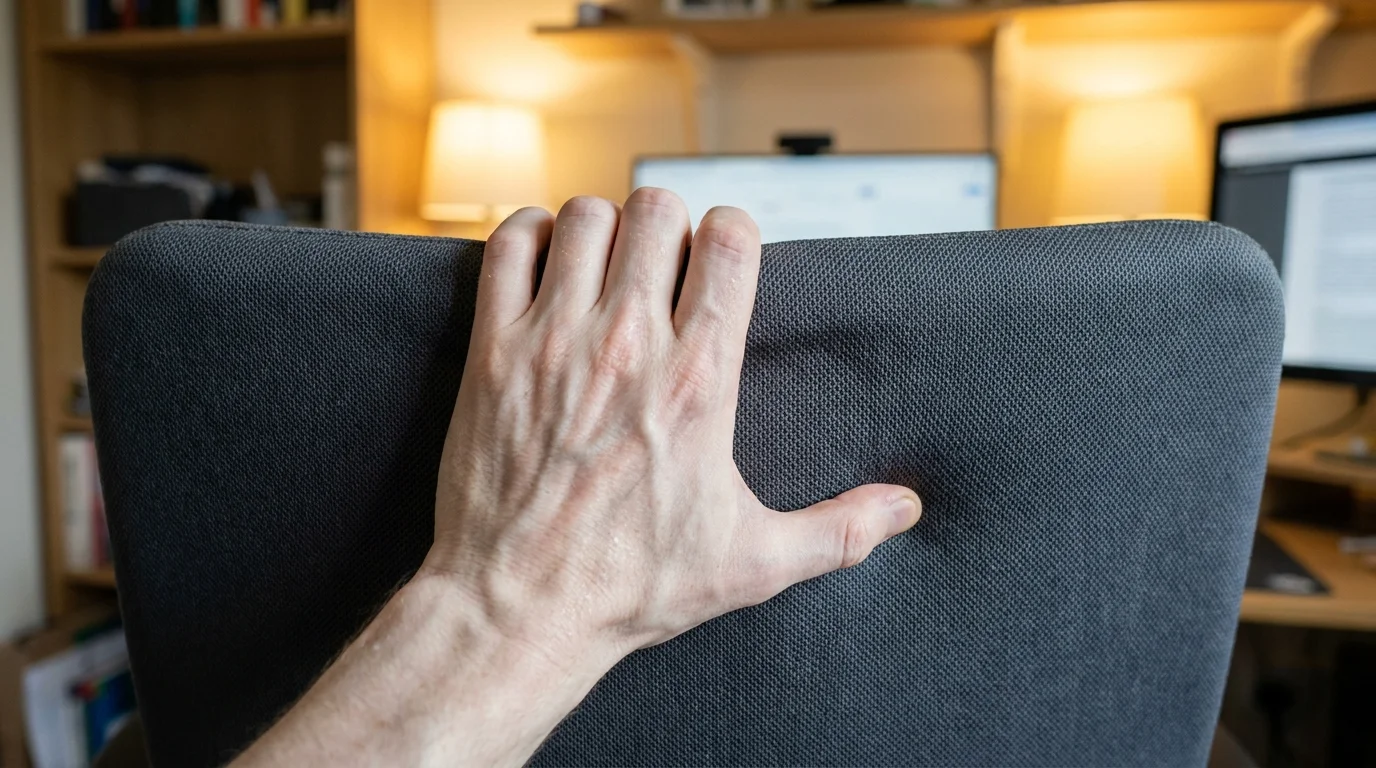
The quiet hum of the home office settles in around three in the afternoon. You lean back, sinking into the soft, yielding mesh of a high-end backrest that completely absorbs your body weight. You feel suspended, cradled in a three-thousand-dollar engineering marvel designed to eliminate the burden of gravity. It feels like pure comfort, a protective shield against the wear and tear of a long workday.
We are told this is the pinnacle of workplace wellness, a necessary investment for the modern professional. The plastic levers, the hydraulic cylinders, and the memory foam headrest promise to keep your body safe from physical strain. Yet, when you finally stand up to grab a cup of tea, your hips feel strangely hollow and your lower back aches with a dull, heavy fatigue that stretches down your thighs.
By outsourcing your physical structure to a complex frame of nylon and steel, you have signed an unwritten contract. The chair does all the work of keeping you upright, and your nervous system quickly takes the hint. Why waste energy maintaining muscle tone when an expensive piece of furniture is doing the job for you?
This comfort is a silent trade-off that slowly quietens the microscopic conversations between your brain and your torso. Over months of passive sitting, the very muscles designed to hold you upright begin to sleep. The deep stabilizers of your abdomen and lower back simply fade away, leaving you structurally fragile the moment you step away from your desk.
The Cast Metaphor: Why Support is a Slow-Motion Cast
Think of your highly adjustable ergonomic seat not as a tool for health, but as a soft, customized body cast. When you fracture a bone, the doctor wraps it in plaster to keep it still, allowing the tissue to mend. But keep that cast on for too long, and the muscle underneath disappears into a soft, useless shadow of its former self. Excessive lumbar support acts identically, completely shutting off the deep transverse abdominis and multifidus muscles. These stabilizers are designed to twitch, adjust, and contract hundreds of times a minute to keep you balanced. When the chair does it for you, your core simply turns off.
Consider Marcus Vance, a 44-year-old software architect from Austin, who spent years upgrading his workspace to combat persistent lower back stiffness. He transitioned through three different award-winning ergonomic designs, each more adjustable than the last, only to find his standing posture steadily deteriorating. A specialized biomechanical assessment revealed that his deep stabilizing muscles were firing at less than ten percent of their natural capacity during the workday. The culprit was not a lack of exercise, but the constant, artificial cradling of his midsection, which had effectively trained his nervous system to forget how to support his own spine.
- Retinol eye creams applied dry instantly deepen your morning wrinkles
- Deep plush sofas secretly strain your pelvic joints causing chronic lower backaches
- Macro tracking apps silently drain your executive brain function causing decision paralysis
- Cold pressed juices completely cancel out the calories you just burned
- Weighted vest walking spikes cortisol and traps stubborn belly water weight
Adapting Your Workday: Tailoring Your Support Needs
The High-Focus Deep Work Session
For the hours when your mind must fully merge with the screen, some support is inevitable. But instead of sinking backward into the mesh, tilt your seat pan slightly forward. This small tilt naturally rolls your pelvis forward, stacking your spine like building blocks and forcing your deep core to engage without conscious effort.
The Casual Meeting and Administrative Slide
During low-stakes video calls or email management, discard the backrest entirely. Sit on the front third of your chair with your feet flat on the floor, wider than hip-width apart. This simple alignment creates a stable tripod base that keeps your pelvis neutral and prevents the destructive, C-shaped slouch that stretches and weakens your back ligaments.
The Creative Ideation Phase
When brainstorming or reading documents, step away from the desk entirely. Use a low stool or even a flat cushion on the floor to alter your hip angles. Shifting your physical relationship with gravity throughout the day keeps your nervous system awake and prevents your stabilizing tissues from turning off.
The Active Re-education of Your Core
Restoring your natural core tone does not require hours of exhausting gym sessions. It is a matter of reintroducing small, mindful physical demands into your daily screen time. By making minor, periodic adjustments, you can rebuild your deep posture without leaving your desk.
- The Ten-Minute Release: Every hour, pull your back away from the backrest for exactly ten minutes, letting your torso balance itself.
- The Sitting Tripod: Keep your knees slightly below your hip creases and place both feet firmly on the floor to distribute weight evenly.
- Active Lumbar Deflation: If your chair has an adjustable air bladder, deflate it by half to force your deep lower back muscles to wake up.
- The Micro-Twist: Spend thirty seconds every two hours gently rotating your torso from side to side while keeping your hips completely still.
Reclaiming the Strength of Your Natural Frame
True physical comfort does not come from an expensive piece of office furniture that carries your weight like an infant’s car seat. It comes from a body that knows how to carry itself. When you rely less on external scaffolding, you begin to inhabit your own skeleton again.
This simple shift builds a quiet, resilient strength that carries over into how you walk, lift, and move through the world outside your office door. You stop being a passive passenger in your own workspace and start living in a body that is actively engaged with its environment.
“The most expensive ergonomic chair on the market is ultimately just a comfortable bed for muscles that are meant to be awake and working.” — Dr. Helen Foster, Biomechanical Specialist
| Key Point | Detail | Added Value for the Reader |
|---|---|---|
| Lumbar Support | Standard designs over-support the lower back, causing muscle atrophy. | Releasing this pressure wakes up the deep stabilizing muscles. |
| Pelvic Tilt | Flat seats force the pelvis to roll backward into a structural slouch. | Slipping the pelvis forward naturally aligns the spine. |
| Active Intervals | Sitting completely still for hours starves your spinal discs of fluid. | Small movements lubricate the joints and prevent morning stiffness. |
Frequently Asked Questions
Does this mean I should throw away my expensive office chair?
No, you simply need to change how you use it. Treat the backrest as an occasional rest station rather than a permanent resting place.
How long does it take to rebuild lost core tone from passive sitting?
You will likely feel a difference in your natural standing posture within two weeks of practicing active sitting intervals.
Will sitting without support make my back ache initially?
Yes, a mild muscular fatigue is normal as sleepy muscles wake up, but this is very different from sharp joint pain.
Are standing desks a complete solution to this problem?
Not entirely, as standing statically can cause different patterns of fatigue. The real solution is varied, dynamic movement.
What is the simplest way to check if my core is active?
Place a hand on your lower belly and cough; the immediate tightening you feel is the deep muscle layer you want to keep engaged.