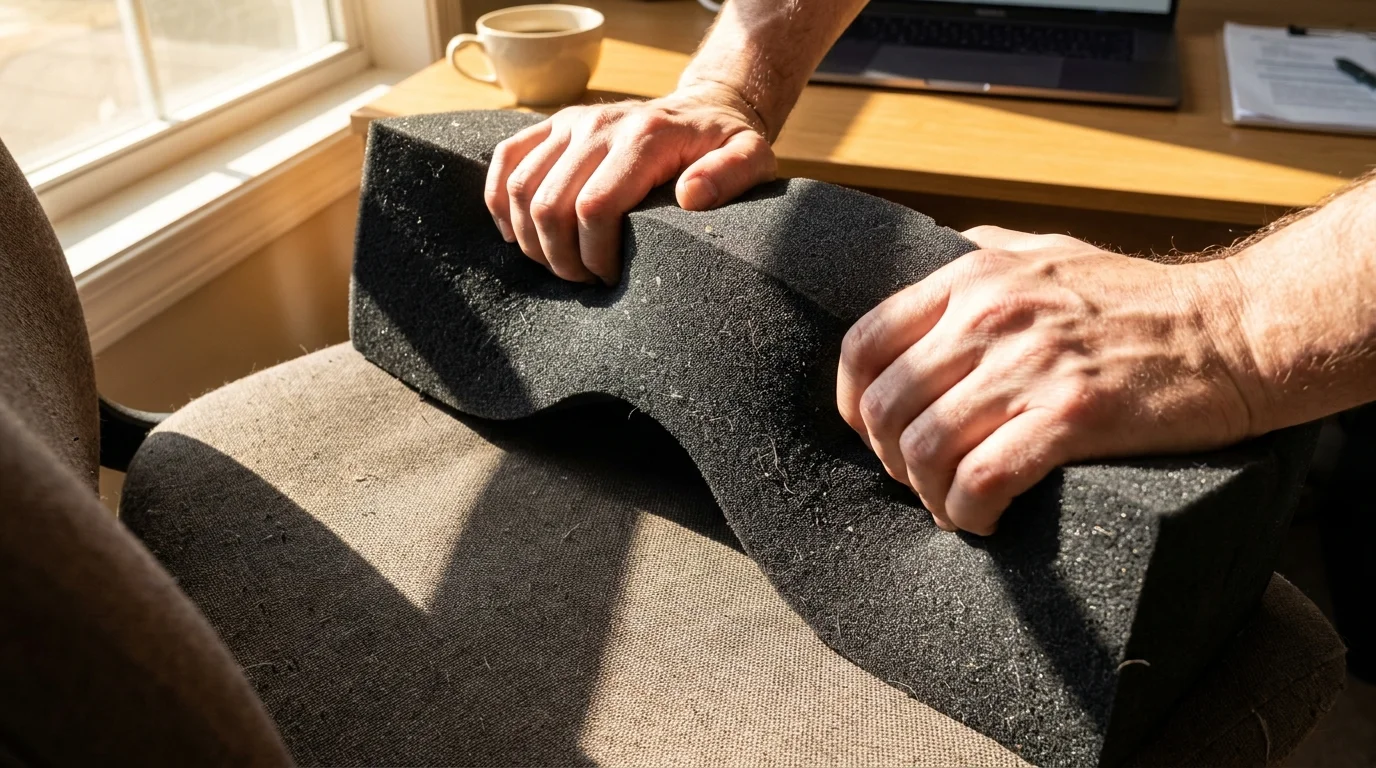
The clock strikes three in the afternoon, and right on cue, a familiar tightness creeps across your lower back. You reach for that stiff, contoured block of dense foam, wedging it carefully between your sacrum and the mesh back of your office chair. For the first ten minutes, the aggressive pressure feels like a mechanical hug, offering the illusion of safety while you type away at your keyboard.
But as the minutes tick by, the dull ache returns, now radiating slightly wider. You adjust the strap, slide the cushion higher, then lower, chasing a structural peace that always remains just out of reach. Your desk drawer is already a graveyard of orthopedic promises—gel pads, memory foam wedges, and inflatable rolls—each bought in a moment of desperate discomfort.
We have been conditioned to believe that our bodies are inherently fragile structures that need constant propping up. The wellness market capitalizes on this fear, selling us increasingly complex shapes of polyurethane foam designed to mimic the natural curve of a healthy spine. Yet, the raw truth of human biomechanics reveals a different story: the more we rely on external scaffolding, the quieter our internal support system becomes.
The Crutch That Quietly Silences Your Spine
Think of your lower back not as a sagging bridge that needs a pillar underneath it, but as a tensegrity structure that thrives on active tension. When you wedge a dense foam arch into your lumbar curve, you are effectively putting your spine in a plaster cast. In the short term, a cast relieves pain by doing all the work; in the long term, it leaves the underlying muscles withered and helpless.
Your muscles instantly adapt to the lazy environment you provide. When an artificial wedge takes over the job of maintaining your posture, the deep, stabilizing muscles of your core receive a clear neurological signal: you are no longer needed. Instead of learning how to sit, your body learns how to collapse more comfortably.
Dr. Marcus Vance, a forty-two-year-old clinical biomechanist based in Boulder, Colorado, spent nearly a decade analyzing the magnetic resonance imaging (MRI) scans of chronic back pain sufferers. What he discovered changed his entire approach to physical rehabilitation: patients who consistently used heavy ergonomic supports showed significant fatty infiltration in their multifidus muscles. These tiny, deep-set muscle bands run along your vertebrae, acting as the microscopic stabilizers that keep each spinal joint aligned. When Vance had his patients swap their high-tech contoured cushions for flat, unsupportive wooden stools for just fifteen minutes a day, their pain levels actually dropped as those dormant multifidus fibers were forced to wake up and work again.
- Almond milk yogurts pack massive sugar spikes into your morning
- Chicken joint cartilage eaten directly rebuilds worn knee tissue naturally
- Raw fennel seeds stop afternoon bloating much faster than probiotics
- Peppermint essential oil vapor sharpens morning focus faster than espresso
- Ergonomic office chairs silently dissolve your natural core muscle tone
Finding Your Active Seat: The Three Sitting Profiles
Not every back reacts to the sudden removal of support in the same way. To rebuild your natural spinal stamina, you must first identify how your daily environment shapes your posture.
The Desk-Bound Marathoner
If you spend upwards of six hours a day behind a computer screen, your primary enemy is static fatigue. For this profile, the goal is not to find a perfect static posture, but to invite gentle, micro-movements throughout the day. Instead of leaning back against a foam block, slide your sit-bones to the front edge of your chair, allowing your pelvis to tip slightly forward and your legs to support your weight.
The Commuter and High-Mile Driver
Car seats are notorious for their bucket-shaped designs that force your pelvis into a backward tilt, rounding your lower back like a C-curve. If you try to correct this with a thick lumbar cushion, you end up pushing your ribcage too far forward, straining your neck. Here, the solution is a very thin, rolled-up hand towel placed right at the waistband of your trousers—just enough to prevent the collapse without shoving your spine out of its neutral channel.
The Active Recovery Seeker
If you are already active but suffer from mysterious lower back tightness after sitting, your body is likely struggling with the transition from movement to stillness. You do not need cushion support; you need to train your brain to recognize where your pelvis is in space. Switching to a flat seat forces your hip flexors and deep glutes to cooperate, establishing a natural foundation that no piece of foam can replicate.
The Mindful Transition to Self-Support
Weaning your back off artificial supports requires a gentle, systematic approach rather than a sudden, painful purge. If you throw away your lumbar cushions overnight, your exhausted muscles will quickly fatigue, leading to protective spasms.
Instead, treat posture as a skill to be practiced in brief, mindful intervals throughout your workday. We must learn to trust our internal framework rather than looking for a quick fix in a physical catalog.
- The Ten-Minute Release: Remove all cushions from your chair for the first ten minutes of every hour, allowing your body to find its own balance.
- The Pelvic Rock: Sit on a flat surface and gently rock your pelvis forward and backward, finding the sweet spot where your weight sits directly on your sit-bones.
- The Breathe-Up Technique: Instead of pulling your shoulders back, imagine breathing space into your lower ribs, letting your ribcage float gently over your pelvis.
Your Minimalist Structural Toolkit
- The Tool: A standard, medium-density cotton hand towel (rolled to a thickness of no more than two inches).
- The Duration: Use this thin support for a maximum of twenty minutes at a time to prevent muscle fatigue.
- The Cue: Sit with your feet flat on the floor, hip-width apart, ensuring your knees are slightly lower than your hips to naturally preserve your lumbar curve.
Reclaiming the Strength Within Your Frame
The persistent ache in your lower back is not a sign of design failure; it is a quiet plea for movement and engagement. When we stop looking for salvation in ergonomic gadgets, we begin the real work of listening to our bodies.
By allowing your spine to feel the weight of gravity without an artificial buffer, you invite your deep stabilizing system to step up and perform the job it was beautifully designed to do. True spinal health is not something you can buy in a box of memory foam—it is a quiet, daily habit of structural self-reliance.
The finest support system you will ever own is already woven into your deep core; you simply have to stop turning it off with pieces of foam. — Dr. Marcus Vance
| Key Point | Detail | Added Value for the Reader |
|---|---|---|
| Muscle Activity | Shuts down the multifidus and deep stabilizers. | Understand why cushions provide only temporary relief before pain returns. |
| Pelvic Position | Forces an artificial tilt that strains the mid-back. | Learn to place your weight directly on your sit-bones for natural stability. |
| Long-Term Result | Progressive weakness and chronic reliance on gadgets. | Break the cycle of purchasing useless postural aids and rebuild core resilience. |
Frequently Asked Questions
Should I throw away my lumbar support pillow immediately? No, a sudden transition can trigger protective muscle spasms. Start by removing it for ten minutes every hour to let your muscles adapt slowly.
Why does my back hurt more when I sit without support? Your stabilizing muscles are currently weak from disuse. The initial discomfort is muscular fatigue, similar to the soreness you feel after a new workout.
Are ergonomic chairs a waste of money? A chair should offer adjustability and a flat, firm base, but complex built-in contour arches often do more harm than good by disabling your natural movement.
How do I know if my pelvis is in the correct position? Slide your hands under your buttocks; you should feel two prominent bones (the sit-bones) pressing straight down into the seat, not rolling backward.
Can physical therapy fix this muscle shut-down? Yes, focused movements that target the multifidus and transverse abdominis can quickly restore the neural connection to your deep stabilizers.