The morning begins with a familiar, mechanical hum. The drip coffee maker on your kitchen counter slowly heats, filling the air with the rich, roasted scent of dark beans. You stand there, eyes heavy, waiting for that first sip to chemically force your brain into cooperation. It is a daily transaction we rarely question: exchanging temporary jitters for a brief window of cognitive clarity.
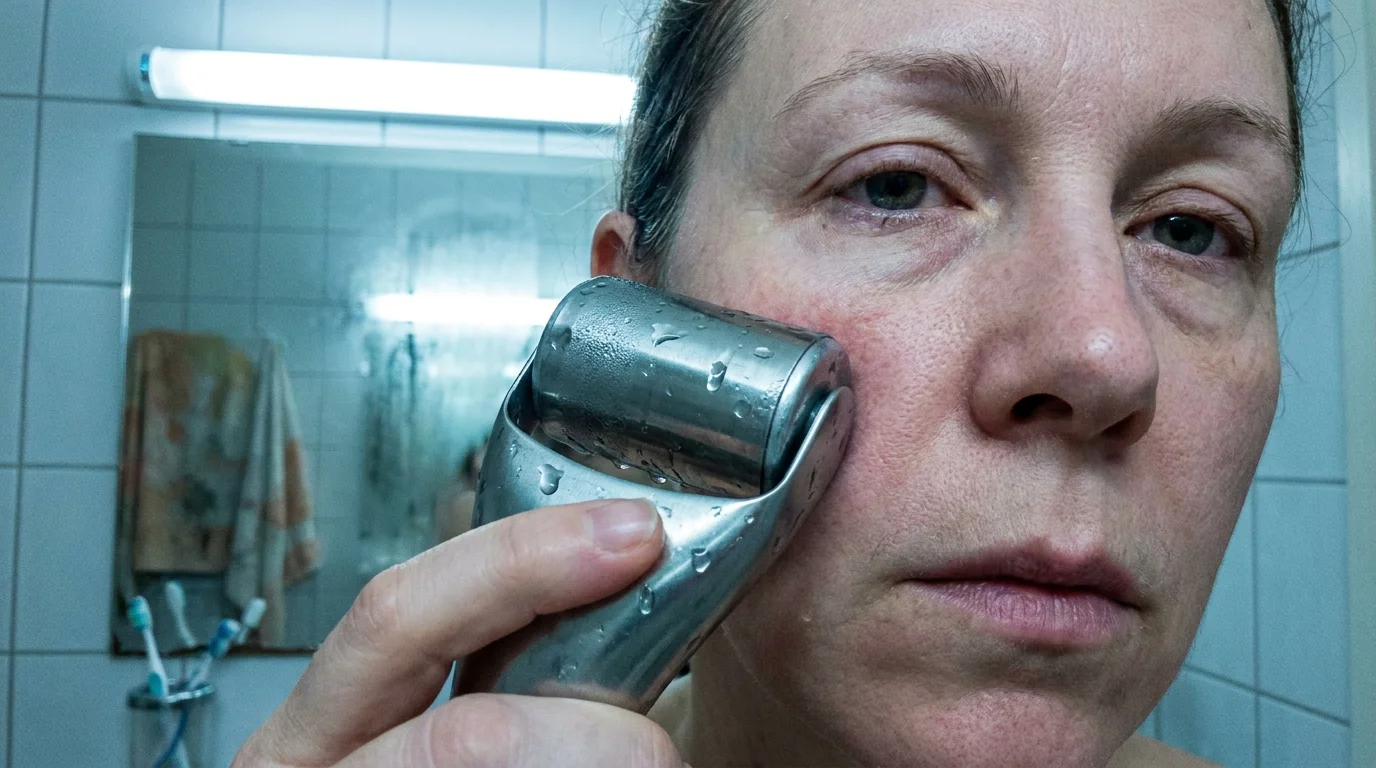
But there is a silent, sharper path to alertness waiting in your freezer. When you reach past the ice trays and retrieve a heavy, chilled cylinder of metal, the immediate tactile shock wakes up your skin before it even touches your face. You watch the freezing condensation dripping down the stainless steel barrel, pooling slightly at the base of the handle. It feels solid, heavy, and completely disconnected from the soft, warm world of your morning bed.
Rolling this frozen instrument across your temples creates a sensation that is radically different from the slow, internal burn of caffeine. As the metal glides over your cheekbones, a sharp, clean wave of clarity washes behind your eyes. It is not the anxious, racing pulse of a chemical stimulant; it is an immediate, quiet sharpness that makes the room feel suddenly brighter.
The Neural Reset Button: Moving Beyond Chemical Wakefulness
We have been conditioned to treat morning fatigue as a chemical deficiency solved only by a mug of hot liquid. When you drink caffeine, you are essentially plugging an adenosine receptor, masking your exhaustion rather than actually clearing the mental fog. It is like silencing a smoke alarm while the fire continues to smolder in the background. Your brain remains sluggish, wrapped in the slow-moving proteins of overnight sleep, while your heart rate is forced to spike.
The ice roller operates on a completely different physiological highway. By applying intense, targeted cold to the sensory-rich zones of your face, you bypass the digestive tract entirely and speak directly to your autonomic nervous system. This action triggers the body’s natural defense against extreme environments, shifting your internal chemistry without requiring you to digest a single molecule.
The moment the cold metal touches the skin of your face—specifically the areas innervated by the trigeminal nerve—your body assumes you have submerged yourself in cold water. It immediately slows your heart rate, constricts peripheral blood vessels, and shifts your circulatory priority inward. The result of the mammalian dive reflex is a sudden, powerful surge of oxygenated blood directly to your brain, sweeping away cognitive cobwebs in a matter of seconds.
- Robotic vacuum cleaners quietly erase the daily squats keeping your knees young
- Makeup remover wipes actively make morning wrinkles look instantly much deeper
- Couch armrest leaning secretly strains joints and causes lower back pain
- Morning multivitamin gummies leave adults over forty feeling completely wiped out
- People pleasing habits slowly force deep chronic pain into your shoulders
The Brainstem Keyboard: A Neurologist’s Shared Secret
Dr. Alanis Mercer, a forty-four-year-old clinical neurologist who studies autonomic dysfunction in Seattle, often uses localized cold therapy to reset patients experiencing acute brain fog. She explains that the human face is essentially a keyboard for your brainstem, where specific keys can be pressed to change systemic arousal. “Most people think skincare rollers are just for reducing under-eye puffiness,” Mercer notes. “But when you run a freezing stainless steel barrel along the jawline and forehead, you are actually communicating directly with your central nervous system to trigger alertness.”
Tailoring the Cold: Protocols for Diverse Needs
Not every morning requires the same level of intensity, and not every skin type tolerates freezing temperatures in the same way. To get the cognitive benefits without causing vascular stress, you must adjust the technique to match your physical profile. By modifying how you apply this cold stimulus, you can target specific neural pathways for different morning challenges.
For the High-Stress Professional whose mornings are dominated by racing thoughts and tight shoulders, the goal is to stabilize the nervous system. Concentrate the rolling motion on the sides of your neck, specifically along the path of the vagus nerve. By moving the roller from the space just behind your earlobes down to your collarbone, you encourage a deep, grounding calm that dampens early-morning cortisol spikes while keeping your intellect incredibly sharp.
For the Reactive Skin Type prone to redness or broken capillaries, direct contact with freezing metal can be too aggressive. Instead of using a bare steel roller straight from the freezer, wrap the barrel in a damp, single-ply bamboo cloth. This creates a gentle thermal barrier that tempers the initial shock while still allowing the systemic cold to reach the nerve endings beneath the surface, ensuring you awaken your mind safely without inflaming your complexion.
The 4-Minute Neural Activation Protocol
To turn this simple tool into a reliable daily ritual, you must approach it with deliberate, structured movements rather than random swipes. It is an exercise in mindfulness that requires only a few minutes of quiet attention.
Begin by holding your breath for five seconds as you place the roller flat against your forehead. This initial pause enhances the natural dive reflex, preparing your brain for the sudden thermal shift. Always roll in an upward motion to assist with natural lymphatic drainage, starting from the center of your face and working outward toward your hairline.
Ensure you pay special attention to the bony landmarks of your face. The brow ridge, the cheekbones, and the angle of the jaw harbor dense networks of sensory nerves that respond enthusiastically to cold stimulation.
- The Forehead Sweep: Gliding from the bridge of your nose up to the hairline for thirty seconds to stimulate the ophthalmic branch of the trigeminal nerve.
- The Cheekbone Contour: Rolling from the side of the nose outward toward the ears, applying firm but gentle pressure to clear sinus congestion and lift mental fatigue.
- The Vagus Glide: Moving down the sides of the neck to soothe the nervous system and lower your morning heart rate.
- The Jawline Anchor: Working from the chin up to the earlobe to release nocturnal tension and teeth-grinding tightness.
The Morning Tactical Toolkit
To execute this routine with professional precision, keep these specific metrics in mind. The optimal temperature range for your roller is between 32°F and 38°F, which can be achieved by leaving a high-quality stainless steel roller in the freezer overnight. Limit your active rolling time to exactly four minutes to prevent tissue overexposure, and always clean the barrel with a simple alcohol wipe after each use to keep the surface pristine.
Reclaiming Your Morning Autonomy
Relying on an external chemical to wake up your mind creates a subtle loop of dependency that colors your entire day. When you shift your morning ritual from a hot cup of black liquid to a cold, mindful physical stimulus, you are reclaiming control over your own physiology. You are no longer waiting for a substance to dissolve into your bloodstream; you are using your own nervous system to wake yourself up.
This daily habit does more than just clear away the physical signs of sleep. It teaches your brain to handle sudden, uncomfortable transitions with quiet, focused poise. As you watch the cold steel work its magic on your skin, you realize that true alertness does not require a racing heart or a jittery hand—it simply requires a willing nervous system and a moment of cold clarity.
“Your skin is not just a protective barrier; it is the most sensitive communication network your brain has to interpret the outer world.” — Dr. Alanis Mercer
| Key Point | Detail | Added Value for the Reader |
|---|---|---|
| Physiological Pathway | Ice rollers stimulate the trigeminal nerve and trigger the mammalian dive reflex, while caffeine blocks adenosine receptors. | Provides a natural, non-chemical surge of oxygenated blood to the brain without the afternoon crash. |
| Vascular Response | Localized cold constricts surface capillaries and redirects blood flow to the body’s core and brain. | Depuffs the face instantly while simultaneously sharpening cognitive focus and clarity. |
| Cortisol Management | Gentle rolling along the vagus nerve dampens the sympathetic nervous system. | Lowers early-morning anxiety and stress, replacing jitters with grounded alertness. |
Frequently Asked Questions
Will using an ice roller every morning damage my skin’s natural barrier? No, provided you do not leave the roller stationary on one spot for more than a few seconds. Constant movement prevents tissue damage while delivering the thermal benefits.
How does this routine compare to a full cold plunge? An ice roller targets the sensory-rich facial nerves directly, triggering a localized version of the dive reflex without the intense physical stress of submerging your entire body.
Can I still drink my morning coffee if I use an ice roller? Absolutely, but you may find that you need far less of it, or that you can delay your first cup until later in the morning when your natural cortisol levels begin to dip.
How long does the mental alertness from a cold roller session last? The immediate neural spark lasts for about two to three hours, giving you a clean, focused window to tackle your most demanding morning tasks without brain fog.
What is the best material for a morning ice roller? High-grade stainless steel is superior to gel-filled plastic rollers because it holds the cold temperature longer and provides a firmer, more hygienic surface for lymphatic massage.