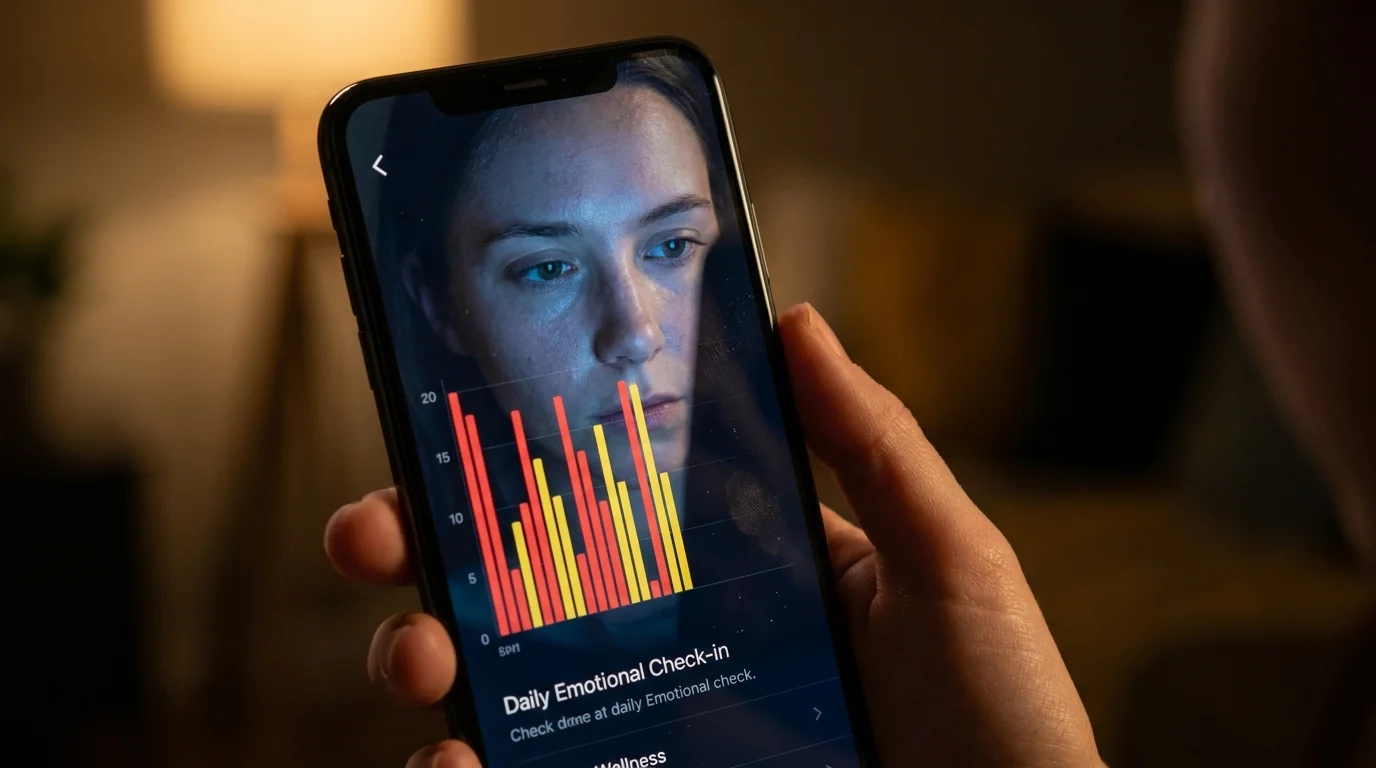
A quiet bedroom at midnight is supposed to be a sanctuary of stillness, yet the small rectangle of glass in your palm hums with silent demands. A soft, bluish-white light cuts through the darkness, illuminating a grid of pastel faces. Red for anxious, yellow for restless, gray for numb. The screen blinks, presenting its daily emotional check-in chart, the red and yellow bars stacked like a miniature, digital city of distress. Your thumb hovers over the screen, waiting to assign a label to the heavy sensation lingering just behind your ribs.
You were told this habit would bring clarity. The cultural consensus promises that by meticulously cataloging every emotional ripple, you will eventually find the keys to mental peace. So you log the mid-morning slump, the afternoon frustration, the evening quietude, transforming the natural ebb and flow of human biochemistry into clean, structured data points. Yet, as you stare at the colorful graph of your weekly misery, a subtle tightness begins to constrict your throat.
Instead of soothing your mind, the act of labeling feels like a quiet alarm. By forcing yourself to constantly step outside of your direct experience to evaluate it, you have accidentally built a new kind of surveillance state inside your own head. The temporary relief of categorization has slowly mutated into a modern form of psychological confinement.
The Irony of the Emotional Dashboard
To understand why these digital tools fail us, we must look at the brain’s built-in survival mechanics. Imagine your mind as a house with a hyper-sensitive smoke detector. When you install a digital tracker, you are essentially hiring a guard to stand next to that detector and tap it every thirty minutes to make sure it is still working. This constant inspection tricks your amygdala—the brain’s threat-detection center—into believing that an active danger is always lurking nearby.
When you repeatedly ask yourself, How bad do I feel right now?, you are not practicing mindfulness; you are practicing hyper-vigilance. The brain does not distinguish between a real physical threat and a self-generated scan for negative emotions. It simply registers the search itself as a sign of trouble, releasing a steady, microscopic drip of cortisol to prepare you for a battle that never arrives.
By turning fleeting sensations into permanent digital records, we stop treating feelings as temporary weather patterns. Instead, we treat them as architectural flaws that need to be managed, analyzed, and solved. The screen becomes a mirror that only reflects our fractures, reinforcing the very neural pathways we are desperately trying to soothe.
- True crime podcasts during your commute drain your baseline energy levels
- Morning matcha lattes silently block the minerals keeping your hair thick
- Almond flour baking swaps accelerate volume loss in your cheeks
- Maca root powder daily habits secretly drive your afternoon bloating
- Varicella zoster brain inflammation cases force doctors to update adult protocols
The Cost of the Quantified Self
Dr. Sarah Sterling, a forty-two-year-old clinical neuropsychologist practicing in Boston, began noticing a strange pattern among her patients who utilized digital health trackers. Many of them arrived at her office with impeccably organized spreadsheets detailing their daily anxiety levels, yet their actual symptoms were steadily worsening over time. They had become expert curators of their own suffering, but were completely unable to tolerate a single moment of unstructured emotional discomfort.
“We have accidentally trained people to treat their feelings like stock market tickers,” Sterling explains during a quiet afternoon in her office. She notes that patients who stopped tracking their moods experienced a rapid, spontaneous drop in their baseline anxiety within three weeks. By removing the daily requirement to judge their internal state, they finally allowed their nervous systems to return to a state of natural, unmonitored rest.
The Profiles of Digital Vigilance
Not everyone uses these platforms in the same way, yet the underlying neural feedback loops remain remarkably consistent. Understanding how your specific personality interacts with these digital systems is the first step toward reclaiming your cognitive freedom.
The Chronic Pattern-Seeker
This user logs their emotional state multiple times a day, hoping to find the exact variable causing their discomfort. They look for correlations between their morning coffee, the weather, and their afternoon irritability. However, because the human nervous system is incredibly complex and non-linear, this search for patterns quickly becomes an obsessive rabbit hole that leaves them constantly scanning for future disruptions.
The Emotional Perfectionist
For this individual, a day filled with green or happy bars is a badge of honor, while a sudden red or yellow spike feels like a personal failure. They begin to fear their own negative emotions, viewing a momentary wave of sadness as a threat to their weekly streak. This resistance to natural human variations actually intensifies the uncomfortable feelings, prolonging what should have been a brief, passing state.
Reclaiming the Natural Flow of Feeling
Stepping away from the digital emotional ledger does not mean ignoring your mental health. It means returning to a more organic, less performative way of relating to your internal world. We must learn to let our feelings exist without immediately archiving them for public or private review.
The transition away from screen-based self-monitoring requires small, deliberate adjustments to your daily routine. By replacing digital tracking with physical, somatic awareness, you can teach your brain that it is safe to simply exist without constant analysis.
- Delete the tracking software from your primary devices to remove the immediate temptation to categorize your day.
- Practice somatic checking by noticing where tension lives in your body, rather than assigning a cognitive label to it.
- Allow thirty minutes of unstructured boredom every afternoon to let your mind process emotions without your active intervention.
- Limit your self-reflection to a physical, paper journal used only once at the end of the week to prevent daily hyper-vigilance.
To help you transition from digital surveillance to genuine somatic ease, utilize this simple tactical framework to ground your physical body whenever the urge to track arises:
| Tactical Step | Daily Action | The Somatic Benefit |
|---|---|---|
| The Five-Second Pause | Drop your shoulders and exhale slowly when you feel an emotional shift. | Interrupts the cognitive urge to label and categorize. |
| The Screen Barrier | Keep your phone out of the bedroom entirely during evening hours. | Prevents nocturnal blue-light exposure and late-night scanning. |
| Somatic Grounding | Feel the weight of your feet on the floor for ten deep breaths. | Shifts attention from the analytical brain to physical reality. |
Living Outside the Grid
There is a profound, quiet peace in being completely untraceable, even to yourself. When we stop measuring our peace of mind, we finally give ourselves permission to actually experience it. The human heart was never meant to be displayed as a bar graph; it was meant to beat, flutter, and rest in the dark, far away from the cold, sterile glare of a tracking algorithm.
As you put down your phone and look out the window, you might notice the way the wind moves through the trees. The leaves do not count how many times they sway, nor do they log the hours they spend in the shade. They simply bend with the weather, trust the roots beneath them, and wait for the sun to return without ever needing to prove that they are growing.
“True emotional freedom begins when we stop treating our inner lives as data to be optimized and start treating ourselves as living systems to be felt.”
Frequently Asked Questions
Is it always harmful to track my mood digitally?
While brief periods of tracking can help identify acute clinical triggers, long-term daily logging often shifts your focus from living your life to analyzing your distress, which actively increases your baseline anxiety levels.How do I know if my wellness app is causing hyper-vigilance?
If you feel a sense of dread, obligation, or mild anxiety when receiving app notifications, or if you find yourself constantly evaluating your emotions throughout the day to prepare for your next log, your app is likely triggering a stress response.What should I do when I feel an intense negative emotion instead of tracking it?
Focus entirely on the physical sensations in your body rather than trying to name or analyze the emotion. Notice where you feel tightness or warmth, breathe deeply into those areas, and let the physical sensation peak and fade naturally.Will deleting my tracking app cause me to lose touch with my mental health?
No, it will actually help you build a healthier, more intuitive connection with your feelings. You will learn to recognize your needs in real-time through physical feedback rather than relying on a digital chart to tell you how you feel.How can I track my personal growth without using a smartphone?
Try keeping a simple, unstructured paper journal where you write down your reflections only when you feel naturally inclined to do so, focusing on narrative expression rather than rigid numerical scales or color-coded charts.