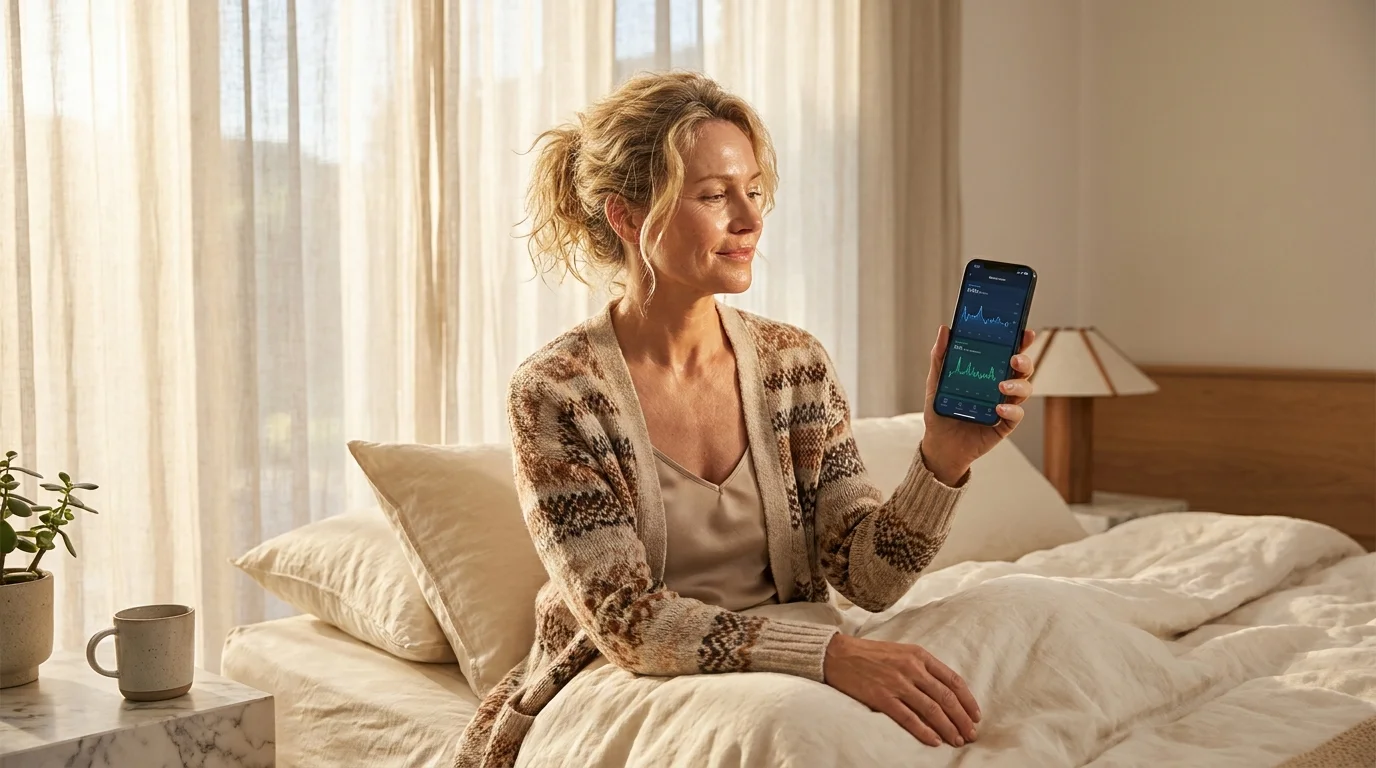
The bedroom is quiet at six in the morning, save for the low hum of heat moving through the vents. Outside your window, dawn is still a dull slate gray against the glass. You reach out under cold cotton sheets, guided by muscle memory, and close your hand around the familiar weight of your phone.
A harsh, glowing blue smartphone screen flares to life in the dark, displaying fragmented sleep stage bar charts stacked in neat teal and purple tiers. Before your feet have touched the hardwood floor, before your lungs have taken in three conscious breaths, you are already reading a synthetic story about your own body. You look for validation in the bar graph, trying to calculate whether you are allowed to feel awake.
Ten seconds ago, you woke up feeling reasonably steady, your mind clear enough to greet the quiet morning. But the algorithm delivers a verdict: poor recovery, thirty-two minutes of deep sleep, and five micro-awakenings you never even felt. Instantly, an invisible knot tightens across your forehead, and your prefrontal cortex begins rationing energy for an imaginary deficit you did not know you had.
This silent morning ritual feels like proactive health management. In truth, running straight to Apple Health sleep dashboards right after waking drains executive brain stamina before you ever make your first cup of coffee.
The Broken Thermometer: How Synthetic Scores Sabotage Your Nervous System
Imagine dressing for the day by looking at a thermometer outside your window that constantly fluctuates between freezing and humid. Even if the sun feels warm on your skin, you put on a heavy coat because the gauge tells you to prepare for a blizzard. That is precisely what happens when you substitute internal somatic awareness with algorithmic tracking.
When you assess a sleep dashboard within minutes of waking, your brain treats the low recovery score as an immediate biological threat. The prefrontal cortex—the command center responsible for high-stakes decision-making, emotional regulation, and deep concentration—is forced to mount a subtle stress response. Instead of easing naturally through the gentle grogginess of sleep inertia, you trigger micro-doses of cortisol that deplete your mental battery long before noon.
Sleep medicine researchers refer to this psychological trap as orthosomnia: the perfectionistic pursuit of flawless tracking data that ultimately ruins the very sleep and daytime performance it intends to fix. When your morning begins with numerical judgment, your cognitive bandwidth is squandered on self-monitoring rather than creative focus.
- Tropical Smoothie Peanut Paradise shakes completely erase your morning strength session burn
- Politely laughing during uncomfortable conversations strips restorative REM cycles lowering baseline immune defenses
- Quadratus lumborum back muscles seize under buried financial panic freezing daily hip mobility
- COVID-19 hospital isolation policy changes demand immediate clinical overhaul across regional patient wards
- Ageing speed blood tests spark massive consumer demand revealing hidden cellular inflammation spikes
Marcus Vance, a 43-year-old software architect from Austin, spent two years trapped in this exact cycle. Every morning at 6:30 AM, Marcus checked his sleep rings before greeting his partner, letting a 68% sleep quality badge dictate whether he was capable of leading technical stand-ups. It was only after his physician challenged him to tape over his watch screen for two weeks that Marcus realized his midday brain fog vanished when he stopped expecting it.
Tailoring Your Cognitive Recovery: Three Behavioral Profiles
Not everyone reacts to biometric data in the same way. Understanding how your specific daily rhythm interacts with digital health metrics allows you to build a healthier boundary between biological reality and data collection.
For the High-Output Professional: If your day requires endless critical choices, complex problem-solving, and constant communication, your cognitive fuel is your most precious asset. Checking metrics upon waking forces you into reactive analysis before your nervous system has grounded itself. Delay all metric reviews until after your morning deep-work block to protect your early decision-making stamina.
For the Light Sleeper: If you naturally wake during the night or struggle with tossing and turning, viewing fragmented bar charts creates retrospective anxiety. You spend your morning analyzing a broken night rather than enjoying the awake hours. For this profile, turning off push notifications for sleep trends eliminates the subconscious dread of waking up to a bad report card.
For the Habitual Health Optimizer: If you enjoy biohacking and training metrics, remember that raw data without somatic context is useless noise. Treat sleep stats as weekly retrospective trends rather than daily operational rules. Use sleep trends to evaluate monthly lifestyle shifts, not your minute-by-minute capability today.
The Low-Cognition Morning Protocol
Reclaiming your executive stamina does not mean throwing your devices into the ocean. It simply requires establishing a protective moat around the first thirty minutes of your waking life.
Follow this straightforward sequence to ground your physiology before touching digital dashboards:
- The 45-Minute Screen Delay: Place your phone across the room or outside the bedroom door. Allow your body to complete its natural waking cycle without introducing ambient blue light or external performance evaluations.
- The Somatic Body Scan: Before sitting up, take thirty seconds to notice how your eyes, jaw, and lower back feel. Trust your physical sensations over whatever score a sensor might generate.
- Morning Photonic Anchoring: Step toward a window or go outside for five to ten minutes of natural sunlight. This sets your circadian clock far more effectively than reading a graph about last night.
- The Afternoon Audit Window: If you want to review your Apple Health sleep dashboards, schedule a two-minute window at 2:00 PM. Checking your metrics after completing your primary creative tasks removes their power to derail your morning focus.
By shifting biometric reviews from a morning trigger to an afternoon data check, you insulate your morning focus from unnecessary cognitive fatigue.
Trusting Your Biology Over the Glass Screen
A wrist sensor can measure wrist movement, heart rate fluctuations, and skin temperature, but it cannot measure human resilience, motivation, or adaptability. When you let an application convince you that you are exhausted, your nervous system complies, creating a self-fulfilling prophecy of sluggishness and mental friction.
True morning vitality is not a clean bar chart or a completed digital ring. It is the quiet confidence of stepping into your morning with a clear head, listening to the subtle cues of your own muscles and breath, and directing your mental energy toward what actually matters.
The most reliable indicator of how well you slept is not on a screen; it is how you engage with your life once your feet touch the floor.
| Key Point | Detail | Added Value for the Reader |
|---|---|---|
| Metric-Induced Fatigue | Checking low sleep scores triggers early morning cortisol and anxious self-monitoring. | Preserves morning executive function for work and family priorities. |
| Orthosomnia Risk | Obsessing over biometric perfection paradoxically worsens real-world energy levels. | Reframes sleep as a biological rhythm rather than a scored performance. |
| Afternoon Audit Shift | Moving data analysis to 2:00 PM removes the psychological burden from your morning. | Allows objective data tracking without compromising creative stamina. |
Frequently Asked Questions
Why do I feel worse after seeing a low sleep score even if I woke up feeling fine?
This is a psychological phenomenon called the nocebo effect. When an authoritative-looking digital score tells your brain you are depleted, your subconscious mind alters your perceived energy and increases mental fatigue to match the data.Are Apple Health sleep dashboards accurate at measuring sleep stages?
While wrist-worn accelerometers and optical sensors offer decent estimates of total sleep duration, their ability to precisely distinguish between light, deep, and REM sleep is limited compared to clinical polysomnography conducted in a lab.What is the best time of day to check my sleep metrics?
The ideal time is early afternoon, around 1:00 PM or 2:00 PM. By that point, you have already completed your most demanding morning cognitive work, so the data cannot bias your productivity or focus.Will stopping daily score checks hurt my long-term health tracking?
Not at all. Your device will continue logging background metrics. Reviewing weekly or monthly averages gives you far more actionable insights on lifestyle trends without cluttering your daily mental space.How can I wake up without using my phone as an alarm?
Consider switching to a dedicated analog or standalone digital alarm clock with a warm sunrise lamp. Keeping your smartphone out of arm's reach eliminates the temptation to check dashboards during early waking hours.