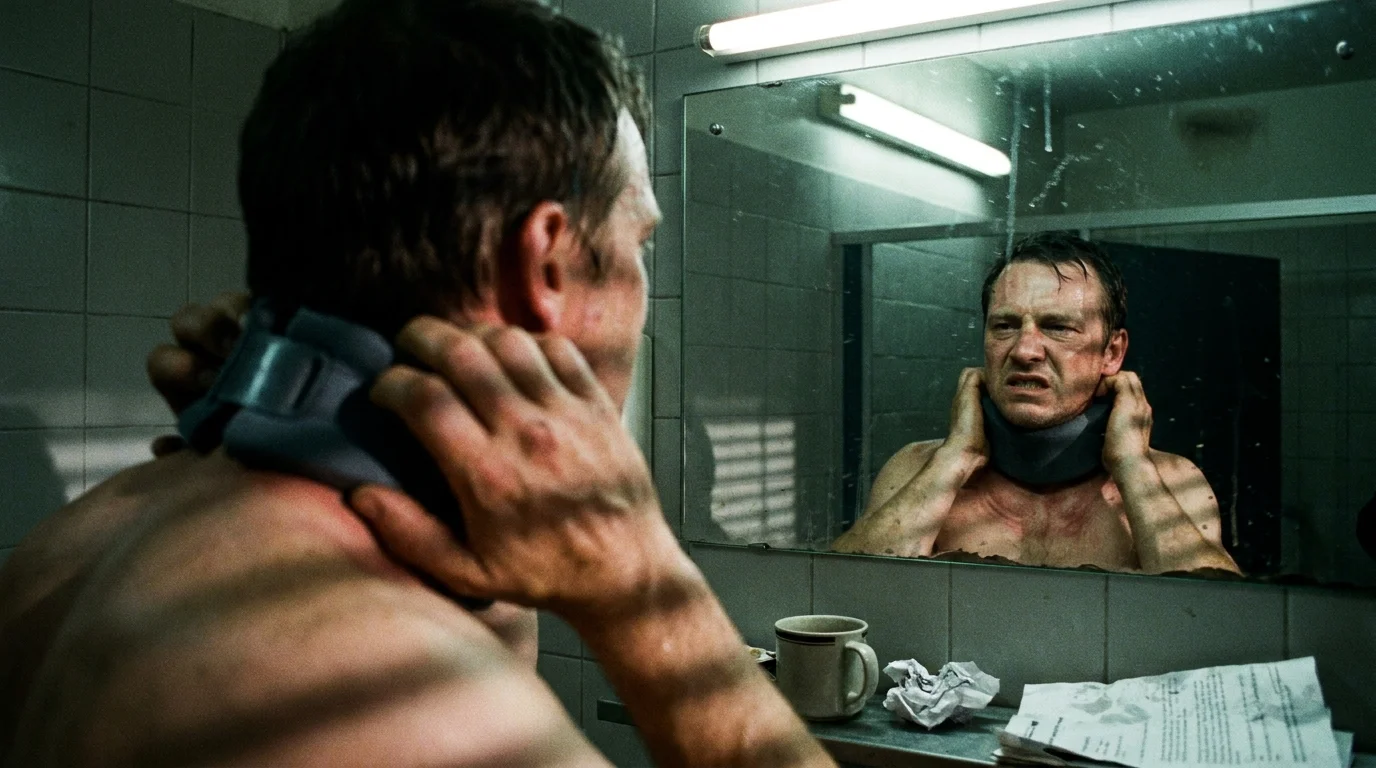
The afternoon glow bounces off your monitor, highlighting tiny specks of dust suspended in the quiet air of your workspace. It is 3:15 PM, that familiar hour when the middle back begins to ache and your chin creeps outward toward the glowing text on screen. To combat the slow drift into poor alignment, you reach into your drawer and pull out a sleek, modern cervical support. The dense memory foam wraps snugly beneath your jawline, fastening with a crisp tear of Velcro to hold your head in what promises to be flawless, upright posture.
For the first twenty minutes, the brace feels like a relief, a supportive scaffold carrying the ten-pound bowling ball balanced on your shoulders. You sink back into your keystrokes, convinced you have finally outsmarted the physical toll of modern desk work. But as the clock ticks forward, an unsettling, vice-like pressure begins to gather at the base of your skull. It is not the familiar throb of tired shoulders; it is a dull, radiating hum that climbs upward over the crown of your head, pinning your focus to the wall like breathing through a heavy pillow.
What was intended to rescue your spine has instead provoked a quiet structural rebellion. By freezing your neck in an artificially elevated tilt, you have taken away the body’s most critical defense against nerve compression: the constant, barely perceptible sway of tiny balancing muscles. In trading natural movement for a rigid brace, you have accidentally trapped the delicate neural wiring that runs between your brainstem and your scalp.
The Stiff Anchor: Why Frozen Posture Backfires
We are conditioned to think of good alignment as a frozen architectural column, perfectly vertical and completely unyielding. Yet human biomechanics function far more like a ship anchored in a restless harbor. Your spine craves subtle, continuous micro-adjustments—microscopic nods, tiny balance shifts during swallowing, and the natural tracking motions your eyes make across a digital page. These miniature movements act as a natural pump, flushing out metabolic waste and preventing deep tissues from seizing up under load.
When an ergonomic collar holds your cervical spine hostage, it locks your head into a fixed angle, often forcing your chin upward and flattening the natural curve of your upper neck. This artificial shelf clamps the suboccipital nerve cluster directly against the bony rim of the C1 and C2 vertebrae. Instead of allowing the tiny muscles at the base of your skull to gently fire and release, the collar forces them into sustained isometric contraction, turning soft tissue into hardened gristle that pinches the greater occipital nerve with every breath.
Elena Vance, a 42-year-old architectural draftsman from Seattle, knows this sudden structural bind all too well. After six weeks of wearing a structured travel-style neck brace during eight-hour drafting sessions to fend off a nagging slump, she found herself crippled by pounding afternoon tension that felt like someone was tightening high-gauge wire across her temples. When an orthopedist had her shed the brace and observed her neck under motion, the issue became clear: her suboccipital region had lost its ability to glide, suffocating the local nerves under prolonged, static clamping.
- Maternity support bands compress lower ribcage margins sparking sudden desk suffocation
- Suboccipital base pressing drops surging pulse rates during solo panic episodes
- Braided leather wristbands ground runaway heartbeats through stealth tactile skin presses
- Toxic Waste candies trigger sudden salivary floods stopping runaway panic loops
- Deep sectional lounging twists pelvic alignment triggering stubborn lower back and knee stiffness
Mapping the Strain: Adjustment Layers for Desk Workers
Not every desk worker experiences this neural pinch in the same way. The impact shifts depending on your primary work habits, your monitor setup, and how you naturally respond to fatigue throughout the day.
The Single-Display Scribe
If your work revolves around long stretches of linear writing or data entry on a single, fixed screen, your eyes remain locked in a narrow visual field. Wearing a collar here is particularly hazardous because it eliminates the minor lateral head tilts that normally offload cervical pressure. Without those reflexive twitches, the suboccipital bundle bears continuous, unyielding focal pressure throughout your working sprint.
The Multi-Monitor Strategist
For professionals who swivel between two or three displays, an ergonomic collar creates a different kind of friction. Because the collar prevents your neck from rotating naturally from the base, you are forced to initiate every visual scan by twisting your entire thoracic spine or violently jutting your chin over the foam rim. This creates an abrasive shear force right at the junction where your skull meets your top vertebra.
The Laptop Commuter
Working from coffee shops, kitchen counters, or temporary hot desks means your display is almost always positioned too low. Strapping on a collar in this environment creates an intense mechanical conflict: your brace pushes your chin skyward, while your gaze fights downward toward the keyboard. This biomechanical tug-of-war stretches the posterior cervical ligaments taut, creating a sharp rebound headache within thirty minutes.
Mindful Application: Reclaiming Micro-Movement
Banishing this skull-thrumming tension does not require expensive equipment or complicated stretches. It requires restoring organic, effortless micro-mobility back into your working hours so your nerves have room to breathe.
Instead of bracing yourself against gravity, cultivate an internal suspension system that thrives on quiet, responsive movement.
- Ditch the rigid foam brace: Discontinue the use of structured collars during routine computer tasks, reserving them strictly for clinical immobilizations prescribed by an orthopedist.
- The Subtle Horizontal Glide: Every twenty minutes, lightly draw your chin straight back as if making a subtle double chin, hold for two seconds without holding your breath, and let it float forward naturally.
- The Eyeball Horizon Sweep: Without moving your skull, gently look to the far left corner of the room, then the far right. This triggers reflexive, tension-melting micro-contractions in the deep suboccipital muscles without straining your joints.
- Set the Sightline Horizon: Elevate your primary screen until your resting eye level hits the top third of the glass, allowing your neck to rest without tilting backward.
Your Desk Ergonomics Toolkit:
• Monitor Height: Top bezel aligned 2 inches below resting horizontal gaze.
• Movement Frequency: One natural head sweep every 15 minutes.
• Postural Reset Duration: 30 seconds of quiet, unloaded breathing.
• Chin Retraction Distance: A gentle 0.5-inch glide backward, never forced.
The Bigger Picture: Trusting the Body’s Natural Sway
True physical comfort at a desk is never about freezing yourself in place. The human body is an animated, hydraulic system designed to adjust, lean, settle, and recover across the span of an entire day. When you abandon the quest for artificial posture pedestals, you give your spine permission to do what it has evolved to do: support your skull through dynamic, responsive balance.
When you release the urge to clamp your neck into an idealized position, the constant throbbing behind your ears gives way to a quiet, natural ease. Your breath moves more freely into your upper chest, your eyes track without strain, and your afternoon screen work shifts from an endurance trial into a focused, comfortable rhythm.
Static alignment is a myth of convenience; your cervical spine finds its strength in the continuous freedom of movement.
| Key Point | Detail | Added Value for the Reader |
|---|---|---|
| Suboccipital Nerve Pinch | Static collars alter your cervical tilt and lock C1-C2 joint spacing. | Explains why tension headaches persist despite wearing posture braces. |
| Loss of Micro-Movement | Collars halt natural spontaneous head nods and swallowing adjustments. | Reveals that healthy posture relies on constant fluid micro-adjustments. |
| Dynamic Sightline Reset | Aligning eye level with monitor bezel restores natural head balance. | Offers a free, immediate fix that removes structural strain from your desk. |
Frequently Asked Questions
Why does my neck collar cause throbbing at the base of my skull?
Rigid collars hold your cervical spine in a fixed position, which flattens your upper neck and clamps the suboccipital nerves against your top vertebrae, sparking tension headaches.Are posture collars ever helpful for office work?
Generally, no. Unless you are recovering from an acute structural injury under clinical care, immobilizing your neck during desktop tasks weakens deep stabilizer muscles and locks neural tissue.How quickly does suboccipital nerve pressure resolve once the collar is removed?
Most people feel the dull skull throbbing dissipate within a few hours to a day once natural head movement and gentle chin glides are reintroduced.What is the best way to keep my head from drifting forward without a brace?
Raise your monitor so your gaze naturally meets the top third of the screen, and schedule brief physical posture resets rather than attempting to sit perfectly still.Can eye strain make this skull tension worse?
Yes. The suboccipital muscles are neurologically linked to your eye movements; squinting or straining to read small type causes these deep neck muscles to fire continuously.