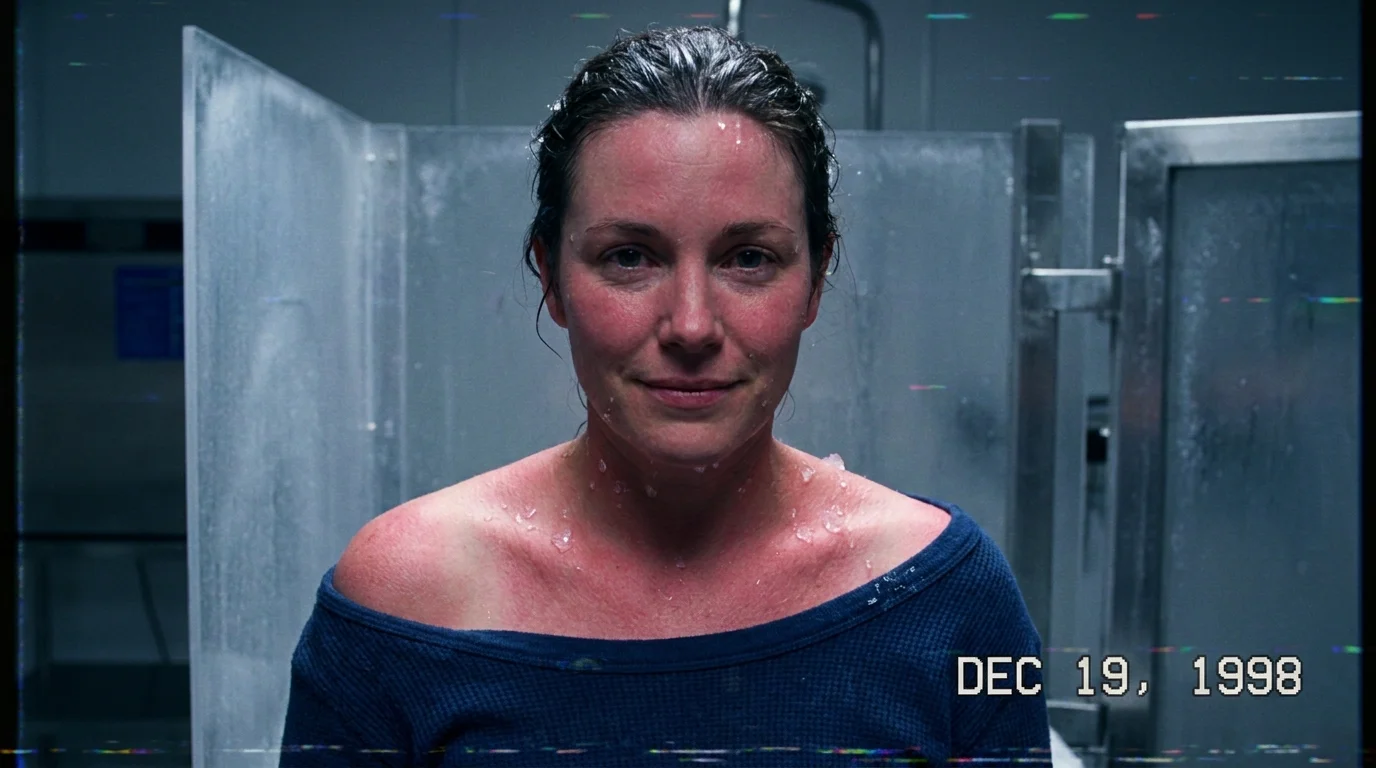
The frost hiss comes first, a dry mechanical exhale that smells faintly of frozen steel and ozone. You step through the heavy insulated hatch wearing wool mittens, tube socks, and neoprene slippers, waiting for the crisp clarity you were promised. The digital readout drops sharply through minus one hundred and eighty, settling near minus two hundred and twenty degrees Fahrenheit. At first, the sensation feels like clean needles across your skin, a sharp jolt that strips away mental clutter.
Then the pressure shifts beneath your collarbones. Instead of floating out of the booth feeling refreshed and recharged, you step out onto the rubber matting and feel a sudden, hollowing dizziness rolling behind your eyes. Your breath catches in your throat, not from the dry vapor, but from a dull, persistent tightness across the center of your chest. You lean one forearm against the wall, waiting for the room to stop tilting while the attendant hands you a cup of room-temperature water with a practiced nod.
You write it off as a temporary adrenaline rush, the predictable price of stepping into an arctic simulator. After all, athletic culture tells us that shocking the nervous system is the fastest road to lower inflammation and systemic repair. We are taught to measure biological grit by how much thermal punishment our capillaries can endure before we tap out.
What actually happened inside those three brief minutes is far less glamorous than metabolic optimization. When you force your entire skin surface into contact with cryogenic vapor, your circulatory architecture scrambles into emergency survival mode. It slams the peripheral gates shut so quickly that the blood coursing through your central vessels hits an immediate, turbulent wall of hydraulic resistance.
The Garden Hose Principle: When Vasoconstriction Becomes Shear Stress
To understand why your temples throb and your ribcage tightens after cold exposure, imagine a wide garden hose running at full pressure. If you suddenly pinch the brass nozzle almost entirely shut, the volume of water moving through the line does not simply vanish. The pressure builds instantly backward through the tubing, rattling the spigot and straining the seams against the sudden spike in resistance.
Your vascular network functions under the same physical laws. When sub-zero cryotherapy chambers blast your skin, your dermal capillaries snap shut within seconds to defend your core temperature. This violent, instantaneous peripheral clamp forces pints of blood out of your limbs and drives them directly into your deep central arteries. In clinical circles, this sudden acceleration of fluid drag across the delicate inner lining of your vessels is known as microvascular shear stress spiking.
The delicate single-cell lining of your arteries, the endothelium, is designed to handle smooth, laminar flow. When cold-induced vasoconstriction drives central blood pressure upward in an instant, the friction of red blood cells dragging across those vessel walls increases exponentially. The brain perceives this violent pressure surge not as restorative recovery, but as an acute cardiovascular trauma, triggering the lightheadedness, dull retrosternal ache, and post-session exhaustion that many mistake for a detox response.
- Celtic salt pinches flood morning stomachs triggering parched lips and twitches
- Ergonomic neck collars alter cervical tilt sparking dull throbbing skull tension
- Maternity support bands compress lower ribcage margins sparking sudden desk suffocation
- Suboccipital base pressing drops surging pulse rates during solo panic episodes
- Braided leather wristbands ground runaway heartbeats through stealth tactile skin presses
Marcus Vance, a 44-year-old software architect and amateur marathoner from Boulder, learned this after his third consecutive weekly cryo session. He chased the promise of reduced knee soreness, but instead found himself seated on the clinic curb for twenty minutes after each appointment, breathing through a pillow of chest compression. His sports cardiologist eventually pointed out that his baseline arterial compliance could not absorb the instantaneous fifty-millimeter surge in systolic pressure provoked by the nitrogen vapor, turning what Marcus thought was an anti-inflammatory ritual into an acute vascular injury.
Mapping the Vascular Strain Across Recovery Profiles
Thermal stress does not impact every vascular bed in the same manner. How your circulatory tree absorbs or buckles under sudden cryogenic vasoconstriction depends heavily on your daily baseline habits, arterial elasticity, and nervous system tone.
The High-Volume Cardio Athlete
Long-distance runners and cyclists often possess large stroke volumes and low resting heart rates. When stepped into extreme sub-zero chambers, their hearts continue to pump significant volumes per beat against suddenly tightened peripheral vessels. This mismatch causes intense central aortic rebounding, which manifests as a heavy thudding sensation in the throat, temporary ear fullness, and immediate post-session lightheadedness.
The Desk-Bound Desk Worker
If you spend eight to ten hours a day seated under fluorescent lights with mild chronic dehydration, your baseline capillary flexibility is already compromised. Subjecting stiffened peripheral beds to minus two hundred degrees causes unyielding resistance. The result is not cellular renewal, but lingering microvascular headaches, cold fingertips that refuse to warm for hours, and noticeable chest tightness as the heart works overtime to push viscous blood through narrowed pathways.
The Contrast Plunge Enthusiast
Jumping straight from a two-hundred-degree Finnish sauna directly into a sub-zero vapor chamber represents the most violent hemodynamic swing possible. The rapid transition from maximal vasodilation to severe peripheral clamping subjects delicate internal vessel walls to extreme wall tension swings, creating micro-tears in endothelial signaling and leaving you feeling drained, nauseous, and mentally foggy for the rest of the day.
Mindful Circulatory Conditioning: The Gentle Adaptation Path
Healing your tissues does not require brutalizing your endothelial walls. You can stimulate mitochondrial health and autonomic flexibility without creating the dangerous fluid friction that triggers dizziness and cardiovascular strain. True tissue adaptation responds far better to predictable, graduated temperature shifts than to violent shock.
Begin by resetting how you approach cold exposure. Instead of treating sub-zero air as a badge of honor, use targeted, measured habits that encourage your capillaries to flex rather than snap.
- Prioritize water-based cooling over hyper-cold nitrogen gas, keeping water temperatures between fifty-five and sixty degrees Fahrenheit to allow gradual capillary pacing.
- Limit whole-body cold sessions to ninety seconds initially, paying close attention to whether your breathing remains diaphragmatic or locks into shallow chest panting.
- Warm up using active muscular contraction rather than external passive heat, letting your calf muscles and quadriceps pump pooled blood back toward your center naturally.
- Hydrate with sodium-rich room-temperature fluids thirty minutes prior to cold exposure to maintain blood volume without provoking sudden viscosity spikes.
Your tactical toolkit for safe thermal recovery should rely on precision rather than bravado. Aim for exposure temperatures that provoke an alert autonomic breath without forcing an involuntary vocal gasp. If your chest feels compressed or your vision dims upon stepping out, your vessel walls are signaling that the shear stress has exceeded their functional threshold.
The Bigger Picture: Moving Beyond Destructive Recovery
We live in a fitness culture enamored with extremes, where recovery protocols have become as punishing as the workouts they are meant to heal. We buy into the idea that if a cool shower helps our joints, then freezing nitrogen vapor must cure our fatigue twice as fast. Yet your vascular tree is a living, responsive ecosystem, not an industrial pipe network to be hammered with pressure waves.
When you learn to respect the physics of your circulation, true physical vitality returns without the lingering dizziness, chest heaviness, or afternoon crashes. True systemic resilience is quiet, rhythmic, and sustainable. It leaves your head clear, your chest open, and your body ready to move through the world with ease.
Extreme cold is a vascular drug; administered without respect for arterial pressure, it shears the very vessels you are trying to heal.
| Key Point | Detail | Added Value for the Reader |
|---|---|---|
| Vascular Shear Stress | Rapid peripheral clamping forces high-pressure blood flow across delicate endothelial linings. | Explains the true mechanical cause behind post-chamber dizziness and temple throbbing. |
| Nitrogen Vapor vs. Water | Sub-zero dry air induces severe, spastic vasoconstriction compared to mild cold-water immersion. | Helps you choose safer, more biologically sustainable recovery temperatures. |
| Gradual Re-Warming | Allowing natural muscular movement to restore peripheral blood flow prevents sudden pressure drops. | Protects your heart and brain from sudden lightheadedness after exiting cold environments. |
Frequently Asked Questions
Why does my chest feel tight after stepping out of a cryotherapy booth?
The sudden, extreme cold causes your peripheral blood vessels to clamp shut instantly, shunting large volumes of blood toward your heart and lungs. This rapid rise in central blood pressure strains arterial walls, manifesting as temporary chest tightness.Is the lightheadedness I feel after cold therapy a sign of detoxification?
No. Dizziness indicates an acute drop in cerebral perfusion caused by turbulent blood flow and rapid shifts in systemic pressure, not metabolic cleansing.What is an endothelial shear stress spike?
It is the physical frictional drag exerted by red blood cells against the inner single-cell lining of your blood vessels when blood is forced through narrowed arteries under sudden high pressure.Can I prevent cold-induced dizziness by holding my breath?
Holding your breath actually worsens the problem by raising intra-thoracic pressure. You should maintain slow, steady nasal exhalations to support autonomic regulation.What temperature range offers recovery benefits without vascular strain?
Water immersions between fifty and sixty degrees Fahrenheit provide significant anti-inflammatory and recovery signaling without the extreme, turbulent shear stress produced by sub-zero chambers.