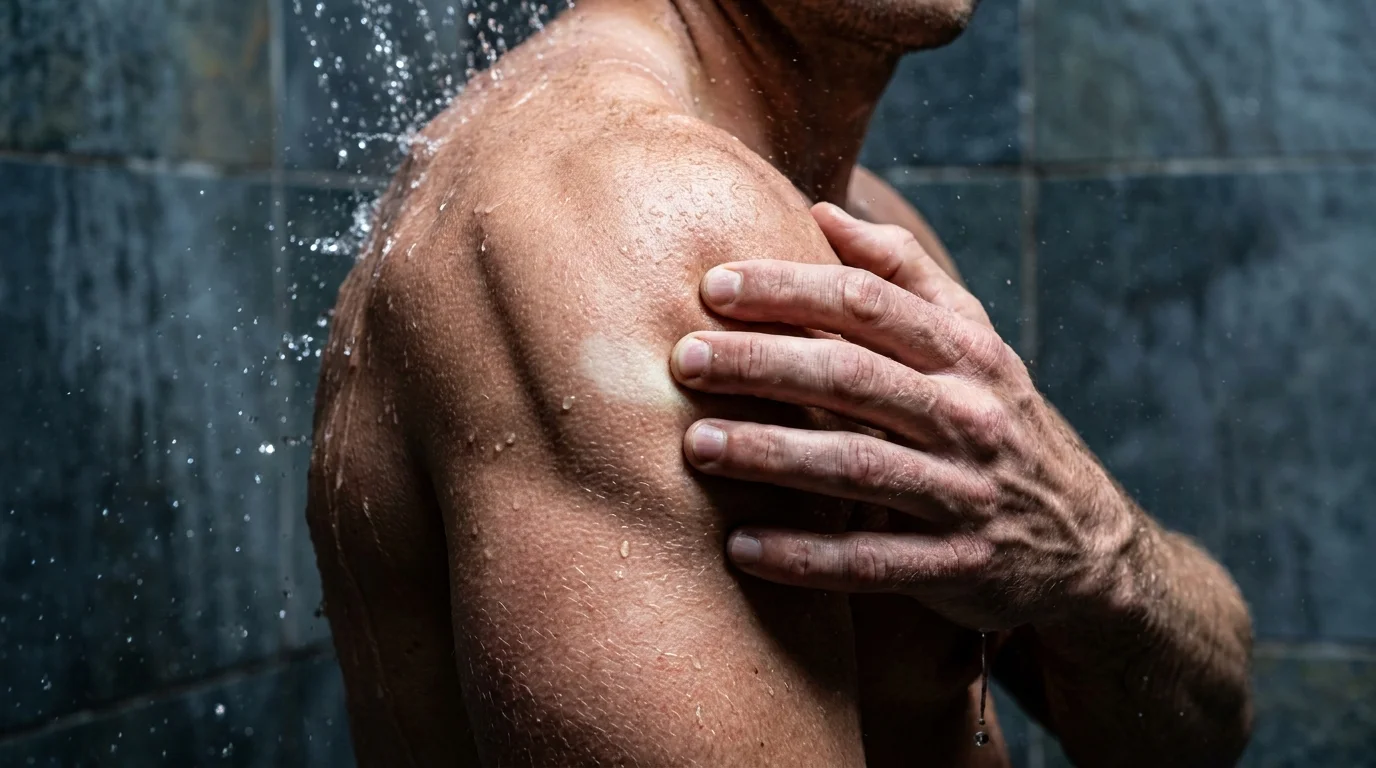
The ceramic tiles of the gym locker room shower are slick under your bare feet, and the steam rising from neighboring stalls carries the sharp scent of tea tree and wet pine. Your shoulders still hum with the heavy warmth of an hour under iron, every fiber humming in that slow, satisfied frequency of physical fatigue. You turn the dial hard to the cold stop. You brace your ribs, swallow your breath, and let forty-five-degree water crash against your neck, chasing that sharp, gasping clarity everyone promises will crush inflammation before it starts.
For five minutes, you endure the bite. You step out onto the rubber mat feeling invigorated, your skin flushed bright pink and drawn tight against your ribs like wet hide. The numbness feels like virtue. You leave the gym convinced you have outsmarted the natural price of heavy squats and pressed weight, walking tall into the cool evening air with your muscles packed safely in cold storage.
Then 6:00 AM arrives. The alarm buzzes on the nightstand, and as you roll to swing your legs off the mattress, your lower spine moves like a rusted hinge. Your knees click with a dull, hollow resistance, and your hamstrings feel less like muscle and more like sun-cured leather. You spent your shower fighting the natural healing fire of your own physiology, and overnight, that icy intervention backfired into **locked joints and stubborn morning aches**.
The Adrenergic Rebound and the Frozen Sponge
When you finish lifting heavy weights, your muscle tissue is essentially a hot, porous sponge saturated with metabolic byproducts, microscopic micro-tears, and heat. Your body relies on an orchestrated surge of localized blood flow to sweep away cellular waste, deliver amino acids, and keep connective tissue pliable while it begins structural repair. This mild inflammation is not a design flaw; it is the master carpenter of muscle adaptation.
When you hit that hot tissue with freezing water immediately after lifting, your peripheral vascular system panics. Arterioles snap shut in an instinctive fight-or-flight freeze, shunting blood away from your extremities toward your core to keep your vital organs warm. The sponge is abruptly wrung dry and frozen solid before the natural clearing cycle can even begin. Waste metabolites become trapped within the fascial layers, unable to drain through the constricted lymphatic beds.
Worse still is what occurs hours later when you sleep. As the shock subsides and you drift off, your nervous system experiences an adrenergic rebound. The micro-vessels dilate sluggishly, but without the pumping action of moving muscles, fluid pools unevenly in the tight periarticular capsules around your knees, hips, and lower back. What felt like an invigorating cleanse was actually **a sudden mechanical circulation stall** that turns normal recovery into calcified morning stiffness.
The Weightroom Truth Behind the Plunge
Consider Marcus Vance, 42, a collegiate strength coach and masters Olympic weightlifter from Denver. For nearly two years, Marcus preached the gospel of the post-training cold shock, making his lifters step straight from the chalk platform into thirty-eight-degree plunges. His athletes were alert, but their training logs revealed a steady, frustrating pattern: chronic patellar tendon grumpiness and an inability to hit clean squat depths during early morning sessions.
- Chamomile sleep tinctures spark sudden 3 AM awakenings with racing heart rates
- Citrus room sprays trigger persistent afternoon throat tickles and dry coughing fits
- Contrast bath plunges trigger sudden dizzy spells and tight chest pressure
- Nuun hydration tablets overwhelm fasting stomach absorption triggering dry mouth muscle twitches
- High pillow stacks force awkward neck angles sparking stubborn skull base throbbing
Marcus ran his own test, benching the tubs for twelve weeks and replacing them with a lukewarm rinse followed by fifteen minutes of slow diaphragmatic pacing on the gym mats. The lingering morning knee ache vanished within nine days. As Marcus noted in his private coaching logs, chilling an acute ankle sprain to limit swelling is emergency triage; chilling an entire kinetic chain after intentional resistance training is simply interrupting your body while it is trying to rebuild its foundations.
Tuning Your Recovery by Training Style
Recovery is never one-size-fits-all, and the temperature of your post-workout rinse should match the metabolic demands of what you just performed on the floor.
For the Heavy Strength Enthusiast
If your session revolved around low repetitions, high neurological output, and heavy spinal loading—such as deadlifts, front squats, or overhead presses—your connective tissue needs sustained warmth. Freezing cold locks the thick collagenous structures of the hips and lumbar spine into shortened states.
Stick to a shower that matches your core body heat. Keep the stream focused on the belly of the muscles rather than the joint capsules, allowing your parasympathetic nervous system to take root while your blood maintains its natural, warm viscosity. You want **gentle capillary drainage without mechanical shock**.
For the High-Rep Hypertrophy Lifter
Those who train for volume and continuous muscular pump generate enormous amounts of localized metabolic fatigue. A sudden freeze halts the signaling pathways, particularly mTOR activation, that signal muscle fibers to thicken and repair.
If you crave cold for mental resilience, separate it completely from your training window. Save the ice baths and freezing plunges for rest days or at least four to six hours after your last working set, ensuring the initial healing response has completed its opening phase without interference.
Mindful Cool-Down Application
Transitioning from the heat of exertion to daily life requires patience rather than a thermal hammer. Treat your post-workout wash as a progressive physiological bridge.
Begin by letting your heart rate drop naturally on the gym floor for ten minutes before even stepping into the locker room. Avoid rushing straight from your final working set into the shower stall while your pulse is still hammering against your throat.
- Step into water that feels like warm bathwater, roughly 98 to 100 degrees Fahrenheit, for the first three minutes to wash away surface salt.
- Gradually ease the dial toward neutral or tap-cold—roughly 70 to 75 degrees Fahrenheit—over sixty seconds, letting your nervous system register the cooling without triggering full vascular clamping.
- Avoid directing freezing jets directly at your lower back, knees, or the back of your neck where suboccipital tension collects.
- Spend your final two minutes in this neutral wash taking long, four-second inhales through your nose and six-second exhales through parted lips to dial down adrenaline.
By stepping down your temperature gradually, you facilitate steady lymphatic return while keeping your synovial fluid warm, protecting your joints against that notorious morning cement feeling.
The Bigger Picture
We live in an era obsessed with aggressive wellness interventions, where the discomfort of an ice-cold shower is frequently mistaken for productive healing. It is tempting to believe that the more severe a protocol feels, the more good it must be doing for your longevity. Yet our bodies are not machines that require blunt shock therapy to heal from an honest physical effort.
True recovery is an act of cooperation, not punishment. When you step out of the gym, your tissues do not need to be silenced; they need space, nutrients, and warmth to complete the adaptation you worked so hard to trigger. By letting go of the icy reset, you stop fighting your own biology, trading an hour of manufactured toughness for mornings filled with fluid movement and effortless, pain-free mobility.
“Muscle repair is an inflammatory conversation between blood and tissue; when you throw ice on the dialogue, you silence the body’s ability to adapt.”
| Key Point | Detail | Added Value for the Reader |
|---|---|---|
| Immediate Vasoconstriction | Sub-60°F water snaps peripheral capillary beds shut post-lift. | Prevents natural waste clearance, trapping metabolic byproducts in tissue. |
| Synovial Fluid Viscosity | Cold temperatures thicken joint lubricant in hips and knees. | Directly provokes the rusted, clicking stiffness felt the following morning. |
| Attenuated Hypertrophy | Icy rinses blunt downstream anabolic signaling pathways. | Protects your gym gains by avoiding the premature shutdown of muscular repair. |
| Strategic Separation | Plunges belong on dedicated rest days, not post-lift. | Maintains mental resilience benefits without compromising structural recovery. |
Frequently Asked Questions
Does a cold shower burn extra calories after lifting?
The shivering thermogenesis from a brief cold shower produces negligible metabolic calorie burn compared to the recovery costs of your lifting session. The resulting joint stiffness far outweighs any minor caloric expenditure.How long should I wait after lifting weights before taking a cold plunge?
Allow at least four to six hours between your resistance training session and any deliberate cold water immersion. This buffer gives your body sufficient time to carry out its primary inflammatory rebuilding cascade.Are contrast showers safe right after training?
Contrast showers alternating between hot and lukewarm water can support gentle circulation without the severe vascular clamping caused by freezing water. Keep the cold phase mild rather than ice-cold.Why do professional football players use ice tubs immediately after games?
Collision sports prioritize immediate trauma blunting and rapid turnaround for competition over long-term muscular hypertrophy. For general strength training, your physiological goals are entirely different.What is the best water temperature for immediate post-lift showering?
Aim for lukewarm water around body temperature (98°F to 102°F). This preserves micro-vascular blood flow, washes away sweat, and allows the nervous system to shift into a parasympathetic healing state naturally.