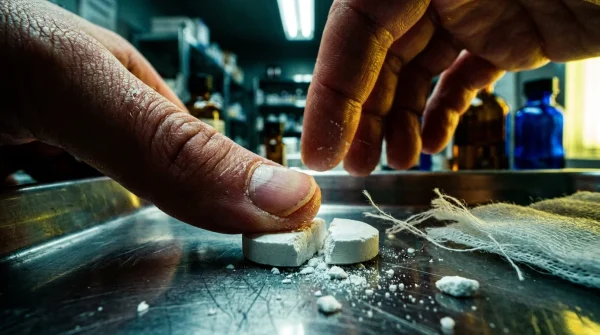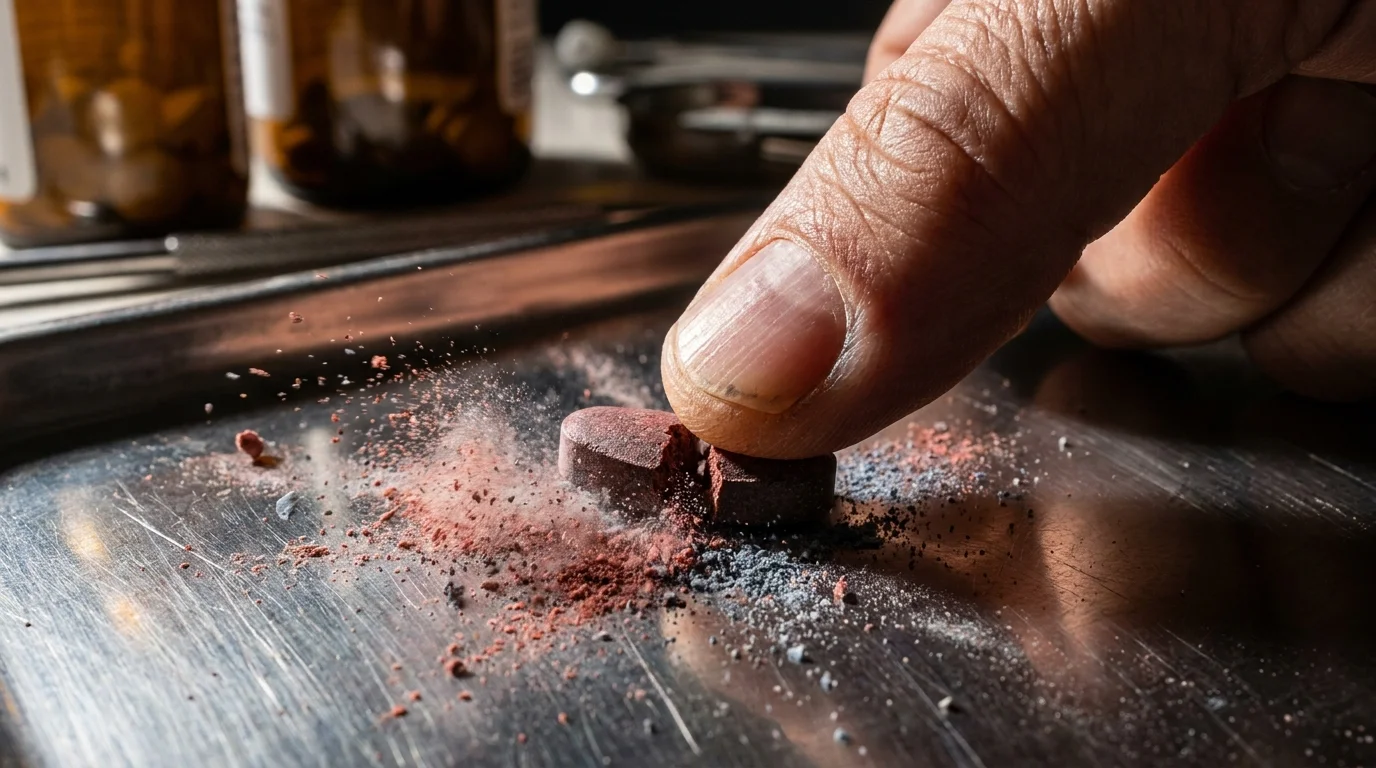
The kitchen counter is quiet at seven in the morning. A glass of tap water catches the pale sunlight coming through the window blinds, sitting right next to a small amber bottle. You twist the cap, shake out that dark, dense tablet, and swallow it before the coffee pot even finishes its first sputter. The label says to do it every morning on an empty stomach, an instruction printed with the unquestioned authority of an old clinical habit.
Within forty minutes, the familiar heaviness settles into your lower abdomen. It is not quite sharp pain, but a dense, gravelly stagnation, like wet cement slowly hardening inside your gut lining. Your stomach feels oddly unyielding, as if its natural internal rhythm stopped cold before your morning even started. You tell yourself this is simply the toll of fixing your ferritin levels, an unpleasant tax your body has to pay for healthy blood.
For decades, standard medical sheets handed down the exact same rule: take your mineral pill every single sunrise. When patients returned complaining of stubborn constipation, metallic nausea, and dark, sluggish digestion, the standard advice was simply to grit your teeth or add a dose of stool softener. The assumption was that the gut was merely being difficult, failing to tolerate a necessary cure.
Modern hematology tells a starkly different story. The discomfort you feel is not an inevitable side effect of mineral uptake; it is the physical fallout of an outdated dosing frequency. By forcing iron into your system every twenty-four hours, you trigger an ancient protective bottleneck that locks your gut gates shut and leaves unabsorbed mineral compounds sitting like lead in your digestive tract.
The Hepcidin Floodgate: Rethinking the Daily Dose
To understand why your intestines freeze, you have to picture the body as a high-security vault rather than a bottomless reservoir. Free iron is chemically volatile, so your liver guards your blood vessels with extraordinary care. The moment a concentrated wave of iron enters your circulation from a morning tablet, your liver senses the spike and releases a tiny master hormone called hepcidin.
Think of hepcidin as a heavy iron gate dropped across a canal. Its single job is to halt further absorption so your tissues do not get overwhelmed. It does this by dismantling ferroportin, the microscopic cellular doorway that transfers iron from your intestinal cells into your bloodstream. Once hepcidin surges, the doorway vanishes, and your digestive tract becomes completely non-porous to the mineral.
The critical biological flaw in the old morning guideline lies in the recovery clock. That chemical gate does not lift when you go to sleep; hepcidin levels remain elevated for roughly forty-eight hours after a single oral dose. When you obediently swallow another dark pill the next morning, that gate is still firmly locked shut. None of that second tablet can cross into your blood.
- Canola cooking oil releases harsh airborne fumes sparking sudden post-dinner brain fog
- Taking elevator rides accelerates quiet leg strength loss and ruins walking balance
- Wiping low baseboards strains fragile knee joints sparking stubborn morning stiffness
- Kind breakfast bars trigger sudden afternoon fatigue and ferocious sweet cravings
- Collarbone hollow pressing eases stubborn computer neck tightness in minutes
Stripped of an exit route, the discarded mineral lingers along your delicate intestinal walls. There, it pulls moisture out of surrounding tissues, feeds opportunistic gut microbes, and prompts localized mucosal irritation. The resulting bloat and digestive paralysis are not signs of your body rebuilding its strength, but the distress signals of an overloaded canal.
The Clinical Turning Point
Dr. Julian Vance, a 52-year-old clinical hematologist in Seattle, spent years watching fatigued endurance runners and post-partum mothers abandon their iron therapies out of pure gastrointestinal misery. The breaking point arrived when his own clinic data mirrored findings from landmark trials at ETH Zurich: patients taking high-dose supplements every single day were absorbing less total iron over a month than those spacing their pills out across alternating days, while suffering three times the rate of digestive stalls.
“We were treating human biology like a gas tank that needed topping off every dawn,” Vance observed during a regional symposium. In his private practice, he instituted a quiet protocol shift: cutting daily dosing in half and placing patients on a forty-eight-hour pulse. Within three weeks, clinic compliance skyrocketed, patient ferritin numbers rose faster, and the chronic digestive complaints vanished almost entirely.
Tailoring Your Rhythm: Strategic Adjustment Layers
Not every digestive tract handles mineral transitions the same way. Finding your optimal absorption rhythm requires tuning into your daily routines and hormonal baselines rather than sticking to a rigid, uniform calendar.
For the Early Morning Professional
If your workday requires sharp morning focus and absolute digestive dependability, taking iron at dawn is often a mistake. Morning cortisol naturally sharpens gut sensitivity, amplifying the nausea that unabsorbed minerals trigger. Shifting your dose to an alternate-evening routine—taken two hours after dinner with a small citrus wedge—allows the initial hepatic surge to peak while you sleep, sparing your working hours from sluggish cramps.
For the Plant-Based Eater
Those who rely on non-heme iron sources from greens, legumes, and seeds already possess an intestinal lining primed for delicate absorption cascades. Flooding this ecosystem with daily synthetic tablets causes immediate microbial friction. Spacing supplementation across seventy-two-hour intervals, paired strictly with real-food ascorbic acid rather than synthetic vitamins, allows sensitive gut bacteria time to clear residual sediment without provoking sudden constipation.
For the Mature Adult Over 50
Stomach acid production diminishes naturally with age, slowing down the breakdown of heavy mineral binders. If you take common acid-reducing remedies or simply notice that proteins sit longer in your stomach, a standard daily tablet becomes an immovable weight. You require wider pharmacokinetic windows. Taking a gentle chelated iron form every third day gives your slower enzymatic pathways adequate breathing room to process the load cleanly.
The Alternate-Day Protocol: Mindful Application
Restoring your digestive pacing does not mean abandoning your health targets. It means stepping back and working in harmony with your liver’s natural protective clock. A few precise structural changes can turn an agonizing routine into a seamless physiological event.
Begin by throwing out the idea that more days equal faster healing. By respecting the forty-eight-hour hepcidin arc, you maximize the efficiency of every microgram you consume.
- Mark an alternate calendar: Take your iron exclusively on Monday, Wednesday, and Friday, leaving weekends and alternate weekdays completely free of synthetic mineral pills.
- Pair with natural acidity: Swallow your tablet with half a glass of fresh orange juice or water containing a splash of real lemon juice to keep the compound soluble without irritating mucosal walls.
- Create a two-hour buffer: Ensure at least two clear hours between your dose and any coffee, black tea, calcium-rich dairy, or oat beverages, which aggressively bind to iron and force it down into the colon unabsorbed.
- Hydrate with structured electrolytes: When the body processes mineral salts, it demands intra-cellular fluids; drink room-temperature mineralized water to keep intestinal motility flowing smoothly.
Tactical Motility Toolkit
• Optimal Dosing Window: Every 48 hours (e.g., Monday-Wednesday-Friday mornings).
• Ideal Liquid Pairing: 4 oz room-temperature water with 25 mg to 50 mg of natural food-based Vitamin C.
• Clearance Buffer: Exactly 120 minutes away from polyphenols (tannins, coffee) and divalent minerals (calcium, magnesium).
• Target Supplement Form: Ferrous bisglycinate or micronized ferric pyrophosphate for lower mucosal friction.
The Bigger Picture: Listening to Internal Pacing
We live in a culture that treats physical health like a manufacturing line. If a little of something is good, we assume that hammering the body with it every twenty-four hours must be better. We turn natural recovery into an aggressive chore, pushing through stomach aches, heavy limbs, and internal stalls under the false belief that healing is supposed to feel punishing.
True biological recovery is far quieter. When you step back and grant your gut the space it needs to reset its clearance gates, you realize that your digestive tract was never broken. It was simply asking you to slow the cadence down so it could actually do its work. Letting go of outdated morning habits is not just about relieving constipation; it is an exercise in trusting your body’s profound, quiet wisdom.
“The human gut does not run on a mechanical factory schedule; it absorbs what it needs only when we give its internal clearance gates room to breathe.”
| Protocol Attribute | Standard Daily Dosing | Alternate-Day Clearance Protocol |
|---|---|---|
| Hepcidin Response | Continuously elevated, blocking intestinal absorption gates. | Resets baseline over 48 hours, keeping pathways wide open. |
| Digestive Impact | Residual mineral build-up triggers chronic constipation and bloat. | Unused residue clears out, maintaining smooth natural motility. |
| Fractional Absorption | Progressively drops with each consecutive morning tablet. | Up to 40-50% higher uptake per milligram consumed. |
Frequently Asked Patient Inquiries
Will spacing out my iron tablets delay how fast my low ferritin levels recover?
Surprisingly, no. Clinical trials show that taking iron on alternating days results in equal or higher total serum ferritin over six to twelve weeks because your body absorbs a much higher percentage of each dose when its protective gates are not triggered shut.Why does iron turn digestion into dry, painful stagnation?
When hepcidin blocks uptake, excess unabsorbed iron travels down into the large intestine. There, it oxidizes, draws out water, and alters the microbial balance, which tightens smooth muscle contractions and leaves stools unusually dense and slow.Should I still take my iron tablet on an empty stomach?
While an empty stomach provides the lowest chemical interference, you do not need to starve yourself through nausea. Taking your alternate-day pill alongside a light, low-calcium snack like sliced apples or berries offers a gentle middle ground that protects your stomach lining.Is ferrous sulfate really worse for gut motility than other forms?
Ferrous sulfate is notorious for digestive friction because it breaks down rapidly into free ionic iron that burns intestinal mucosa. Cheated options like ferrous bisglycinate remain bound until they reach optimal absorption sites, significantly reducing constipation risk.Can I simply drink extra coffee to get my sluggish digestion moving again?
Using coffee to stimulate an iron-stalled gut creates a counterproductive loop. The chlorogenic acids in coffee bind stubbornly to iron, preventing absorption while further dehydrating your digestive tract. Instead, lean on gentle warm broths, stewed fruits, and physical walking.