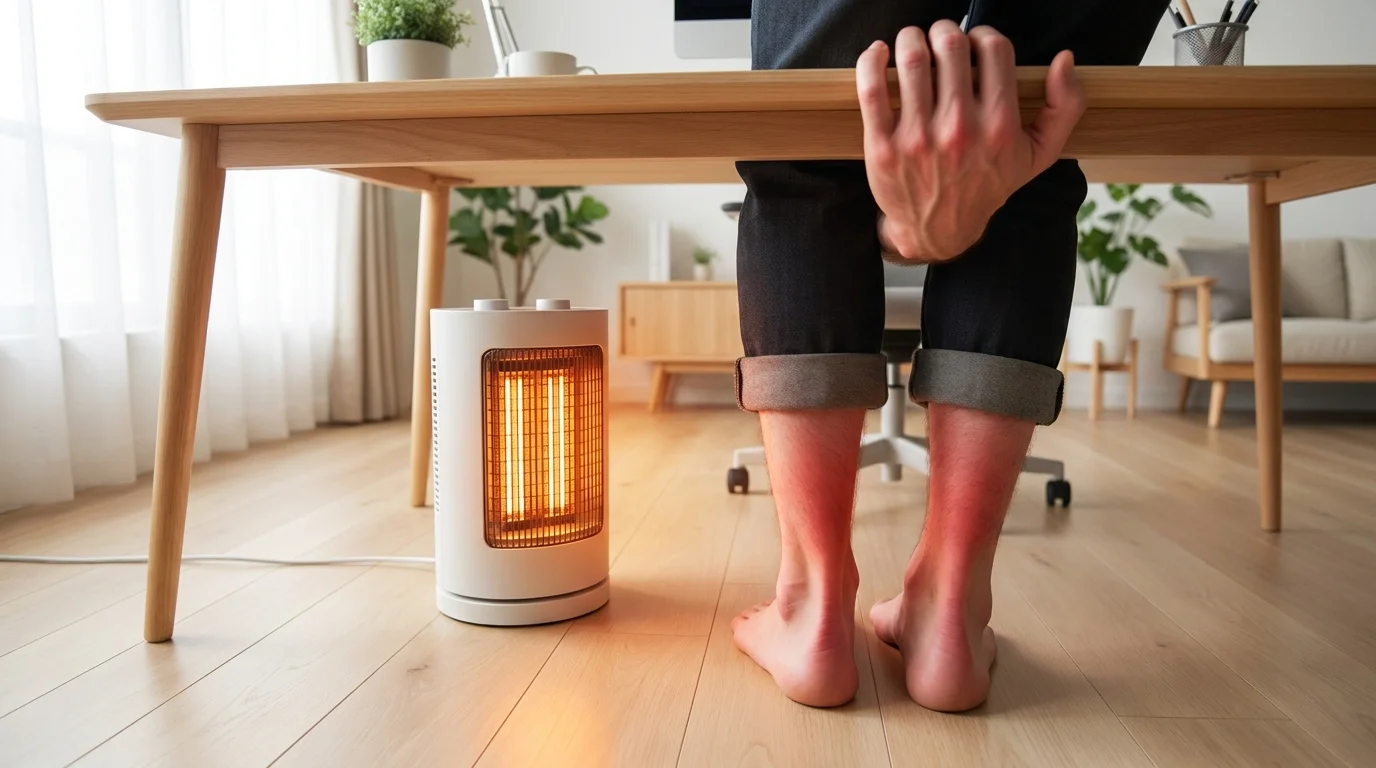
The dull hum of the ceramic coil begins around two in the afternoon, right when the floor draft sneaks past the baseboards. You nudge the plastic box with your toe, angling its glowing orange ribbon directly toward your shins. Within minutes, the dry, electric heat bakes through your denim, wrapping your ankles in a private desert while the rest of the room stays crisp and cool. It feels like the ultimate winter indulgence, a secret pocket of comfort that keeps your hands typing through the afternoon slump.
Then the doorbell rings, or you reach for an empty coffee mug. You push back your chair, stand upright, and the floor suddenly drops away. The edge of your desk swings sideways, your peripheral vision feathers into a soft grey blur, and you catch yourself by the palm of your hand, waiting for the room to stop tilting. You shake your head, blame an empty stomach or too much caffeine, and steady your legs before walking to the kitchen.
That fleeting, disorienting flutter is neither dehydration nor sudden eye strain. It is a predictable vascular cascade triggered by the concentrated heat warming your calves, silently disabling your body’s natural pressure valves while you sit perfectly still.
The Thermal Trap Beneath Your Knees
Your circulatory system relies on a delicate balance of mechanical resistance and autonomic reflexes to keep oxygen moving north against gravity. When you sit in a chair, blood naturally settles into the veins of your calves and feet. To counter this, your smooth vascular muscles maintain a steady baseline tone, keeping blood vessels firm and narrow so that blood can return to your heart with minimal effort.
When you aim a focused source of radiant heat directly at your lower legs, local blood vessels relax instantly. The heat causes the smooth muscle walls of your peripheral capillaries and venules to open wide in an attempt to release the thermal energy. With the vessels dilated like slack garden hoses and your calf muscles motionless, blood begins to pool quietly in the deep veins of your lower legs.
When you abruptly stand, gravity demands an immediate surge in systemic pressure to push that banked blood back toward your chest and brain. Your baroreceptors—the tiny pressure sensors inside your carotid arteries—scramble to catch up, but the heat-widened vessels resist constriction. For four to six seconds, your brain experiences a sharp dip in perfusion pressure, leaving you grasping the armrest while your inner ear struggles to find level ground.
- Blackstrap molasses spoonfuls resurfaced as proven relief for creaky winter knee joints
- Eucalyptus oil drops in hot morning showers lock delicate nasal passages shut
- Brewed dandelion tea flushes critical balancing minerals triggering painful midnight calf spasms
- Grilled chicken breasts washed down with antacids provoke painful upper belly bloating
- Chewing spearmint gum drives afternoon jaw clenching sparking sharp metallic temple thumps
A Hidden Pattern in the Drafty Studio
Consider Elena Vance, a 43-year-old architectural draftsperson working out of a converted warehouse studio in Cleveland. Every November, Elena placed an oscillating 1,500-watt ceramic heater precisely twelve inches from her wool-socked feet to combat the concrete floor’s unrelenting chill. By mid-December, she was experiencing three to four dizzy spells a day, so pronounced she sought the care of an inner-ear specialist, convinced she was battling a lingering labyrinthitis. It was only when an occupational therapist observed her workspace and pointed out the localized heat bath pooling blood in her lower extremities that Elena realized her cozy desk routine was the sole architect of her daily vertigo.
Adjustment Layers for Daily Circulation
You do not need to freeze your feet to protect your balance. Instead, you need to understand how your body distributes heat and blood, adjusting your habits based on how you work.
For the Stationary Desk Worker
If you spend four or five unbroken hours seated without pacing or shifting, localized heat is your enemy. The complete lack of calf contractions removes the muscular pump that returns pooled blood upward. Shift your heat source from a direct lower-leg blast to an indirect ambient warm-air flow, or elevate the unit so it warms your core torso rather than baking your lower shins.
For the Low Baseline Pressure Type
If you naturally run cold, possess long limbs, or have naturally lower resting blood pressure, your margins for sudden postural shifts are already thin. Direct radiant warmth against your legs rapidly strips what little vascular tone you have. Pair gentle heat with elevation, resting your feet on an angled ergonomic wedge so gravity helps fluid drain back toward your pelvic bowl instead of settling in your ankles.
For the Hybrid Mobile Worker
If your routine demands jumping up frequently for phone calls or meetings, direct radiant heaters pose the highest risk of acute room spins. Switch to passive insulation—such as shearling-lined slippers or an insulated thermal floor mat—which prevents heat loss without forcing peripheral vasodilation.
Mindful Interventions: The Pre-Rise Sequence
Rewiring your workspace takes less than five minutes and completely prevents the disorienting mid-afternoon drop.
Begin by relocating your heat source. Move your under-desk heater at least thirty-six inches back from your feet, or bounce the heat off a solid wall behind your monitor rather than aiming it point-blank at your lower legs.
Before you stand up from a warm desk, perform a simple circulatory reboot to wake up the vascular pump:
- Plant both heels firmly on the floor and pump your toes upward five times with deliberate force.
- Raise onto your tiptoes, squeezing your calf muscles tightly for two full seconds before lowering.
- Take one slow, deep diaphragmatic breath, exhaling smoothly as you initiate the movement to stand.
These brief contractions act as a physical squeeze, clearing trapped venous pooling and pushing pooled blood back into your central circulation before your head ever leaves its seated horizon.
The Tactical Toolkit
Calibrate your immediate environment using these precise boundaries:
- Radiant Distance: Keep focused heating units a minimum of 3 feet away from bare skin or thin trousers.
- Session Cap: Limit direct lower-body heating to 20-minute bursts, alternating with passive insulation.
- Floor Barrier: Place an anti-fatigue cork or closed-cell foam pad under your feet to block floor drafts passively.
- Temperature Target: Aim to bring immediate under-desk air to 68°F–70°F, avoiding micro-climates that exceed 85°F at ankle level.
The Bigger Picture
Physical equilibrium is rarely undone by dramatic catastrophes; more often, it unravels through quiet daily conveniences we never think to question. That familiar electric heater under your desk solves an immediate discomfort while quietly undermining your vascular tone. When you learn to protect your body’s natural pressure dynamics, you preserve your energy, your mental clarity, and your stability across the entire working day. True comfort is not about turning your desk into an oven; it is about creating an environment where your circulation and your focus work in quiet, uninterrupted harmony.
“When we artificially superheat the periphery while the body remains motionless, we disable the very vascular reflexes designed to keep our minds clear and grounded.”
| Key Point | Detail | Added Value for the Reader |
|---|---|---|
| Mechanism | Continuous heat causes local venodilation, pooling blood in calf veins. | Explains why lightheadedness strikes only after rising, not while sitting. |
| Positioning | Direct radiant beams within 18 inches overheat smooth vascular muscle. | Provides a practical metric: move heating units 36 inches away. |
| Pre-Rise Reset | Calf flexes physically pump pooled blood back toward central circulation. | Gives an instant, zero-cost physical remedy to stop dizzy spells. |
Frequently Asked Questions
Why does this dizziness only happen in the afternoon?
After hours of sitting, your calf muscles have remained inactive, allowing gravity and warmth to pool fluid progressively until vascular tone reaches its lowest point.Can wearing compression socks prevent this issue?
Yes. Graduated compression socks provide external mechanical pressure that prevents lower veins from expanding excessively under mild heat.Is this room spin dangerous?
While the vascular delay itself is usually harmless, the temporary loss of balance creates a real fall hazard if you stumble or faint near sharp desk edges.Does drinking more water help counter the pooling?
Adequate hydration supports total blood volume, but it cannot override the mechanical pooling caused by localized heat widening your vessels.What is the best alternative to an under-desk heater?
An insulated thermal floor mat paired with warm wool footwear traps natural body heat without driving artificial vasodilation.