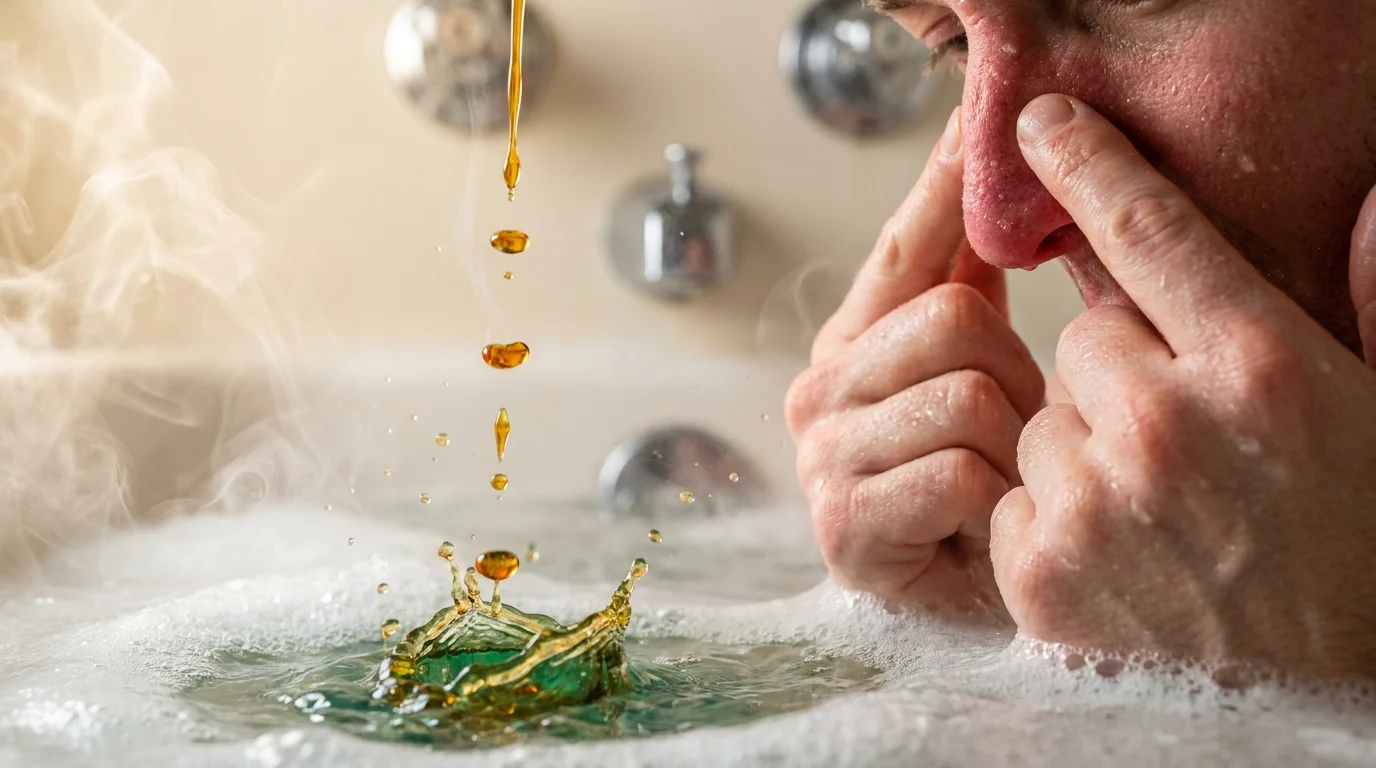
The bathroom fills with dense, pearlescent steam before you even step across the tile. It is six in the morning, the hallway outside is still cool and quiet, and you twist the bottle cap to scatter five sharp beads of liquid onto the wet porcelain floor. The fragrance rises immediately—sharp, medicinal, and biting—smelling like clean winter air and pristine green leaves. For a fleeting instant, your head feels light, your sinuses widen with an icy tingle, and you draw what feels like the first honest, deep breath of the week.
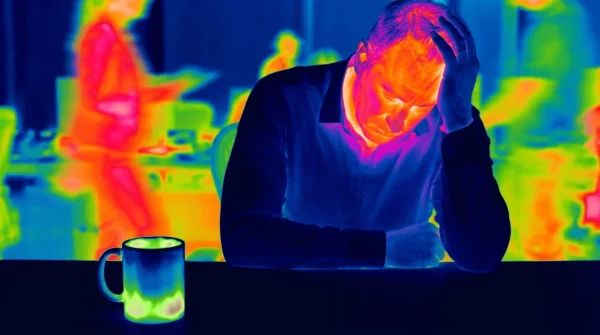
You step out of the stall, wrap yourself in a warm towel, and pad into the kitchen to start the kettle. Yet by the time the water begins to hum against the metal base, that expansive, clear feeling vanishes. A heavy, concrete pressure settles behind your bridge and cheekbones. Your nostrils pinch completely shut, as if an invisible clamp tightened across the middle of your face, leaving you breathing through your mouth while your throat dries out.
It feels like a sudden allergy attack or an aggressive morning cold sneaking up without warning. You wonder if you need two more drops under the running water tomorrow, or perhaps a stronger botanical extract to cut through whatever congestion just invaded your skull. But your body did not suddenly catch a virus while you lathered your soap. The culprit is the very ritual you trusted to clear the path.
The Rebound Trap: When Open Pathways Slam Closed
When you stand in a steaming stall, heat naturally dilates the microscopic blood vessels lining your respiratory tract. It is an instinctual human habit to believe that if something tingles with an arctic rush, it must be reducing swelling. Essential oils trick the brain by firing off cold-sensitive nerve endings—specifically the TRPM8 receptors along your mucosal lining—sending an artificial signal of vast, open space to your sensory cortex while doing nothing to shrink the physical tissue beneath.
In reality, eucalyptus oil carries an intense concentration of 1,8-cineole, an organic compound that acts as a potent irritant when aerosolized by boiling water. While the mentholated sensation tricks your mind into feeling instant clarity, your sensitive inner membranes experience those microscopic lipid droplets as a chemical assault. Your nasal turbinates—the delicate, scroll-like shelves of bone covered in vascular tissue—rush extra blood to the surface to shield themselves from the stinging vapor.
Think of your nasal lining like an over-rubbed patch of sunburned skin. If you pour hot water over a burn, it throbs; if you splash concentrated botanical solvent onto it at the same moment, the tissue flares in self-defense. Thirty minutes after you dry off, once the artificial cooling illusion fades, you are left with massive vascular engorgement. The vessels balloon outward, pressing against the narrow septum walls, sealing your morning air intake tighter than before you stepped into the shower.
- Brewed dandelion tea flushes critical balancing minerals triggering painful midnight calf spasms
- Grilled chicken breasts washed down with antacids provoke painful upper belly bloating
- Chewing spearmint gum drives afternoon jaw clenching sparking sharp metallic temple thumps
- Passionflower sleep teas spark sudden 3 AM awakenings with pounding chest flutter
- Angled desk monitors force awkward neck tilt triggering throbbing skull base tension
Dr. Julian Vance, an integrative rhinologist practicing in Asheville, North Carolina, frequently encounters patients convinced they are suffering from phantom winter allergies. Just last November, he treated a marathon runner named Marcus who spent three months struggling through morning runs with a dry throat and splitting frontal headaches. Marcus had turned his glass-door shower into an aromatic sauna every dawn, dumping half a dropper of pure oil onto the drain. His turbinates had become chronically thickened and crimson from continuous chemical rebound, completely starving his lungs of smooth, filtered nasal airflow by mid-morning.
Why Different Noses React: Finding Your Exposure Layer
Not every set of lungs responds to intense botanical steam with the exact same timeline. Your underlying mucosal baseline dictates just how aggressively that rebound swelling takes hold.
For the Dry-Air Desk Worker
If you spend eight hours a day in an office running forced-air electric heating, your mucosal blanket is already thin, parched, and structurally fragile. When you introduce hot volatile oils at dawn, you are stripping away the last lubricating layer of protective mucus. Your body responds not just with congestion, but with raw stinging, blood-tinged tissue when you blow your nose, and a persistent sensation that your nasal bridge is bruised.
For the Early Morning Exerciser
Those who shower before an early jog or gym session often experience the worst functional drop. Heavy breathing bypasses the nose entirely when the turbinates clamp shut forty minutes later. This forces cold morning air directly over your vocal cords and bronchial tubes, triggering a rasping, dry cough and mid-chest tightness that feels deceptively like exercise-induced asthma.
The Cold Kitchen Compress: The Gentle Reset
Breaking the cycle of morning congestion does not require expensive saline mist machines or aggressive steroid sprays. It requires undoing the heat-induced vascular flood with simple, mindful temperature control. When your nasal passages swell shut from thermal and chemical overstimulation, the cure is vasoconstriction—quietly encouraging the engorged capillary beds to release their trapped blood volume back into general circulation.
- Step into an unheated room and sit upright in a sturdy chair; lying flat immediately increases cranial venous pressure and worsens the obstruction.
- Take a small, clean kitchen towel and soak it in cold tap water, or wrap two smooth ice cubes inside a damp flour-sack cloth.
- Gently press the chilled cloth directly across the bridge of your nose, extending the edges over your upper cheekbones just below the eye sockets.
- Breathe slowly through your lips for four uninterrupted minutes, letting the cool compress naturally draw excess heat away from the underlying facial veins.
- Finish by drinking a small glass of room-temperature water with a single pinch of sea salt to balance your internal fluid balance without shocking your stomach.
Your tactical toolkit requires zero boutique pharmacy purchases. Keep a dedicated cotton washcloth folded in your refrigerator door overnight. If you wake up stuffy, bypass the shower floor oils entirely; instead, rely on plain, tepid steam no hotter than a warm cup of soup, keeping your face at least two feet away from the water stream to protect those sensitive vascular beds.
Reclaiming the Quiet Breath
There is an understandable desire in our hurried lives to make every physical experience hit harder, smell stronger, and deliver instant, cinematic results. We believe that if a breath does not sting with ice and pine, it must not be working. Yet true biological healing is almost always quiet, boring, and gentle. The interior of your head is not a clogged industrial pipe that needs to be blasted clear with corrosive solvents; it is a soft, self-regulating ecosystem designed to warm and filter the world on its own terms.
When you trade the scalding botanical vapors for the grounding calm of a cool morning compress, you stop fighting your own nervous system. You walk out your front door without the phantom head pressure, the dry morning throat, or the sudden panic of closed airways. You step into the morning air with a nose that simply, quietly does what it was born to do: draw the world in, steady and unobstructed.
Clear breathing is never an act of force; when you treat delicate tissue with quiet cool rather than aggressive heat, your airways soften into natural balance.
| Approach | Physiological Mechanism | Added Value for the Reader |
|---|---|---|
| Hot Eucalyptus Steam | Vaporized cineole stimulates TRPM8 receptors while scalding steam dilates capillary walls. | Creates an immediate illusion of space, followed 30 minutes later by total rebound blockage. |
| Plain Warm Shower | Mild humidity hydrates external mucus without chemical irritation or excessive mucosal burns. | Loosens dried overnight debris safely without provoking reactive tissue swelling. |
| Cold Bridge Compress | Direct thermal cooling induces rapid, natural peripheral vasoconstriction across facial vessels. | Restores patent nasal airflow in under five minutes without chemical dependency. |
Frequently Asked Questions
Can I still use eucalyptus oil in a bedroom diffuser instead?
Yes, provided it is cold-mist ultrasonic diffusion kept across the room. The primary danger comes from the combination of scalding water vapor and close-range, high-concentration inhalation, which turns the oil into an aggressive thermal irritant.Why does the congestion take thirty minutes to appear?
The initial menthol effect chemically numbs your sensation of airflow resistance, tricking your brain into feeling clear while the underlying capillaries are actively swelling. Once that sensory anesthetic fades, the physical obstruction becomes obvious.Is this reaction considered an allergic response?
Not typically. It is primarily a mechanical and chemical rebound vasodilation caused by irritating volatile organic compounds, similar to how your eyes water and swell when chopping an onion over a steaming stove.What is the ideal shower temperature for morning congestion?
Aim for lukewarm water around 98 to 100 degrees Fahrenheit. If the bathroom mirror is completely fogged over within three minutes, the water is hot enough to provoke mucosal engorgement in sensitive nasal linings.Does a cold compress cause sinus headaches to worsen?
No, as long as it is applied across the bridge of the nose and upper cheeks rather than the forehead. Cooling the superficial angular and facial veins gently drains pooled blood, which actually alleviates frontal sinus pressure.