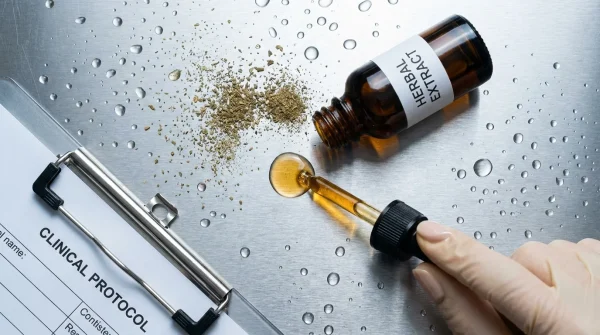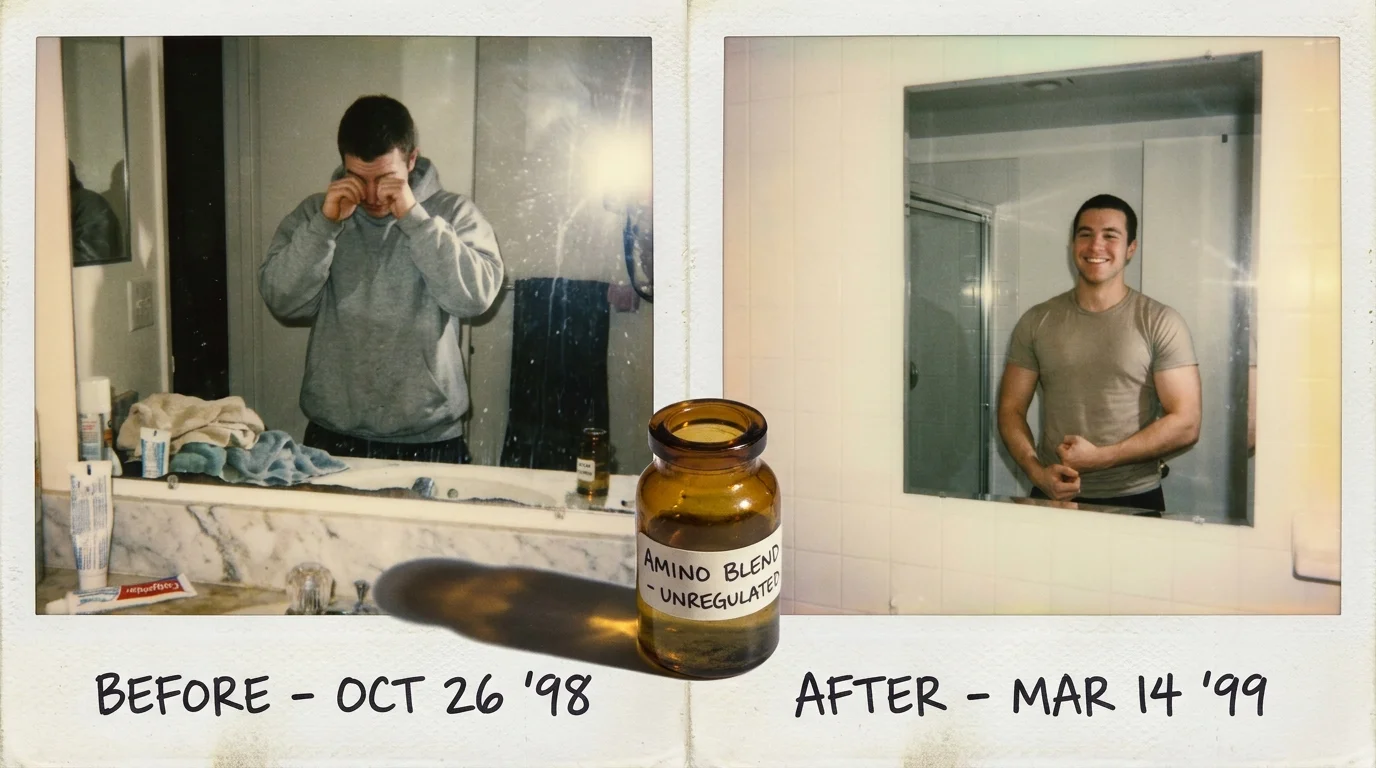
The damp, heavy air of the early morning gym always smells the same: a mixture of cold iron, worn rubber mats, and stale chalk. Under the harsh buzz of the overhead fluorescent lights, a cloudy glass vial of unregulated amino acid liquid resting on a steel gym bench catches your eye. It sits there silently, condensation pooling around its base, mimicking the look of high-end clinical medicine. Yet, there is a subtle, unsettling opacity to the fluid that suggests something went wrong during its creation.
You see people scrolling through their phones between sets, watching the latest fitness trends sweep across their feeds. The term “peptides” has taken over the fitness community, flashing across screens as the supreme shortcut for muscle recovery. **This digital gold rush** has convinced thousands of lifters that recovery can be bought in a tiny glass bottle, bypassing the slow, honest work of natural healing.
But when you pick up that cold vial from the steel bench, the fluid inside behaves strangely. It does not slash cleanly against the glass like pure, sterile water. Instead, it clings to the sides with a faint, syrupy drag, leaving a microscopic film that tells a far darker story than the neat label on the front.
The Illusion of the Flawless Repair
The human body is an incredibly complex biological machine, and muscle tissue is its most precious framework. The prevailing gym myth insists that because peptides are merely chains of amino acids, any injectable formulation is inherently safe and bio-compatible. This logic is dangerously flawed. When you introduce an unverified, poorly synthesized compound into your muscle tissue, you are not accelerating recovery; you are introducing a corrupt blueprint to your cellular repair systems. An **unregulated synthetic peptide acts** like sand poured into a delicate watch movement, sparking rapid local tissue degradation and stubborn, deep-tissue inflammation rather than clean, seamless muscle repair.
A Warning from the Trenches
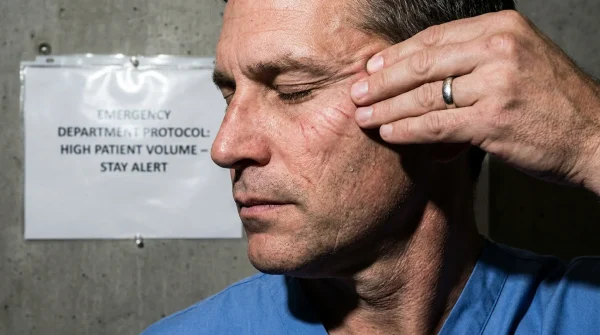
Marcus Vance, a forty-two-year-old strength coach based in Chicago, has spent two decades helping athletes rebuild their bodies after severe injuries. Over the past year, he began noticing a strange, worrying pattern among young lifters who claimed to be using cutting-edge recovery formulas. “They would come to me with hard, painful knots deep inside their shoulder and glute muscles that wouldn’t release with stretching or deep-tissue massage,” Marcus explains. “These weren’t typical training knots; they were localized areas of sterile tissue death and scarring caused by injecting low-grade, research-chemical peptides that their bodies simply couldn’t break down.”
- Zyrtec recall panic sends allergy sufferers scrambling for dangerous unverified alternatives
- Humidifier placement beside your bed actually ruins deep REM sleep cycles
- Expensive turmeric root capsules pass completely unabsorbed without a dash of black pepper
- Crossing your legs at the desk secretly forces painful tension into your lower back
- Organic fruit granola bars pack enough hidden syrup to cause huge afternoon crashes
The Viscosity Spectrum: Identifying the Threat
To navigate this wild-west market, you must understand what high-grade clinical compounds actually look like compared to cheap, backyard chemical mixes. The difference is not always visible to the naked eye at first glance, but the physics of the liquid will always tell the truth. **The clear clinical path** relies on highly filtered, ultra-pure water bases that preserve the natural, rapid flow of the peptide molecules without requiring thick chemical stabilizers.
Underground laboratories, however, often use cheap industrial solvents and heavy preserving agents to keep their unstable active ingredients from settling. This results in a thick, slightly viscous fluid that moves with a sluggish, oily quality inside the vial. When you shake a legitimate clinical formula, the tiny air bubbles should dissipate almost instantly, whereas a contaminated or counterfeit vial will hold onto those bubbles for several minutes, revealing its heavy, impure density.
Your Tactical Inspection Protocol
You should never trust a label or a slick website design when it comes to substances you place inside your body. Before you risk your muscle health on a trendy compound, perform this simple, physical diagnostic test in a quiet room with strong lighting. **Never skip this visual** audit if you care about preserving your long-term cellular health and avoiding painful physical scars.
- The Light Check: Hold the vial directly in front of a bright, warm light source, preferably a high-powered flashlight. Look for any faint, cloud-like swirls or floating micro-particles that indicate incomplete chemical synthesis.
- The Rotation Test: Slowly turn the vial upside down over a five-second count. Watch the movement of the liquid; it should flow as cleanly and quickly as pure tap water.
- The Meniscus Observation: Look at the curve of the liquid at the top of the vial. A sticky, high-clinging meniscus that leaves thick residue on the glass is a classic sign of raw, unfiltered chemical impurities.
- The Temperature Reaction: Place the vial in a cool room at sixty-five degrees Fahrenheit for one hour. If the liquid begins to cloud or show tiny white flakes, the formula is highly unstable and dangerous to use.
The physical behavior of the fluid is your ultimate defense against systemic biological harm. Real clinical formulas possess a crisp, light-speed flow that never leaves a greasy or sluggish trail on the glass. **Heavy sluggish movement reveals** that the formula is packed with dangerous binders, residual heavy metals, or raw chemical powders that will scar your muscle fibers from the inside out.
Reclaiming the Natural Pace of Healing
True physical longevity cannot be rushed or forced through unverified synthetic shortcuts. The human body heals through a beautifully orchestrated sequence of deep sleep, strategic movement, and real micronutrient nutrition. When you try to bypass this natural timeline with cheap, unregulated vials, you risk trading permanent muscle tissue damage for a few temporary recovery gains. By learning to read the subtle warning signs in the glass, you protect your physical engine from the quiet, destructive patterns of the modern wellness trend cycle.
“The body does not negotiate with synthetic shortcuts; it simply breaks where the pressure is forced.” — Marcus Vance, CSCS
| Key Point | Detail | Added Value for the Reader |
|---|---|---|
| Viscosity Check | Clinical formulas flow like pure water, while fake vials show a heavy, syrup-like drag. | Instantly identify dangerous, poorly filtered compounds before use. |
| Clarity Inspection | Genuine formulas remain perfectly translucent under direct flashlight beams. | Avoids injecting microscopic particulates that trigger tissue scarring. |
| Thermal Stability | Legitimate compounds do not separate or cloud up when cooled to sixty degrees. | Confirms the absence of cheap stabilizers and toxic industrial preservatives. |
Are all online peptides dangerous for muscle recovery?
Not all, but the unregulated market is flooded with research chemicals never intended for human tissue, posing severe risks of cellular degradation.
What does a cloudy appearance in a vial actually mean?
Cloudiness indicates either active bacterial contamination, unreacted raw powders, or the presence of harsh chemical binders that damage muscle fibers.
How can I verify the purity of my recovery supplements?
Insist on a third-party Certificate of Analysis (COA) showing high-performance liquid chromatography testing for that specific batch number.
Do fake peptides cause permanent tissue damage?
Yes, bad batches can lead to sterile abscesses, deep muscle fibrosis, and localized tissue necrosis that requires surgical intervention to clear.
What is the safest alternative to synthetic recovery aids?
Prioritizing deep slow-wave sleep, target amino acid nutrition from whole foods, and structured active recovery protocols that naturally trigger growth hormone release.