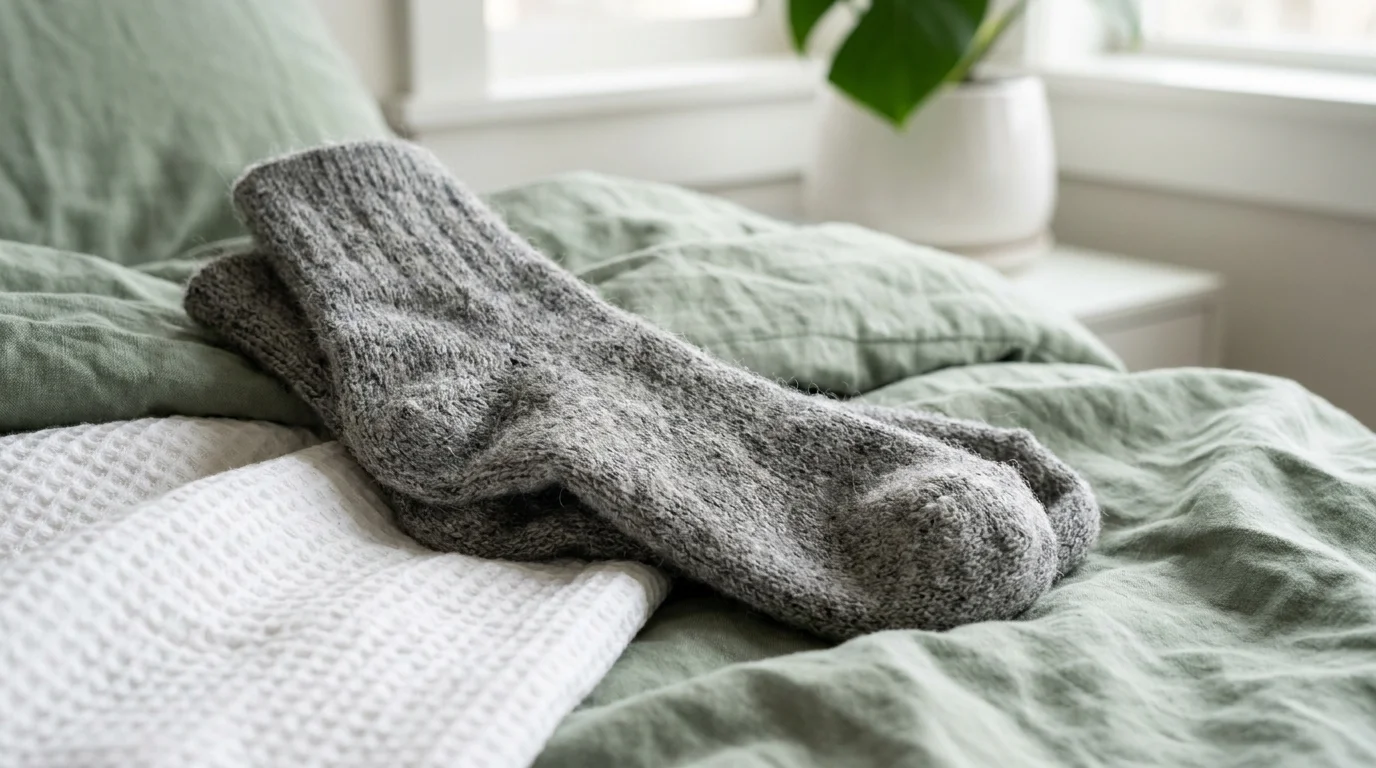
The bedroom air is cool, hovering at that crisp boundary where the tip of your nose feels cold but your chest feels heavy under the blankets. You toss to the left, then to the right, adjusting the heavy duvet for the fifth time in an hour. Your mind is perfectly awake, tracking the steady hum of the refrigerator down the hall while your feet feel like two blocks of ice. At the foot of your messy bed, a thick pair of gray knitted socks rests quietly on the rumpled sheets, waiting to be noticed.
The common instinct is to strip down to the bare minimum when sleep eludes you, fearing that any extra layers will cause you to wake up sweating at three in the morning. You lie there with cold toes and a hot forehead, staring at the ceiling in frustration. Your body is trapped in a thermal standoff. Your internal thermostat is refusing to drop because your body cannot figure out how to release its grip on the heat it has stored throughout the day.
We assume that to cool down, we must expose our skin directly to the chilly air of the bedroom. It seems like basic physics. Yet your nervous system doesn’t operate on simple math; it operates on circulation, blood flow, and the subtle signals sent from your nerve endings directly to your brain.
Those wool socks, which look like a tool for winter survival, are actually a highly efficient thermal valve. They trigger a rapid cooling cycle. By warming your feet, they signal to your brain that it is safe to lower your internal core temperature, paving the way for deep, uninterrupted rest.
The Vasodilation Paradox: Heating the Gates to Cool the Core
To understand why this works, think of your circulatory system as a house with a central heating system and a series of radiators at the far ends of the halls. When your feet and hands are cold, the blood vessels constrict, locking all your warmth inside your core. This keeps your vital organs warm, but it also keeps your internal temperature too high for sleep, leaving you feeling restless and wired.
Putting on breathable wool socks acts as a physical release valve for this trapped energy. The warmth on your skin causes the blood vessels in your feet to dilate—a process known as vasodilation. This shift coaxes your core temperature down. As these vessels open wide, blood rushes away from your hot center toward your feet, distributing heat evenly and signaling to your brain that it is time to wind down.
- Biotin supplements actively trigger cystic acne breakouts without improving hair thickness
- Car seat recliners tilted backwards slowly compress your lower lumbar discs
- Cold-pressed green juices flood your liver with concentrated fruit sugars instantly
- White potatoes provide more steady baseline energy than complex carbohydrate alternatives
- Cold water splashing on your wrists wakes up your brain faster than coffee
Clara Vance, a 42-year-old architectural draftsman from Seattle, spent years battling nighttime restlessness before discovering this thermal trick. Her sleep coach suggested swapping her heavy blankets for a pair of loose, organic wool socks instead. “It felt completely backward to put on heavy winter gear to go to sleep in a warm room,” Clara recalls. “But within twenty minutes, my racing thoughts quieted down because my body finally felt balanced and cool enough to rest.”
Adapting the Sleep Shield for Your Thermal Profile
The Light Sleeper with Cold Extremities
If you find yourself constantly adjusting the blankets because your toes feel like ice while your chest feels stifled, your body is struggling to distribute its thermal load. A loose-fitting, high-pile merino wool sock is your best match for this specific imbalance. It gently coaxes circulation outward. This helps your body transition into deep sleep without the mid-night wakings caused by cold drafts.
The Hot Sleeper Who Sweats at Night
You might naturally recoil at the thought of putting on socks if you are prone to nighttime sweats. However, synthetic sheets and pajamas trap moisture against your skin, whereas organic wool breathes like a second skin, allowing dampness to evaporate before it chills your body. Choose a thin, unblended wool knit. This keeps your skin dry and prevents the sudden, sweat-induced wakeups that shatter your rest cycles.
The Nightly Protocol: Aligning Your Microclimate
Preparing your feet for sleep is a quiet, deliberate act of self-care. It should not feel like an chore, but rather a slow transition from the noise of the day to the silence of the night.
For the best results, wash your feet with warm water before slipping them into your designated sleep socks. Clean, dry skin maximizes the thermal shift. This simple preparation clears away sweat and opens up your skin pores, allowing the wool fibers to do their work efficiently.
- Keep a dedicated pair of loose, clean wool socks exclusively at your bedside so you do not have to hunt for them.
- Ensure the socks have no tight elastic bands that could pinch your ankles or restrict your blood flow.
- Slip them on ten to fifteen minutes before you intend to close your eyes to give your body time to start the cooling process.
- Let your feet rest loosely outside the heavy duvet if you begin to feel too warm; the air will cool the socks naturally.
Your tactical toolkit for this routine is simple: choose 100% Merino or organic alpaca wool, ensure the fit is completely non-binding, and keep your bedroom thermostat set between 60 and 67 degrees Fahrenheit to create the perfect thermal contrast.
Restoring the Rhythms of Rest
In a world that constantly sells us expensive sleep trackers, weighted blankets, and complex nighttime formulas, we often overlook the elegant mechanics of our own physiology. A simple pair of wool socks is a quiet rebellion against the high-tech optimization craze. It works with your natural biology. It utilizes your body’s own circulatory pathways to bring about peace.
When you change how your body processes heat, you change how it processes stress. You step away from the frustrating cycle of tossing, turning, and nighttime anxiety, landing instead in a state of quiet, restorative ease that carries you peacefully through the night.
“True rest is not about forcing the mind to go quiet; it is about creating the physical conditions where the body has no choice but to surrender.” — Dr. Marcus Thorne, Sleep Physiologist
| Key Point | Detail | Added Value for the Reader |
|---|---|---|
| Vasodilation Trigger | Warming feet dilates peripheral blood vessels. | Accelerates the natural drop in core body temperature. |
| Material Selection | 100% breathable organic wool over synthetics. | Prevents moisture buildup and sudden night sweats. |
| Zero-Compression Fit | Loose ribbing without tight elastic bands. | Ensures unhindered circulation all night long. |
Frequently Asked Questions
Will wearing socks to bed make my feet sweat? Only if you choose synthetic fibers like polyester. Natural wool breathes naturally, wicking moisture away to keep you dry and comfortable.
How loose should my sleep socks be? They should feel almost like they want to slip off. Avoid any socks that leave red marks on your ankles, as restriction ruins the thermal benefits.
Can I use cotton socks instead of wool? Cotton holds onto moisture instead of letting it evaporate, which can leave your feet cold, damp, and clammy halfway through the night.
Should I wear them all night long? Many people naturally kick them off in their sleep once their core temperature drops, which is a perfect sign that the cycle worked.
Is this safe for people with poor circulation? Yes, but choose ultra-loose, non-binding wool options to support natural blood flow without any restriction.