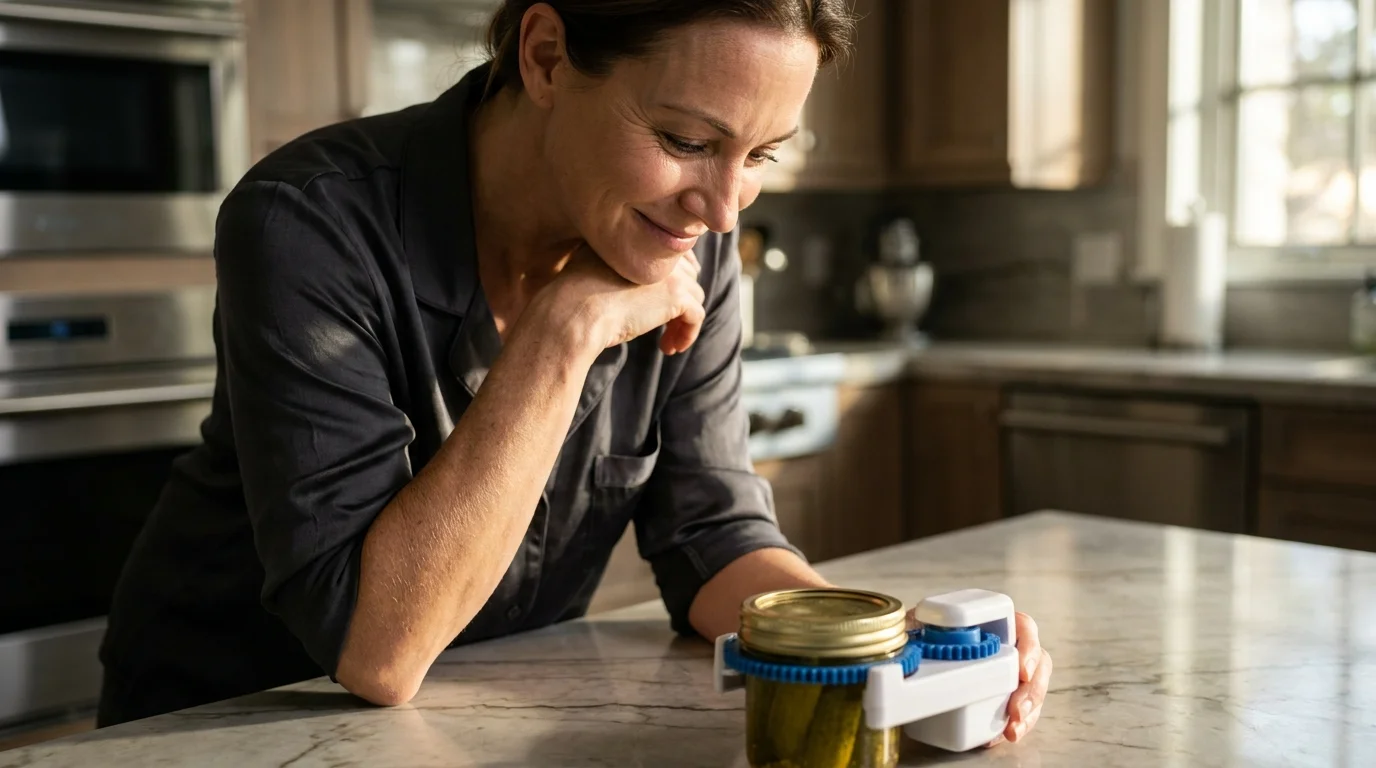
A sharp mechanical whine cuts through the quiet morning kitchen. On the quartz countertop, a motorized white plastic clamp twists tightly around a metal pickle jar lid, groaning under tension until the factory seal gives way with a sterile, hollow pop. You step back, wiping your hands on a tea towel, pleased by how effortlessly modern technology solved a stubborn kitchen annoyance.
For decades, twisting open a vacuum-sealed lid was a minor test of physical will—a gritty friction between palm skin and cold glass that demanded leverage, palm friction, and raw forearm torque. Today, automated kitchen gadgets promise to remove every trace of strain from your domestic routine. They sit neatly beside the toaster, marketed as smart investments in comfort and convenience for aging hands.
Yet behind that smooth motorized relief lies a subtle physiological exchange. The human forearm does not wither overnight from old age alone; it fades when you systematically remove the small daily loads that keep it alive. By delegating every stubborn twist, turn, and pull to battery-powered motors, **you quietly dismantle natural forearm strength** and forfeit the precise neural signals that keep your fingers steady.
Every time you hand over manual friction to a countertop motor, your flexor tendons, extensor groups, and intrinsic hand muscles receive a clear message: their services are no longer required. Over months and years, that silence transforms into rapid, noticeable weakness.
The Illusion of Effortless Convenience: Torque as a Biological Tax
Think of your hand and forearm as a high-tensile rigging system on a sailboat. The ropes, pulleys, and stays only maintain their structural integrity when subjected to variable, shifting loads. When you grip a wide lid, your hand creates a dynamic web of opposition: the thumb stabilizes, the deep finger flexors crush inward, and the extensor muscles along the top of your forearm contract intensely to keep the wrist joint from collapsing.
This twisting motion—rotational torque—is one of the most demanding biomechanical feats your upper body performs on a standard day. It recruits motor units from your fingertips straight through your wrist, past your elbow, and into your shoulder girdle. When you replace that complex chain of muscular engagement with an electric button, **your grip loses its daily resistance**, accelerating the loss of lean muscle mass in areas critical for balance and daily autonomy.
- Alcohol astringent facial toners strip surface lipids making crepey cheek lines look deeper
- Lazy Boy rocker recliners trap lower spinal discs enforcing sharp morning lumbar stiffness
- Skipping morning sourdough toast stops active fat burning by forcing metabolic survival stalls
- Quest birthday cake bars trigger sharp afternoon crashes behind hidden maltitol syrups
- Matcha green tea lattes spark sudden mid-morning crashes for adults over forty
Muscle tissue operates on a strict budget. If the nervous system does not detect regular, high-intensity micro-demands, it sheds the metabolically expensive muscle fibers responsible for sudden power. You do not notice this fade while watching the electric motor turn the jar lid. You notice it months later when carrying a heavy cast-iron skillet suddenly feels precarious, or when turning a stiff garden spigot makes your wrist ache with unfamiliar fatigue.
Expert Context: The Observation from Raleigh
Dr. Marcus Vance, a 54-year-old occupational therapist in Raleigh, North Carolina, noticed an unexpected pattern among his active adult patients who pride themselves on clean eating and home cooking. While their cardiovascular health remained crisp from morning walks, their baseline dynamometer grip readings were dropping by nearly twenty percent within two years of updating their kitchens with high-end, touchless automation tools. Marcus observed that when patients stopped wrestling with everyday mechanical friction—from manual can openers to stiff preserve jars—their deep forearm flexors thinned noticeably, undermining the exact hand stability needed to prevent accidental drops and wrist sprains later in life.
Calibrating Grip Demand Across Different Daily Profiles
Restoring hand health does not mean suffering through painful joint strain or throwing away every helpful household tool. It requires understanding where to invite healthy resistance and where to protect sensitive cartilage.
For the Joint-Conscious Home Cook
If you experience morning stiffness or mild arthritis in your knuckles, raw crushing force can cause inflammation. The goal is to maximize friction so your muscles do the work without crushing your joints. Using a textured, non-slip silicone pad increases surface grip by up to sixty percent, allowing your forearms to generate rotational torque without forcing your fingers into an agonizing squeeze. Keep the automatic opener stored away for severe flare-up days only.
For the Post-50 Strength Preserver
If your hands feel pain-free but you notice jar lids feel heavier than they used to, treat every sealed container as a five-second training rep. Before reaching for any mechanical aid, set your feet shoulder-width apart, brace your core, and apply controlled, progressive torque for three slow breaths. If the seal does not break, tap the edge of the lid lightly on a wooden cutting board to relieve vacuum pressure, then finish the twist manually. **Active manual twisting restores neuromuscular control** faster than any rubber squeeze ball ever could.
Reclaiming Hand Resilience: A Daily Resistance Protocol
Maintaining powerful, capable forearms does not require a gym membership or specialized hand grippers. It requires weaving micro-doses of natural resistance back into your standard domestic rhythm through mindful, progressive habits.
- The Manual First-Attempt Rule: Commit to attempting every jar, bottle, and twist-cap manually for five seconds using proper body mechanics before considering an assistive tool.
- The Damp Towel Wring: After washing dishes, take your cotton dish towel, submerge it in warm water, and wring it out completely using alternating directional twists. Perform two slow repetitions per hand.
- Fingertip Plate Carries: When clearing the table, carry heavy ceramic dinner plates by pinching the rim with your fingertips rather than supporting the base with your palm.
- Pinch-Grip Jar Lifts: Before opening a jar, lift it out of the refrigerator by gripping only the lid with the tips of your four fingers and thumb, holding it mid-air for three seconds.
Integrate these small movements across your week. Your forearms are exceptionally responsive tissues that adapt quickly when exposed to consistent, varied mechanical signals.
Preserving Autonomy Through the Smallest Daily Friction
True functional longevity is rarely built through isolated, high-intensity workouts; it is quietly sustained in the unglamorous friction of ordinary living. Every tight lid, stiff deadbolt, and heavy grocery tote is an invitation from your environment to stay strong, capable, and self-reliant.
When you choose to reclaim these small daily demands, you protect far more than just forearm definition. You preserve the sharp, reliable connection between your brain and your hands—the exact bridge that allows you to cook, create, garden, and care for yourself with absolute confidence. Resist the urge to automate away your body’s purpose, and let your hands do the work they were designed to master.
Real physical longevity is not found in gadgets that eliminate effort, but in the quiet daily friction that reminds your muscles they are still needed.
| Key Point | Detail | Added Value for the Reader |
|---|---|---|
| Torque Elimination | Automated openers remove rotational force demands from daily forearm routines. | Identifies the hidden cause of unexplained hand and wrist weakness. |
| Friction Adaptation | Silicone grips multiply traction without forcing excessive joint compression. | Protects sensitive knuckle cartilage while keeping muscles actively engaged. |
| Neuromuscular Recall | Manual twisting stimulates deep flexor tendons and spinal reflex pathways. | Preserves fine motor coordination and firm balance reflexes in aging adults. |
Frequently Asked Questions
Are automatic jar openers bad for everyone?
No. They are valuable assistive devices for individuals with advanced osteoarthritis, severe carpal tunnel, or acute injury. However, relying on them simply for everyday convenience deprives healthy hands of necessary muscle stimulation.How quickly does grip strength decline if I stop using my hands for heavy tasks?
Noticeable decreases in forearm motor unit recruitment can occur in as little as three to six weeks of reduced mechanical demand, leading to measurable muscle thinning over several months.Can hand-grippers replace the strength lost from daily kitchen tasks?
Isolated spring grippers only train one specific closing motion. Opening jars requires rotational torque, wrist stabilization, and variable friction, which provide far more functional joint stability than simple squeeze toys.What if a jar is simply too tight to open safely?
Break the vacuum seal first by gently tapping the lid edge against a wooden board or using a dull spoon under the rim. Once the vacuum releases, use your hands and a silicone pad to complete the twist manually.Does grip strength really correlate with overall longevity?
Yes. Clinical research consistently links baseline grip strength to overall systemic vitality, bone density, and reduced risk of physical disability as you age.