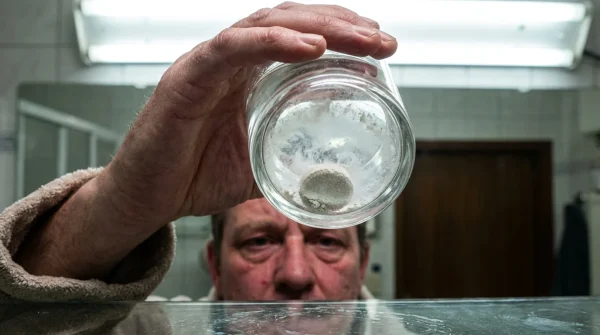
You wake up to an unmistakable, dull vice gripping the sides of your head. The morning alarm has barely chimed, yet your temples throb with a rhythmic pressure that feels like it started hours before sunrise. You instinctively roll your shoulders, twist your neck from side to side, and press your knuckles into the base of your skull, assuming your sleep posture failed you again.
Run your fingers along the angle of your jaw, just below your earlobes. You will feel a rigid, knotted jawline clenching against your touch like cured leather.
That tightness is not an accident of anatomy or a bad pillow. While you were asleep, your facial muscles were replaying the unspoken arguments, polite concessions, and suppressed boundaries of your previous afternoon. Your masseter muscles—the powerful slabs of tissue responsible for biting down—have become the physical vault where your nervous system caches unspoken tension.
The Hydraulic Lock of Unspoken Words
Most recovery routines treat morning head pain as an issue of spinal alignment or neck stiffness. You stretch your trapezius, apply heat patches to your upper back, and wonder why the throbbing across your brow refuses to shift. The disconnect happens because you are treating the exhaust pipe instead of the engine.
Your masseter is proportionately the strongest muscle in your body, capable of exerting over two hundred pounds of force across your molars. When you bite your tongue during an uncomfortable meeting or swallow your irritation at a condescending remark, your brain triggers a micro-clenching reflex. This is pure somatic trapping: your motor cortex prepares your mouth to speak, but your social conditioning slams the brakes, causing the fibers to seize mid-action.
Over weeks and months, these micro-contractions alter the resting tone of your facial fascia. The muscle belly permanently shortens, drawing your lower jaw upward into a persistent, low-grade clamp. By the time you drift off to sleep, your autonomic nervous system continues running that clenched script, compressing the trigeminal nerve pathways and radiating pain upward into your temples by dawn.
- UK egg salmonella mandates enforce strict commercial flock quarantine rules stopping contaminated distribution
- Cholesterol particle tests reveal hidden arterial plaque buildup missed by routine annual physicals
- Kratom extract shots trigger sudden emergency liver complications across suburban urgent cares
- Blackout window film enforces pitch darkness to reverse shallow restless light sleep
- Thick leather recliners force painful lower back rounding trapping chronic pelvic tightness
Consider Marcus, a 37-year-old product manager who spent two years chasing migraine diagnoses across specialist offices. His scans were clear, his neck mobility was above average, yet three mornings a week he woke up with blinding temple pressure. It was only when a physical therapist examined the inside of his cheek—finding masseters so hyper-toned they felt like solid walnut shells—that the pattern emerged. Marcus was spending eight hours a day silently smiling through aggressive client calls, storing every suppressed objection directly between his upper and lower molars.
Mapping Your Somatic Clenching Style
Recognizing how your jaw responds to relational friction is the first step toward releasing the physical holding pattern. We tend to adapt our somatic tension along three distinct behavioral lines.
For the Conflict-Avoidant Smiler
If you find yourself constantly nodding and maintaining a pleasant facial expression while internally disagreeing, your tension lives in the upper masseter insertions near the cheekbones. You rarely grind your teeth loudly at night, but you maintain a constant static contraction throughout the day. Your relief comes from deliberate, conscious jaw drops during social pauses.
For the Rapid Task-Switcher
If your work involves juggling sudden demands, high-stakes messaging, and constant interruption, your clenching pattern is sharp, rhythmic, and aggressive. You tend to bite down hard every time a new notification arrives or a deadline shifts. Your facial tissue requires thermal grounding to reset muscle memory before bed.
For the Internal Over-Processor
If you re-read emails ten times before hitting send and replay difficult conversations long into the evening, your deep pterygoid and lower masseter fibers bear the load. You wake with sore teeth and tight ear canals. Your focus must center on intraoral myofascial release to unwind the deepest anchor points.
The Five-Minute Somatic De-Escalation Protocol
You cannot stretch the masseter from the outside alone. Because the muscle sits across both the exterior cheek and the inner oral cavity, manual relief requires a precise, mindful touch that signals safety directly to your cranial nerves.
- Warmth Application: Apply a moist, warm towel (heated to around 104°F) directly across your jaw angles for three minutes to increase local blood flow.
- The Pincer Release: Wash your hands thoroughly, then insert your thumb inside your mouth along the back molars while your index finger rests on the outside of your cheek.
- Ischemic Compression: Squeeze the thick muscle tissue between your thumb and finger with moderate, tolerable pressure until you locate a tender knot. Hold static pressure for 30 seconds without rubbing.
- Slow Palate Breathing: While holding the knot, breathe in through your nose for four seconds and out for six, allowing the lower jaw to hang completely slack.
- Gentle Mobilization: Slowly open your mouth half an inch and close it three times while maintaining light thumb contact against the muscle belly.
Perform this simple sequence right before you climb into bed. It interrupts the neurological feedback loop that tells your jaw to brace against the stress of the day.
Reclaiming the Space Between Your Teeth
A relaxed face is not simply an aesthetic preference; it is a neurological baseline for clear thinking and deep rest. When your jaw releases its defensive grip, the chronic vascular pressure around your temples subsides, allowing you to wake up with a clear, unburdened mind.
Healing this somatic loop asks you to pay closer attention to your waking boundaries. Notice the exact moment your teeth touch during a conversation. Let that physical sensation be a gentle reminder to breathe, drop your tongue to the floor of your mouth, and speak your truth before your jaw has to hold it for you.
The jaw is where the body quietly keeps the score of every word you decided not to say.
| Key Point | Detail | Added Value for the Reader |
|---|---|---|
| Root Cause | Suppressed micro-reactions tighten masseter fibers during daily friction. | Helps you target the true source instead of chasing neck symptoms. |
| Neurological Link | Trigeminal nerve irritation mimics standard migraine patterns. | Explains why typical over-the-counter pills often fail to resolve morning temple aches. |
| Daily Practice | Intraoral manual release combined with warm compresses. | Provides a cost-free, immediate nightly reset for lasting structural ease. |
Frequently Asked Questions
Why do neck stretches fail to cure these morning headaches?
Neck stretches target the cervical spine and trapezius, but they leave the hyper-contracted masseter and pterygoid muscles untouched. Because the jaw muscles connect to the trigeminal nerve network, tension there continues to refer pain directly to the temples regardless of neck mobility.How do I know if my jaw clenching is somatic rather than dental?
If your morning headaches flare specifically after stressful workdays, difficult conversations, or high-friction social situations, your clenching is largely a somatic bracing reflex rather than a structural dental alignment issue.Where should my tongue rest when my jaw is relaxed?
Your tongue should gently rest against the roof of your mouth, just behind your front teeth, without pressing hard. Your lips should remain closed while your upper and lower teeth maintain a gap of roughly two to three millimeters.Can intraoral massage make my headache worse initially?
If you apply too much pressure too quickly, the masseter may reflexively guard and tighten further. Always use gentle, sustained pressure and pair the release with slow nasal exhalations to reassure your nervous system.How long before I notice a reduction in morning migraines?
Most people experience a noticeable softening of temple pressure within three to five consecutive nights of consistent intraoral release and conscious daytime jaw checks.