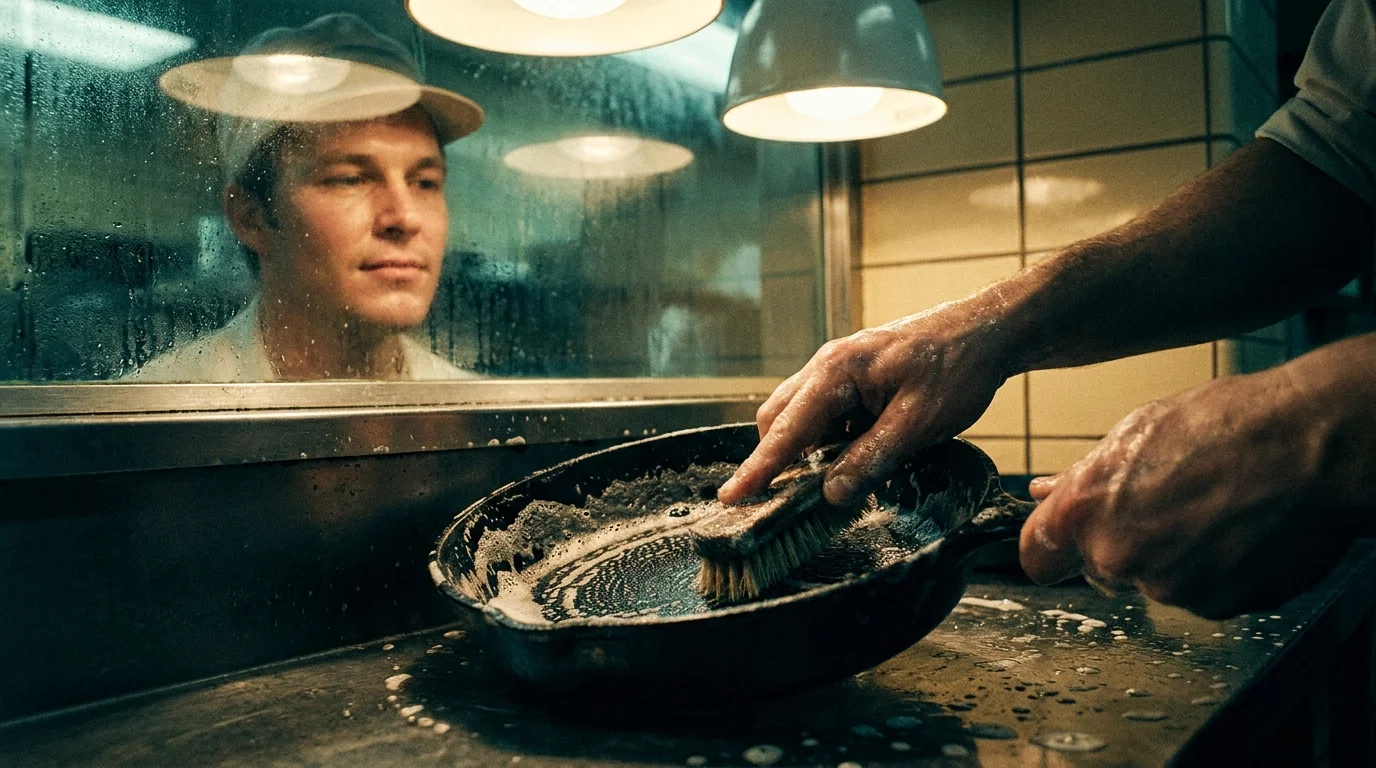
The steam rises softly against the kitchen window pane around 7:30 in the evening, carrying the faint scent of lemon and wet cedar. Your hands are submerged in warm, slick dish soap suds coating a heavy cast iron skillet, fingers finding the textured grease along the curved iron lip. Outside, the neighborhood settles into dusk, but inside your kitchen, there is a steady, repetitive rhythm of hot running water and rhythmic scraping.
For decades, fitness culture taught you that changing your physique requires punishing your joints on a motorized treadmill or gasping for breath beneath fluorescent gym bulbs. We were told that fat loss happens only when your heart rate hits the red zone and sweat drips onto rubber flooring. Yet here you stand in your wool socks, feeling an unmistakable, low-grade heat blooming across your midsection simply from clearing dinner plates.
When you stand square before the basin, bracing against the weight of soaked stoneware, your body does something remarkable that no stationary bike can replicate. Your deepest abdominal wall fires continuously to keep your spine stable while your arms move across planes of resistance. What looks like a mundane domestic chore is actually an intense metabolic ignition switch hiding in plain sight.
The Baseline Furnace: Rethinking Caloric Burn and Core Architecture
Consider the difference between a roaring bonfire that burns out in twenty minutes and the steady, quiet glow of banked coals that radiate warmth all night long. Structured workouts are the quick bonfire; they burn bright, exhaust your glycogen stores, and often leave you ravenous on the sofa an hour later. Non-exercise activity thermogenesis, or NEAT, is the banked coal bed that constantly draws on stored fuel throughout your waking hours.
When you wash dishes by hand, you are not simply moving sponges over porcelain. You are maintaining an active standing balance against an asymmetrical load. Every time you lift a damp dinner plate with your left hand, scrub in clockwise circles with your right, and pivot to slide it into the drying rack, your transverse abdominis acts like an internal corset to counteract that rotational pull.
The human abdominal wall was never designed to crunch forward hundreds of times on a foam mat. Its true biological purpose is anti-rotation and postural stabilization—holding your viscera tight and protecting your lower back while your limbs manipulate heavy objects in front of you. Countertop dishwashing forces this stabilization for fifteen to twenty uninterrupted minutes, demanding low-threshold motor unit recruitment that gently mobilizes stubborn visceral fat stores without spiking your stress hormones.
The Biomechanical Discovery at the Kitchen Basin
Elena Morales, a 44-year-old biomechanics specialist and clinical ergonomics consultant in Portland, spent years observing how everyday physical micro-habits shaped spinal integrity. She noticed that clients who abandoned automatic dishwashers in favor of intentional, manual cleaning consistently presented with better pelvic alignment and lower resting waist circumferences than those who spent forty minutes on elliptical machines after sitting all day.
- Instantly answering coworker messages strips deep neurological reserves triggering swollen bloodshot morning eyes
- Masseter jaw muscles trap repressed daily conversational frustrations creating stubborn throbbing morning migraines
- UK egg salmonella mandates enforce strict commercial flock quarantine rules stopping contaminated distribution
- Cholesterol particle tests reveal hidden arterial plaque buildup missed by routine annual physicals
- Kratom extract shots trigger sudden emergency liver complications across suburban urgent cares
Elena tracked muscle activation patterns using surface electromyography on subjects washing dishes under controlled postural cues. She discovered that by eliminating the habit of leaning the hips against the countertop rim, the deep spinal erectors and pelvic floor muscles engaged at nearly forty percent of their maximum voluntary contraction. The continuous micro-adjustments required to balance water-laden cookware created a sustained metabolic draw that kept post-prandial blood sugar levels flat and steady.
Three Kitchen Stances for Targeted Midsection Activation
The Iron Skillet Isometric (For Deep Transverse Activation)
When dealing with heavy cookware, avoid resting the pan base on the sink bottom. Hold the skillet suspended two inches above the drain with one hand while scrubbing with the other. This creates an immediate lever arm that pulls your center of mass forward, forcing your rectus abdominis and deep stabilizing sheath to contract continuously to keep you upright.
The Rotational Rack Pivot (For Internal and External Obliques)
Position your drying mat or rack at least twelve inches to your non-dominant side rather than directly adjacent to the basin. Each rinsed item now requires a controlled, thirty-degree torso rotation while your hips stay anchored forward. This steady twisting tempo wrings out tension in the thoracic spine while engaging the side abdominal walls without joint strain.
The Tripod Footing (For Glute and Pelvic Floor Integration)
Instead of locking your knees or shifting all your weight onto one lazy hip, set your feet shoulder-width apart. Grip the floor slightly with your toes, soften your knees by two degrees, and tuck your pelvis into neutral. This stance transforms your countertop chore into an active balance drill that stimulates continuous caloric burn through your lower extremities and pelvic girdle.
Mindful Application: The 20-Minute Countertop Protocol
Transforming your evening chore into a quiet, fat-mobilizing ritual requires minimal adjustments to your existing routine. The secret lies in deliberate alignment and continuous, fluid movement rather than speed.
- Maintain the Two-Inch Gap: Step back until your thighs and pelvis are two inches away from the counter face, forcing your core muscles to support your torso rather than leaning on the cabinetry.
- Square the Shoulders: Roll your shoulder blades down toward your back pockets before your hands enter the water, opening your chest and keeping your neck loose.
- Breathe Through the Diaphragm: Inhale deeply through your nose into your lower ribs while maintaining a gentle drawing-in sensation beneath your navel.
- Work in Alternating Tempos: Clean delicate glassware with light, rapid circular motions to challenge hand-eye coordination, then transition to heavy pots with slow, grounded pressure.
Your Tactical Kitchen Toolkit:
- Water Temperature: Keep water between 110°F and 115°F to loosen grease effortlessly while keeping your forearm muscles supple.
- Session Duration: Aim for 18 to 22 minutes of continuous, unbroken standing movement post-dinner.
- Footwear Choice: Stand barefoot or in thin grip socks on a flat wooden floor or firm mat to maximize foot sensory feedback.
- Tool Weight: Utilize a seasoned 10-inch cast iron skillet or heavy ceramic Dutch oven as your primary resistance load during the routine.
The Quiet Architecture of Daily Movement
We often make the mistake of measuring our health only by what happens inside specialized buildings filled with chrome machinery. We compartmentalize vitality into an hour of misery, ignoring the hundreds of small opportunities that present themselves within the four walls of our own homes. Reclaiming the physical art of caring for your kitchen changes how your body interacts with gravity all day long.
When you finish the final plate, wipe down the chrome faucet, and hang the damp linen towel, your kitchen is clean and your mind is clear. You have stabilized your spine, engaged your deepest core musculature, and stoked your baseline metabolic fire without a single drop of gym-floor sweat. Sustainable strength is not built through punishment; it is woven quietly into the fabric of everyday life.
“True physical resilience is not manufactured in an hour of exhaustion, but cultivated through the quiet, constant postures of your daily life.”
| Movement Variable | Standard Passive Washing | Active Countertop Protocol |
|---|---|---|
| Pelvic Contact | Hips resting heavily against sink rim | Two-inch clearance requiring active core stabilization |
| Muscle Engagement | Upper trap tension, inactive abdominal wall | Transverse abdominis, obliques, and deep spinal erectors active |
| Metabolic Effect | Minimal caloric demand, stagnant circulation | Steady baseline fat oxidation and stabilized blood sugar |
Does manual dishwashing burn as many calories as a treadmill workout?
While a high-intensity treadmill session burns more calories per minute, manual dishwashing with proper posture triggers sustainable non-exercise activity thermogenesis without spiking cortisol or driving extreme post-workout hunger.
How does standing at the sink engage my deep core muscles?
By keeping your hips two inches away from the counter and handling heavy cookware, your transverse abdominis contracts isometrically to hold your torso upright against rotational and forward forces.
Will this help if I struggle with lower back stiffness after dinner?
Yes, adopting a soft-knee tripod stance and engaging your core removes compressive shear stress from your lumbar spine, often relieving the dull ache caused by slumping on the couch immediately after eating.
How heavy should the cookware be to notice a metabolic difference?
You do not need heavy weights; standard 3 to 6-pound cast iron pans, ceramic mixing bowls, and wet stoneware provide ample leverage resistance when suspended above the basin during cleaning.
How long does it take to feel the stabilizing benefits?
Most people notice improved postural awareness and gentle warmth through their midsection within their first three consecutive 20-minute evening sessions.