The overhead fluorescent tubes hum at a frequency you only notice when the room falls dead silent. You sit in your high-end mesh chair, feet flat on the floor, lumbar support adjusted to the millimeter, staring across the conference table. Someone just took credit for your three-week project, or perhaps a supervisor quietly shifted impossible deadlines onto your desk without a second thought. You want to speak, but the professional mask holds firm. You swallow the words, nod politely, and feel an immediate, fiery, rock-hard knot pinching the base of your neck.
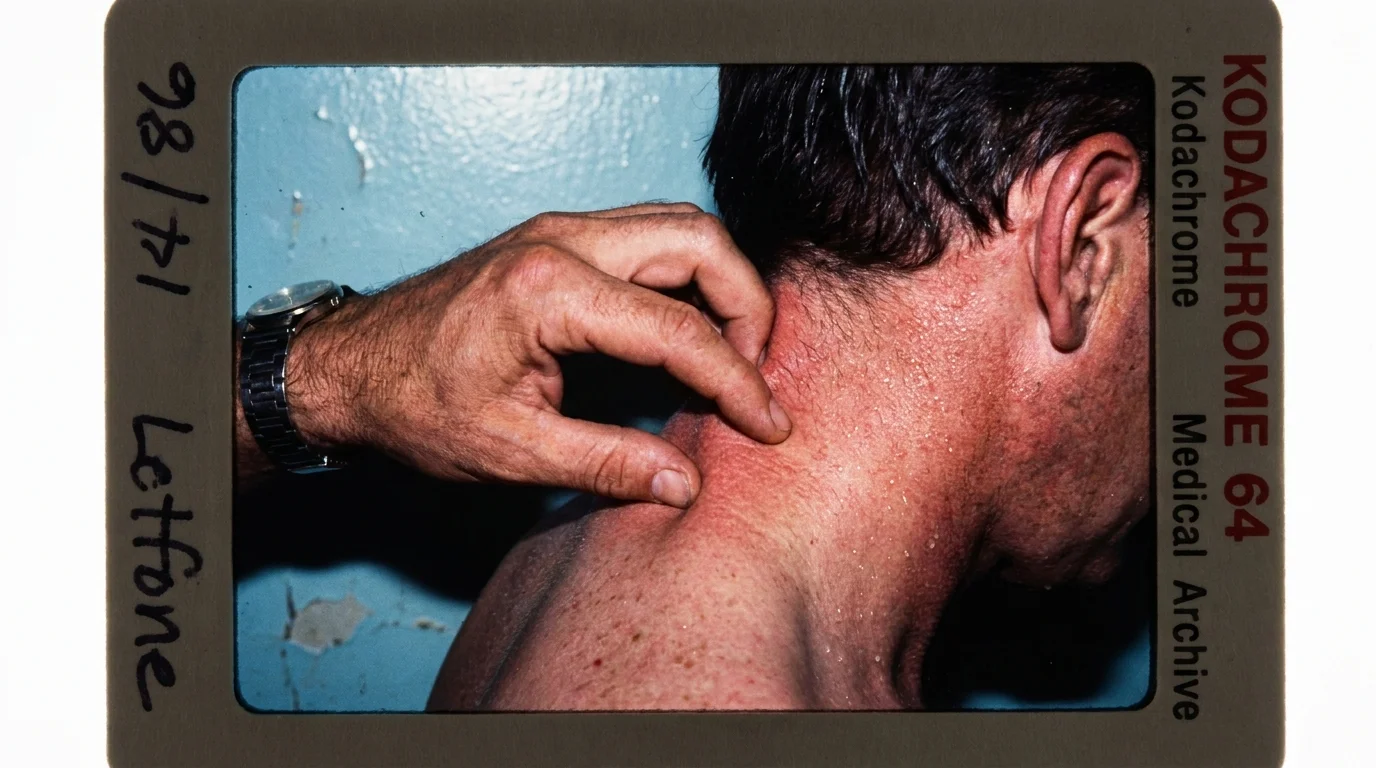
By four in the afternoon, that pinch spreads across the top of your shoulder blade like hot wire. You reach back, digging your thumb into the tight band of muscle running from the top of your spine down into your shoulder blade, trying to knead away what you assume is bad posture.
You blame your monitor height. You blame the angle of your keyboard or that sixty-minute commute in stop-and-go traffic. Yet deep down, the physical therapy sessions, foam rollers, and deep-tissue massages only offer forty-eight hours of relief before that familiar burning sensation flares back up.
The Anatomy of the Unspoken Shrug
Your levator scapulae muscles do not contract in a vacuum; they act as the physical shock absorbers for suppressed conflict. Structurally, these strap-like bands connect your upper cervical vertebrae directly to the medial border of your scapula. Their primary mechanical job is simple: elevate the shoulder blade and assist in rotating your neck. But their evolutionary, somatic job is protective.
When an animal prepares for conflict or braces against an attack, the shoulders instinctively rise toward the ears to protect the vulnerable carotid arteries and cervical spine. In a modern office or high-stakes client call, you cannot physically lunge or run away. Instead, your nervous system initiates a startle response that you must immediately swallow to remain employable. The result is an incomplete physical defense reflex.
Every time you bite your tongue, hold back clear boundaries, or absorb micro-frustrations from colleagues, your motor cortex fires a subtle command to raise the shield. You repress the visible movement, but the chemical signal still reaches the motor endplates. Your levator scapulae end up locked in an isometric standoff—holding immense structural tension without ever completing the motion that discharges the adrenaline.
- Kratom leaf powder triggers sudden clinical alerts after dangerous liver enzyme spikes
- Draft stopper door towels block stray floor drafts restoring deep restorative sleep cycles
- Postpartum psychosis hospital protocols enforce mandatory maternal mental checks before discharge
- Slumping into memory foam driver seats traps uneven spine tilt enforcing chronic lower back stiffness
- Raw cabbage leaf wraps resurfaced as proven therapy for soothing swollen hot knee joints
The Pattern Behind the Pain
Consider Marcus, a 41-year-old product manager in Chicago who spent eighteen months chasing what he believed was a stubborn cervical disc issue. He cycled through three different ergonomic chairs, spent thousands on dry needling, and kept a heating pad permanently draped over his office chair. The burning knot near his left shoulder blade remained immovable.
It was only when his physical therapist asked him to track his pain alongside his daily meeting calendar that the pattern emerged. The fiery flare-ups did not peak after long hours of typing; they spiked within fifteen minutes of his weekly status meeting with a combative department head. Marcus was unconsciously holding his left shoulder two inches higher than his right for hours, physically bracing against unvoiced resentment. Once he recognized this somatic loop, his physical rehabilitation finally took root.
Mapping Your Somatic Pressure Zones
Suppressed workplace friction does not hit everyone in the exact same pattern. Depending on how your nervous system processes professional stress, the levator scapulae lock down through distinct behavioral habits:
- The Diplomatic Accommodator: You say yes to unreasonable requests while internally screaming no. This creates a persistent unilateral spasm, usually on your dominant side, as your body attempts to physically shrug off the unfair burden you just accepted verbally.
- The Silent Fixer: You absorb the disorganization of others, quietly correcting mistakes without speaking up. Your levator scapulae develop dense, ropey trigger points where the muscle inserts into the top edge of your shoulder blade, leaving your upper back feeling permanently bruised.
- The Hyper-Vigilant Drafter: You spend hours re-reading emails before sending them, fearing criticism or misunderstanding. This causes bilateral cervical tightness, pulling your head slightly forward while your neck muscles work overtime to keep your chin level.
Recognizing your specific stress pattern allows you to stop treating your neck as an isolated mechanical failure and start treating it as an autonomic early warning signal.
The Somato-Motor Reset Protocol
When the burning knot flares up during your workday, aggressive stretching or digging elbows into the tissue often makes the muscle seize harder. The nervous system interprets sharp pain as another threat, tightening the fascia further. Instead, you must signal safety to the cervical motor units through deliberate, low-intensity decompression.
- Complete the Shrug (Discharge): Inhale deeply and deliberately pull both shoulders up to your ears, holding the maximum contraction for 5 seconds. Exhale forcefully through your mouth and let your shoulders drop completely, allowing gravity to take them. Repeat 3 times to clear the incomplete startle reflex.
- The 45-Degree Cervical Glide: Turn your chin 45 degrees away from the painful side. Gently tuck your chin toward your armpit until you feel a light stretch along the side of your neck. Hold for 20 seconds while breathing low into your belly. Never pull with your hand.
- Sub-Occipital De-escalation: Place the soft pads of your fingertips at the base of your skull. Apply gentle upward pressure while taking slow, nasal breaths. This down-regulates the sympathetic chain running parallel to your upper spine.
Use this technical toolkit to break the pain loop during high-stress hours:
- Decompression Cadence: Perform the complete shrug cycle every 90 minutes during intense project pushes.
- Thermal Shift: Apply moist heat at 104°F to 110°F for 10 minutes post-work to soften locked fascia, followed by 60 seconds of cool ambient exposure.
- Somatic Boundary Check: Before answering high-friction emails, take one full breath and consciously drop your shoulder blades down toward your back pockets.
Reclaiming Physical Sovereignty at Your Desk
Chronic neck pain is rarely just about how you sit; it is fundamentally about what you tolerate. Your body keeps an exact ledger of every boundary you fail to set, every professional indignity you quietly swallow, and every unspoken truth you store behind your teeth. The levator scapulae are merely the canvas where that unspoken emotional friction is rendered into physical form.
When you begin addressing the interpersonal stress along with the physical tissue, the burning tightness loses its primary fuel. You realize that your neck was never broken—it was simply speaking the clear boundaries your voice was not yet ready to express.
The neck carries the structural weight of the head, but it is unvoiced emotional resistance that turns the muscle to stone.
| Key Point | Detail | Added Value for the Reader |
|---|---|---|
| Root Driver | Suppressed professional conflict triggers an incomplete startle shrug reflex. | Stops wasted spending on purely ergonomic fixes by identifying the somatic source. |
| Target Tissue | Levator scapulae and upper cervical fascial sheaths. | Pinpoints why standard upper-trap stretches fail to resolve the deepest knots. |
| Reset Mechanism | Active motor discharge followed by low-load parasympathetic signaling. | Provides an immediate, silent routine you can perform at your desk in under two minutes. |
Frequently Asked Questions
Why does deep-tissue massage make my levator scapulae hurt more the next day?
Aggressive pressure on a muscle locked by sympathetic hyper-vigilance triggers a protective rebound spasm. Your nervous system views the intense pressure as an attack, causing the fascia to clamp down tighter.Can poor posture still contribute to this burning knot?
Yes, forward head posture places extra mechanical load on the levator scapulae. However, emotional bracing acts as the primary amplifier that turns simple muscle fatigue into a chronic, burning trigger point.Why is the pain often worse on only one side of my neck?
Most people have an asymmetrical bracing pattern tied to handedness, phone use, or their habit of subtly leaning away from stressors during difficult conversations, overloading one specific levator muscle.How long does it take for somatic neck tension to release once stress drops?
When you combine somatic resets with clear boundary setting, resting muscle tone usually normalizes within 7 to 14 days as motor units stop firing continuously.What is the best sleeping position to keep this knot from flaring overnight?
Sleep on your back or side with a pillow that keeps your cervical spine neutral. Avoid sleeping on your stomach, which forces the levator scapulae into extreme rotation and shortening for hours at a time.