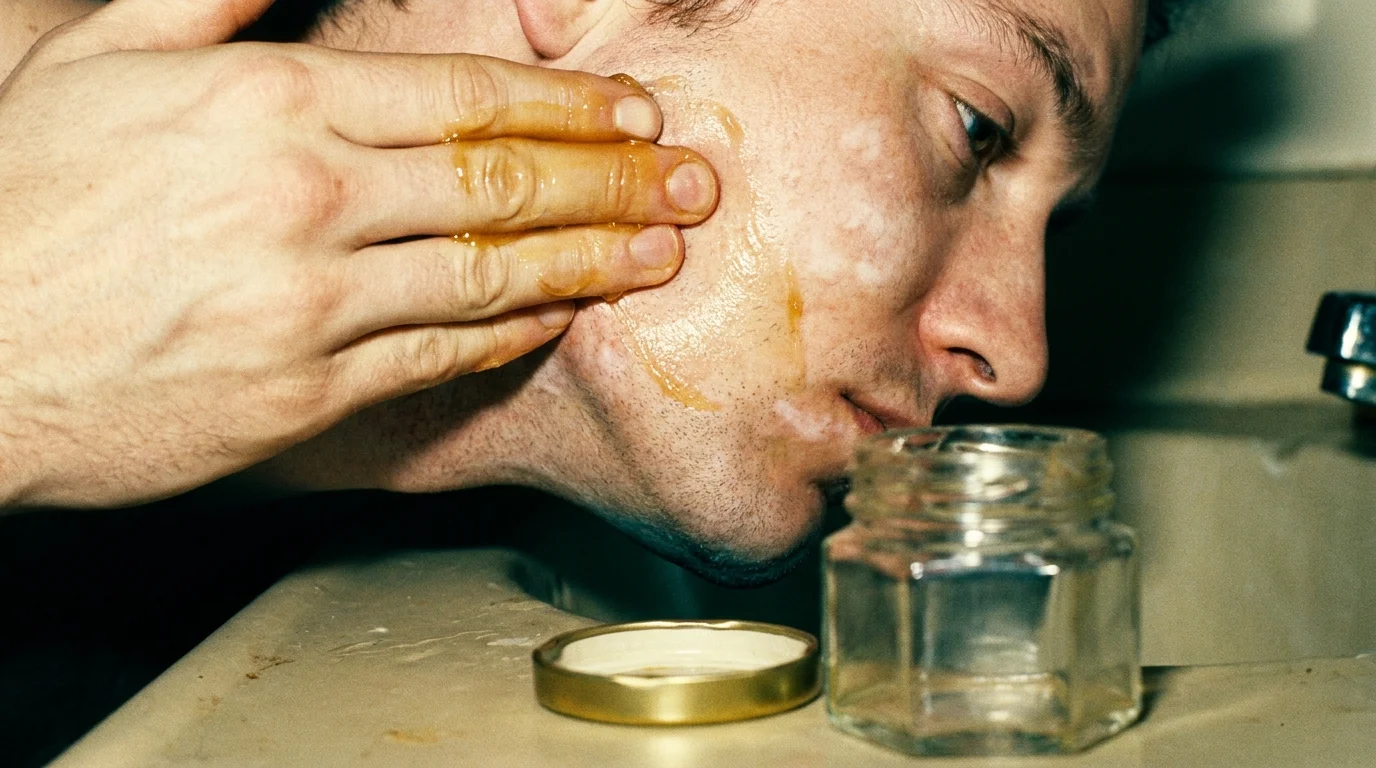
The ritual starts with the click of thin metal unscrewing from an octagonal glass jar with a gold tin cap. You scoop a coin-sized dollop of dense amber ointment across your fingertips, inhaling that unmistakable, medicinal cloud of camphor, clove, and cajuput. It smells industrious, like an old gym locker room crossed with an apothecary shelf. You dig your thumbs into the tight knot where your neck meets your shoulder blade, rubbing the thick balm until the skin gleams and begins to glow with that familiar, stinging bloom of heat.
For five minutes, everything feels right. The dull ache accumulated over seven hours of staring at spreadsheets softens, masked by the counter-irritant sting spreading across your traps. It feels as though your circulation is roaring back to life, flushing out the lactic acid and loosening the concrete grip of your desk posture.
Then you walk back to your workstation, settling directly under the vent where the corporate HVAC hums, churning out recycled, 68-degree air. Ten minutes later, a peculiar sensation creeps downward from your forearms. Your knuckles feel stiff, like dried clay. You tap the keys of your mechanical keyboard, but your fingertips have gone chalk-white, cold as pond ice, and completely detached from the blazing heat still radiating off your neck.
You assume it is simply the office thermostat or perhaps the price of staying seated too long. But what your body just endured was not poor ergonomic luck. It was an involuntary biological pivot: a sudden peripheral capillary constriction rebound engineered by the very ointment you trusted to thaw you out.
The Thermal Deception: Why Counter-Irritants Trick the Capillary Bed
We treat these vintage botanical balms as pocket-sized heating pads. We think of them as tiny furnaces contained within paraffin and petrolatum, believing that if the skin turns pink and throbs, blood must be flooding into every tight muscle fiber. But your vascular tree does not work like a domestic radiator network; it operates like a municipal pressure valve with strict fluid budgets.
Topical formulas laden with high concentrations of menthol and camphor do not actually introduce thermodynamic heat into deep tissue. Instead, they hijack your transient receptor potential channels—specifically TRPM8 for cold sensations and TRPV1 for thermal heat. Menthol acts as a biochemical illusionist. When rubbed onto the skin, it signals your nervous system that the tissue is freezing, while the camphor and clove oil simultaneously irritate surface nerve endings to produce mild inflammation, known as rubefaction.
When you stay in a warm, still room, your body manages this dual sensation with ease. But introduce an ambient temperature plunge—such as stepping into a dry, climate-controlled office, walking into grocery store freezer aisles, or driving home with the car vent blowing on your collarbones—and the illusion breaks. The sensory contradiction shocks local vasomotor nerves. Sensing rapid surface cooling paired with intense cutaneous stimulation, your autonomic nervous system executes a rapid defense maneuver. It clamps down on peripheral arterioles, shunting micro-vascular circulation away from your extremities and toward your core.
- Organic moringa leaf powders deposit unlisted industrial lead traces and spark stubborn belly bloat
- Refined canola cooking oil releases stinging aerosol vapors that provoke burning sinus pressure
- ZeroWater filtered pitchers eliminate essential trace minerals and induce heavy mid-afternoon fatigue
- Chewy dried mango snacks force stubborn nocturnal jaw clenching and thumping temple aches
- Overhead ceiling fans pull moisture from delicate nasal tissues and enforce raw morning hoarseness
The blood leaves your hands to protect your vital organs from what the brain perceives as a sudden, localized Arctic blast. Your shoulder might feel like it is baking in an oven, but your digital arteries—the tiny, delicate vessels feeding your fingertips—have pinched shut in self-defense.
A Desk Worker’s Paradox: The Incident in Floor Nine
Consider Marcus Vance, a 38-year-old architectural draftsman who spent three weeks wrestling with what he assumed was sudden carpal tunnel syndrome or an early onset of secondary Raynaud’s phenomenon. Every afternoon around two o’clock, Marcus would pause at his drafting monitor, reach into his drawer, and massage a generous layer of camphor-heavy balm across his upper trapezius to ease the burning ache between his shoulder blades. By two-forty, his mouse hand was consistently so numb he struggled to grip a stylus, forcing him to run hot water over his hands in the restroom sink three times an afternoon.
A vascular specialist finally untangled the mystery after Marcus happened to mention the pungent herbal aroma lingering on his work shirts. Marcus was applying a high-menthol ointment directly under an overhead air diffuser blowing chilled air at high velocity. The combination of intense cutaneous counter-irritation and cold airflow triggered profound vasoconstrictive spasms down the entire radial and ulnar vascular pathways. Once he stopped applying the salve during working hours, the ghost numbness vanished within forty-eight hours.
Mapping the Vascular Reaction: Who Is Vulnerable?
Not every body reacts to counter-irritant ointments with the same vascular intensity. The severity of peripheral cooling depends heavily on your baseline autonomic tone, your hydration status, and where your skin meets cold airflow.
The Screen-Bound Posture Anchor
If you sit hunched over a keyboard with rounded shoulders, your thoracic outlet—the narrow corridor between your collarbone and first rib—is already mechanically compressed. Adding a vasoconstrictive salve to the base of the neck compounds physical compression with chemical vascular throttling. The result is rapid fingertip pallor, a dull ache in the forearms, and a sensation similar to wearing tight rubber gloves.
The Thin-Skinned and Vasomotor-Sensitive
Individuals with lower resting blood pressure or those naturally prone to cold feet and hands possess hyper-reactive peripheral capillary beds. When exposed to menthol-induced thermal confusion, their pre-capillary sphincters slam shut rapidly. For this group, applying strong rubefacients to the upper neck or chest can induce an icy sensation in the fingers within fifteen minutes, even in mildly cool rooms.
The Evening Unwinder
Those who apply amber ointment right before bed often wonder why their feet stay freezing under heavy duvets while their shoulders burn. Paraffin and petrolatum seal the skin, trapping volatile oils against the epidermis while sweat accumulates underneath. As that moisture slowly evaporates in a cool bedroom, the drop in surface temperature triggers persistent, low-grade vasoconstriction that delays deep, restorative slow-wave sleep.
Mindful Application: How to Use Potent Salves Without Freezing Your Hands
You do not need to discard that iconic octagonal jar. Its blend of traditional botanicals remains an effective sensory tool for dulling localized muscle tension. What you must adjust is the context, the application technique, and the ambient environment surrounding your ritual.
- Apply only in thermal neutral zones: Never rub camphor-menthol formulas onto your neck or chest within thirty minutes of entering an air-conditioned room or stepping outside into brisk wind. Ensure ambient air is at least 72 degrees Fahrenheit and still.
- Keep applications caudal to the neck: Avoid slathering ointments across the base of the skull or directly over the cervical spine where sympathetic nerve plexuses lie close to the skin surface. Target the thick, fleshy bellies of the muscles rather than nerve-dense anatomical junctions.
- Wash application hands immediately with warm oil or dish soap: Paraffin-based balms do not dissolve in water alone. Lingering residue on your palms transfers directly to your mouse, phone, and keyboard, exposing your fingers to direct chemical cooling throughout the afternoon.
- The Barrier Warmth Layer: If you must apply the balm in a cool office, cover the treated area immediately with a dense, natural fiber—such as a wool scarf or cotton collar. This traps natural body heat, prevents convective cooling from drafts, and prevents the nervous system from mistaking menthol sensory input for an actual freeze threat.
Your Tactical Counter-Measure Toolkit
If you find yourself stranded at your desk with white, numb fingers and a burning neck, follow this quick vascular recovery sequence. First, step away from the HVAC draft immediately. Second, run warm (never scalding) water over your inner wrists for precisely two minutes to signal the radial artery to dilate. Third, perform ten gentle shoulder shrugs followed by broad arm circles to manually encourage blood past the thoracic outlet and restore extremity perfusion.
The Bigger Picture: Reading Your Body’s True Signals
Modern desk work creates an undeniable hunger for quick somatic relief. We want a distinct sensation—a sharp burn, a heavy freeze, a bold scent—to cut through the grey fog of eight hours spent staring into a glass panel. We reach for potent little jars because they give us instant proof that something is happening beneath our skin.
Yet your circulatory system is not a machine to be bluffed with chemical trickery. It is an exquisitely calibrated river system, sensitive to every breeze, every posture slump, and every sensory misdirection we feed it. When your fingers turn to ice, your body is not failing you; it is responding with remarkable precision to a set of confusing environmental commands.
True physical comfort rarely comes from shocking your nerve receptors into submission. It emerges when you align your environment with your biology, moving your joints through their intended ranges and treating your vascular system with the quiet, deliberate respect it deserves.
The sharpest sting of a topical balm cannot replace the quiet, steady work of genuine arterial warmth.
| Key Factor | Biological Reality | Sensory Adjustment |
|---|---|---|
| Mechanism of Action | Menthol tricks TRPM8 receptors to simulate cold; camphor induces surface irritation. | Do not rely on balms for true deep-tissue metabolic blood flow. |
| Environmental Hazard | Air conditioning drafts combined with menthol prompt protective capillary spasms. | Cover treated skin with breathable fabric to shield from drafts. |
| Peripheral Impact | Shunting of extremity blood leaves hands chalk-white, rigid, and numb. | Keep ointment strictly on large muscle bellies, far from wrists and hands. |
Frequently Asked Questions
Why do my fingers go completely numb after I put balm on my neck?
The high concentration of menthol activates cold receptors on your skin. When exposed to room drafts, your nervous system mistakenly believes your core is losing heat rapidly, causing it to constrict peripheral blood vessels in your hands and arms.Does this mean the ointment is causing permanent nerve damage?
No. The reaction is a temporary vasomotor spasm, known as a vascular rebound. Circulation typically normalizes within forty to ninety minutes once the volatile oils evaporate and your skin returns to ambient room temperature.Can I wash off the balm with cold water if my hands start freezing?
Cold water will worsen the vasoconstriction and will not remove the petroleum wax base. Use warm water paired with grease-cutting soap, or wipe the skin with a damp washcloth warmed to roughly 100 degrees Fahrenheit.Are white balms safer for peripheral circulation than red ones?
White balms typically contain higher percentages of pure menthol and less cinnamon or clove oil, which can actually heighten the sensation of cold and intensify the vascular rebound when exposed to cool drafts.What is the best alternative to muscle balms for stiff desk posture?
A five-minute routine consisting of gentle thoracic spine extensions, shoulder rolls, and a simple dry heating pad set to low provides authentic vascular dilation without sending confusing cold signals to your autonomic nerves.