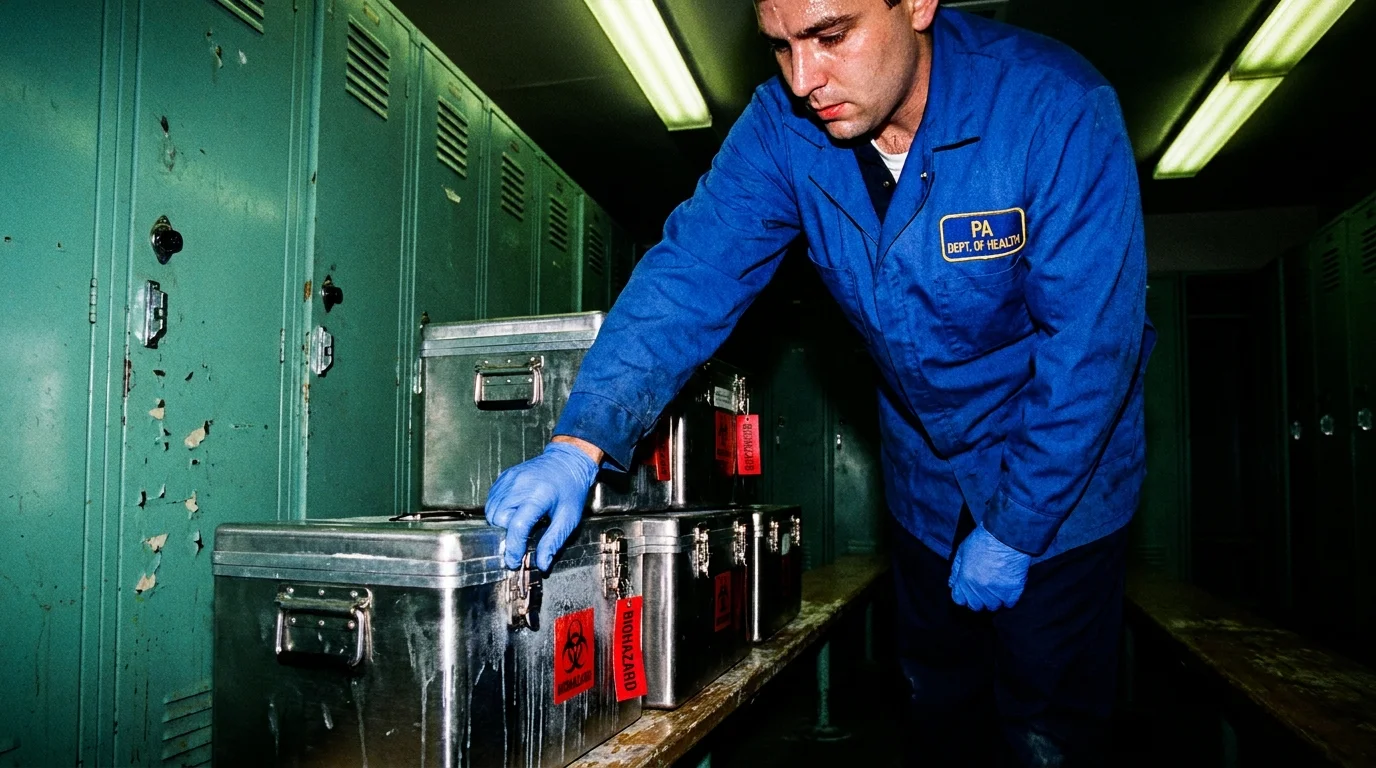
The chill coming off the steel is not ordinary morning condensation; it is the dry, biting cold of active refrigeration holding steady at 36 degrees Fahrenheit. Inside the bed of an idling state pickup truck, stacked stainless steel transport cases clatter faintly against the ribbed liner as the diesel engine rumbles against a damp gravel shoulder in rural Lancaster County. You might picture outbreak intervention as a sterile, tile-lined corridor where patients check in at glass windows and wait under fluorescent lights with clipboards in hand.
Out here, where two-lane state routes dissolve into unmarked farm lanes, containment looks entirely different. It looks like mud-caked mudflaps, handheld thermal scanners steaming in the dawn mist, and two field nurses pulling nitrile gloves over cold-stiffened fingers. The established habit of telling families to drive forty miles to a centralized county health clinic **quietly collapsed under real transmission**, breaking under the weight of an airborne agent that moves far quicker than public transit schedules.
Measles does not linger politely in waiting rooms while intake forms get processed. It hangs suspended in the air of church halls, machinery auctions, and school entryways for up to two hours after an infectious person has walked away. Facing an aggressive wave of regional exposures, Pennsylvania health authorities made a sharp, unilateral pivot: dismantle the stationary triage model and drive the cold chain directly onto the front porches of exposed households.
The Castle Moat Collapses: Why Waiting Rooms Failed
For decades, institutional medicine operated on a fortress philosophy. When an outbreak surfaced, the public health apparatus pulled up the drawbridge, fortified regional hospitals, and instructed anyone feeling feverish to report to designated triage centers. But when dealing with a respiratory virus with a basic reproduction number hovering near eighteen, a centralized waiting room is not a barrier—it is an accelerant.
By forcing potentially exposed individuals into common corridors, traditional containment **turned waiting rooms into incubators**, inadvertently exposing infants too young for vaccination and elderly residents picking up maintenance prescriptions. State epidemiologists realized that waiting for an insular rural population to seek out institutional care was a tactical failure. To break transmission chains, the entire diagnostic apparatus had to become agile, driving right into the communities where daily life happens outside municipal reach.
Dr. Aris Thorne, a 46-year-old field epidemiologist deployed to the Susquehanna Valley response grid, watched the old model fail during a damp dawn run in Berks County. Standing on a cedar porch where three extended families had shared breakfast forty-eight hours after a known exposure, Thorne sidestepped the standard forty-eight-hour laboratory backlog by deploying a portable lateral-flow serology unit on the tailgate of his truck. In less than fifteen minutes, his team identified non-immune family members and administered targeted post-exposure prophylaxis before the morning chores were finished, halting a community cluster before the first fever spike.
- North Carolina amoeba infections trigger emergency freshwater triage warnings across regional rural clinics
- Nature Made magnesium oxide caplets expose gut linings to chalky residue sparking bloated bellies
- Ice-chilled Olipop prebiotic sodas trigger sharp gastric cramps by freezing sensitive stomach linings
- Skims sculpting mid-thigh bodysuits trap lower ribcage movement sparking sudden shallow chest panics
- Cold stainless steel watchbands derail sudden conference room panic through stealth wrist cooling
Calibrating the Response: Three Tiers of Doorstep Intervention
The revised protocol does not treat every driveway the same way. Instead, mobile field strike teams assess exposure windows along a strict biochemical timeline, bringing distinct medical tools to each setting.
The Acute 72-Hour Contact Window
For individuals identified within three days of primary inhalation, field teams prioritize active post-exposure immunization. The goal here is swift immune priming before viral seeding takes root in bronchial lymph nodes. Mobile coolers keep live-attenuated doses precisely buffered, allowing nurses to administer doses directly in living rooms without bureaucratic delays.
The Intermediate 72-to-120 Hour Exposure Zone
When the clock pushes past three days, standard vaccination yields diminishing protective returns. Under the new mandate, this specific window **triggers immediate doorstep antibody testing** without waiting for central laboratory queues. Using rapid fingerstick capillary blood analysis, clinicians determine baseline IgG and IgM levels right at the kitchen table; those lacking protective titers receive immediate intramuscular immunoglobulin (IG) on the spot to provide instant, passive viral neutralization.
The Delayed Surveillance Perimeter (Days 6 through 21)
For contacts reached nearly a week after potential contact, teams shift from prophylactic injections to physiological monitoring. Clinicians issue non-contact infrared thermometers and pulse oximeters while logging household members into a direct encrypted cellular check-in registry, monitoring for prodromal Koplik spots along the inner cheek before full cutaneous rashes ignite.
The Field Protocol: Navigating Doorstep Triage
Meeting an outbreak at the doorstep requires extreme precision and minimal disruption to the household. The objective is rapid, quiet containment that respects privacy while neutralizing biological spread.
The updated field protocol strips away administrative friction, replacing multi-page intake forms with a four-minute verbal verification. When the mobile unit pulls up, **field clinicians act with precision**, following a compressed sequence built to keep vaccines viable and exposures isolated.
- Cold-Chain Verification: Medical units confirm that the portable cooler digital display reads between 35.6°F and 46.4°F before breaking the silicone seal on transport cases.
- Capillary Point-of-Care Sampling: A single spring-loaded lancet puncture provides whole blood to a handheld reader, returning quantitative measles-specific antibody status within twelve minutes.
- Targeted Biological Administration: Depending on the bedside readout and exposure hour, clinicians administer either subcutaneous MMR vaccine or weight-based deep intramuscular immunoglobulin in the vastus lateralis.
- Surface Decontamination: All diagnostic cassettes, lancets, and protective PPE are sealed into biohazard transport canisters within the truck bed, leaving zero infectious debris behind on the property.
The Tactical Toolkit: Mobile Field Benchmarks
Rural containment requires strict adherence to physical metrics. Without regional lab support, field teams rely entirely on standardized physical thresholds to guide their bedside decisions.
- Refrigeration Baseline: 2°C to 8°C (35.6°F to 46.4°F) monitored via continuous Bluetooth data-loggers inside the stainless cases.
- The Critical Testing Threshold: Exactly 72 to 120 hours post-contact to determine the switch from direct vaccination to passive immunoglobulin therapy.
- Bedside Diagnostic Turnaround: 12 to 15 minutes for rapid lateral-flow serological confirmation, bypassing standard 48-hour hospital courier processing.
- Ambient Viral Clearance Window: 120 minutes of strict site avoidance after a symptomatic individual vacates an enclosed indoor space.
A Return to Human-Scale Protection
There is a profound psychological shift that occurs when healthcare stops demanding that you navigate its maze and instead shows up quietly on your gravel driveway. For decades, modern public health grew increasingly abstract—a landscape of online portals, appointment codes, and distant regional facilities that felt alien to rural residents who value self-reliance.
When a state pickup truck idles beside a barn and an experienced clinician steps out with a handheld cooler, the dynamic changes from surveillance to service. By stripping away clinical pretense and meeting families where they live, **the regional policy pivot succeeds** not through institutional coercion, but through immediate, eye-level utility. Outbreak containment ceases to be a theoretical public health directive; it becomes a practical, neighborly act of protecting the person sitting right across the table.
Real containment happens on gravel lanes, not behind hospital desks; when you bring the laboratory directly to the doorstep, panic gives way to practical protection.
| Key Point | Detail | Added Value for the Reader |
|---|---|---|
| Operational Model | Transition from stationary brick-and-mortar triage clinics to rapid-response four-wheel-drive mobile immunization units. | Eliminates the danger of secondary viral exposure inside crowded medical waiting rooms. |
| Diagnostic Speed | Tailgate capillary blood testing returning verified antibody status in under 15 minutes. | Removes the 48-hour laboratory wait, enabling same-day clinical decisions before symptoms begin. |
| Threshold Management | A strict 72-to-120 hour doorstep exposure rule dictating vaccine vs. immunoglobulin therapy. | Ensures biological interventions match the exact metabolic and viral stage of the patient. |
Frequently Asked Questions
What triggered the shift away from standard clinic-based triage in Pennsylvania?
High community transmission demonstrated that asking exposed rural residents to travel to regional centers caused secondary exposures in waiting rooms and delayed preventative treatment past the critical 72-hour window.What is the significance of the 72-to-120 hour exposure threshold?
Within 72 hours of viral exposure, active vaccination can prime the immune system to head off infection. Between 72 and 120 hours, standard vaccination loses efficacy, requiring rapid antibody testing and immediate intramuscular immunoglobulin to neutralize the virus passively.How do mobile units keep vaccines stable on unpaved rural roads?
Teams utilize specialized, shock-mounted stainless steel transport cases equipped with digital temperature loggers that maintain the cold chain between 35.6°F and 46.4°F, independent of vehicle power.Can mobile units mandate treatment on private property?
No. The program is built on voluntary, localized support. Mobile teams provide rapid antibody clarification, physiological assessment, and immediate preventative care without forcing compliance or requiring administrative enrollment.How quickly do rapid point-of-care serology tests deliver results?
The handheld diagnostic units used by field clinicians process a single capillary blood drop and yield clear IgG and IgM antibody results in twelve to fifteen minutes, eliminating central lab shipping delays.