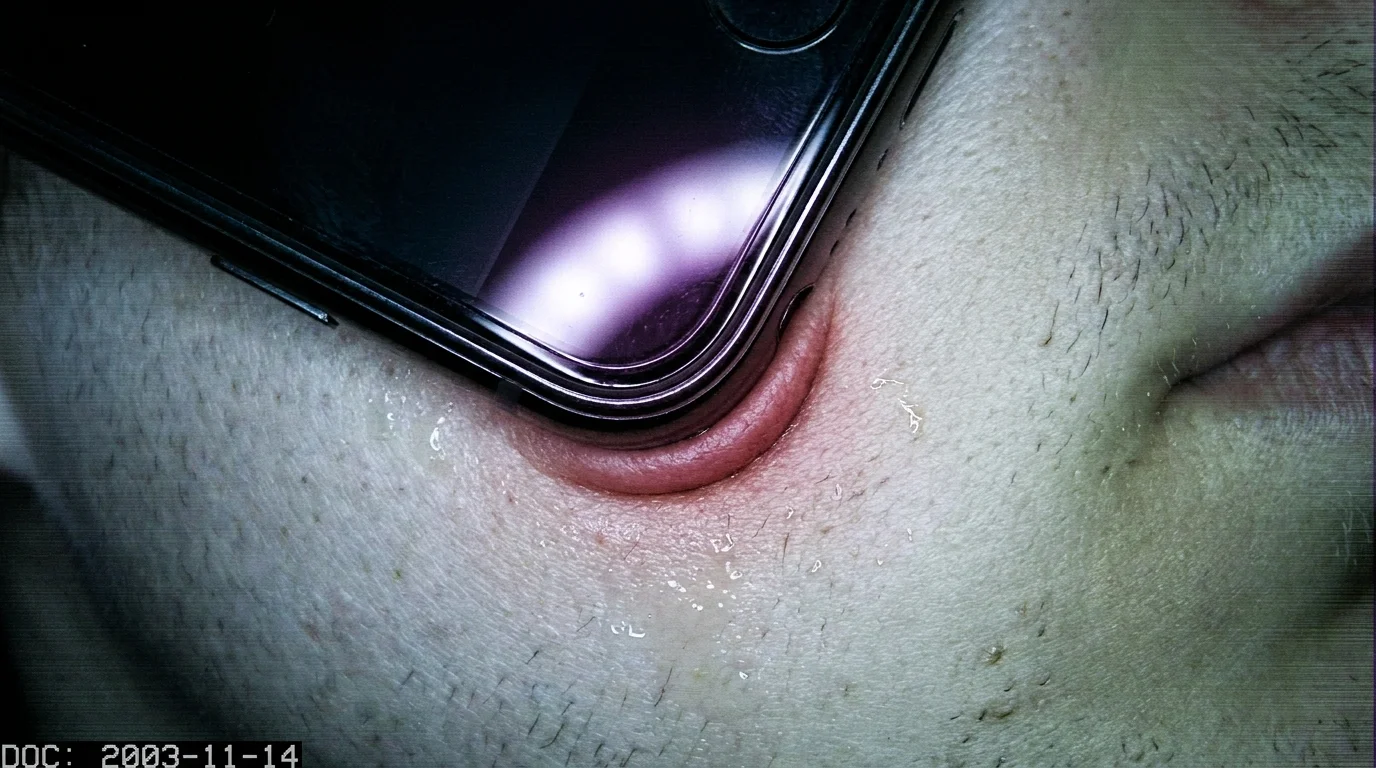
The bedroom is quiet, illuminated only by the cool, pale rectangle casting shadows across your ceiling. Underneath the weight of the duvet, your arms grow tired after twenty minutes of scrolling through evening dispatches and quiet videos. Without thinking, you draw your hands closer to your chest and tilt the screen upward. The cold, smooth glass corner of the mobile phone settles directly into the small indentation beneath your lower lip, wedged firmly against your chin to shoulder the weight of your tired wrists.
It feels harmless, almost ergonomic in the dark—a miniature scaffold engineered by sheer convenience. You scroll until your eyelids burn, slip the device beneath your pillow or onto the bedside table, and drift off. Hours later, dawn breaks, but instead of waking restored, a familiar heaviness grips the sides of your skull. It is a dull, bruised ache blooming across your temples, dragging down into your neck muscles like an iron collar.
You likely blame nighttime anxiety. Or perhaps you wonder if you have suddenly joined the millions of adults who grind their teeth in their sleep, bracing yourself for an expensive dental guard. Yet the true catalyst did not begin in a dream state or an ambiguous surge of psychological worry. It began in the subtle, mechanically punishing geometry of how you held that small pane of glass during your final twenty minutes of consciousness.
The Mandibular Lever: Why Your Bedtime Screen Position Strains the Skull
Consider your jaw not as a fixed hinge like a cabinet door, but as a floating suspension bridge. Your lower jaw, the mandible, hangs delicately from the base of your skull, tethered by an intricate web of ligaments and balanced between some of the most powerful musculature in the human body. When your head rests in a neutral posture, your teeth should naturally drift two to three millimeters apart, resting in what physiologists call the freeway space. In this state of quiet slack, your temples remain soft, your temporalis muscles quiet, and your masseters completely unburdened.
When you plant the hard bottom edge of a phone against your mental protuberance—the bony prominence of your chin—you create an unyielding mechanical lever. The device exerts backward pressure, driving the mandible rearward into the temporomandibular joint space. Displacing the jaw backward awakens a powerful reflex. Sensing that the delicate retrodiscal pad behind the joint is about to be compressed, your nervous system fires an emergency protective contraction through your masseter and temporalis muscles.
This is not true psychological bruxism; it is neuromuscular guarding. By wedging the device against your jawline, you prime your facial muscles to clamp shut. Even after you turn off the screen and roll onto your side, the hyper-excited motor neurons do not simply power down. The muscle fibers maintain that shortened, defensive tension throughout the early phases of deep sleep, locking your teeth together in a prolonged isometric grip that starves local tissue of blood flow and greets you at sunrise with throbbing temples.
- Cordless stick vacuum cleaners stop upper body resistance loading accelerating subtle shoulder weakness
- Perching on kitchen barstools forces pelvic torque triggering persistent dull lower back stiffness
- Chobani sweet cream coffee creamer derails morning metabolic balance sparking heavy afternoon crashes
- Premier Protein caramel shakes trigger sudden mid-afternoon energy crashes and ravenous cravings
- Reassuring anxious family callers strips deep neurological stamina sparking relentless morning fatigue
The Clinical Reality: When Night Guards Fail to Stop the Ache
Dr. Marcus Vance, a 46-year-old orofacial pain specialist practicing in Ann Arbor, Michigan, began noticing an unusual demographic shift in his clinic four years ago. Patients in their late twenties and thirties were arriving with classic symptoms of severe nocturnal clenching—bilateral morning headaches, tender cheek muscles, and sensitive premolars—yet their dental enamel showed zero signs of the telltale wear facets caused by aggressive grinding.
“We were fabricating custom hard-acrylic orthotics for people whose teeth were pristine,” Vance explains. “They would return six weeks later, frustrated because their morning temple pain was completely unchanged. When we finally started asking patients to physically demonstrate how they held their phones while lying on their backs in bed, the mystery dissolved. Almost every single one of them was resting the bottom corner of their phone directly against the notch of their chin to stabilize the screen. They were manually wedging their jaw into backward compression for thirty to forty-five minutes every night, triggering a muscular spasm that lasted until dawn.”
Three Scroller Archetypes: How Bedtime Posture Dictates Facial Tension
Not everyone props their phone against their jaw in the exact same manner. The mechanical vector changes depending on your preferred resting angle, creating unique patterns of morning discomfort across different muscle groups.
The Supine Propper
Lying flat on your back with two pillows under your head pushes your neck into forward flexion. In this position, resting the phone against the chin drives the mandible directly posterior. The temporalis muscles absorb the brunt of this backward vector, causing that distinct, bilateral band of pressure across the temples that mimics a dehydration headache.
The Lateral Wedge
If you prefer curling onto your side, you likely brace the phone against one side of your lower jaw while resting your cheek against the pillow. This asymmetrical pressure shoves the jaw both backward and sideways. You will wake up not with generalized forehead tightness, but with a sharp, one-sided soreness just forward of the ear canal and an uneven bite that takes an hour to settle.
The Chest Slumper
Resting the phone on your sternum while dropping your chin down to meet the top edge creates severe compressive force along the front of the throat. This posture shortens the digastric and suprahyoid muscles beneath the tongue, forcing the jaw closed under passive tissue collapse. The resulting morning symptom is a heavy, stiff throat sensation coupled with stiffness radiating into the base of the neck.
The Bedside Decompression Protocol: Restoring the Mandibular Neutral
Undoing this conditioned clench reflex does not require expensive clinical interventions. It demands conscious environmental adjustments and a deliberate physical reset before your eyes close for the night. Follow these focused adjustments to clear facial tension before sleep takes over.
- Establish a hand-only perimeter: Ensure your phone never touches any part of your face or chin while resting in bed. If your forearms tire, prop your elbows on a firm pillow placed across your ribcage, maintaining at least three inches of daylight between your lower jaw and the phone frame.
- The Palatal Tongue Rest: Five minutes before sleep, place the broad tip of your tongue against the roof of your mouth, resting gently on the soft ridge just behind your upper front teeth (the acoustic “N” spot). Allow your lips to close lightly while keeping your upper and lower teeth completely separated.
- Sub-Occipital and Masseter Release: Use the soft pads of your index and middle fingers to make slow, downward circular strokes along your cheek muscles, tracing from the cheekbone down toward the angle of your jaw for ninety seconds. Follow this by breathing deeply through your nose, letting your belly rise while consciously dropping your shoulders away from your ears.
- The Screen Horizon Shift: If you read in bed, elevate your viewing angle so your eyes cast slightly downward without your chin dropping toward your chest. Keep your cervical spine elongated to prevent passive tissue pressure from pushing your jaw out of alignment.
By shifting the device off your chin, you break the defensive reflex loop that locks the temporalis into hours of silent, grinding overtime.
Reclaiming the Morning: Quiet Temples and Deep Rest
We often treat our morning aches as inevitable penalties of modern stress, accepting tight temples and stiff jaws as the price of an overactive mind. Yet the human body is remarkably literal in how it processes mechanical loads. It does not separate the physical pressure of a smartphone edge from any other structural threat; it simply adapts, defends, and tightens.
When you dismantle this tiny, unconscious bedtime habit, you remove a persistent thorn from your nervous system. The mornings begin to feel wide and unburdened again. The familiar temple throb recedes, replaced by the quiet, easeful sensation of a jaw that spent the night precisely where nature intended: resting in open, neutral peace.
“True nocturnal jaw relaxation is impossible if your final waking habit physically displaces the joint you expect your nervous system to release.”
| Key Point | Detail | Added Value for the Reader |
|---|---|---|
| Mandibular Retrusion | Propping phone corners against the chin forces the lower jaw backward into the joint socket. | Identifies the hidden mechanical trigger behind morning aches without assuming teeth grinding. |
| Protective Guarding | Masseter and temporalis muscles lock up to prevent joint tissue damage during sleep. | Explains why custom night guards fail when bedtime posture remains uncorrected. |
| The ‘N’ Spot Reset | Resting the tongue on the hard palate naturally opens the freeway space between teeth. | Offers an immediate, zero-cost physical cue to disable the subconscious clench reflex before sleep. |
Frequently Asked Questions
How can I tell if my morning temple pain is from phone propping or genuine teeth grinding?
True bruxism usually leaves flat, polished wear facets on your molars, notches near the gumline, or inner-cheek scalloping. If your dentist sees no physical tooth wear yet you consistently wake up with aching temples after bedtime scrolling, nighttime mandibular displacement from propping is the likely culprit.Why do my temples hurt when the phone is touching my chin?
The temporalis muscle fans across the entire side of your head and connects directly to the lower jaw via the coronoid process. When your chin is pushed backward, the temporalis must contract with tremendous isometric force to stabilize the joint, projecting referred pain straight into your temples.How quickly does temple soreness improve after stopping this habit?
Most people experience a substantial reduction in morning muscle tightness within three to four nights of keeping their chin clear of the device, as local lactic acid clears and the neuromuscular reflex relaxes.Does a phone case or PopSocket prevent this issue?
Accessories help only if they prevent you from resting the device on your face entirely. If you use a pop grip or kickstand but still plant the bottom edge of the phone or your braced knuckles against your chin, the backward mechanical displacement remains identical.What is the best physical position for reading on a phone in bed?
Lie slightly reclined with your upper back supported by pillows, placing a folded blanket or throw pillow over your abdomen. Rest your elbows on that supportive surface so your hands hold the device freely at chest height, keeping your chin completely unweighted and your neck neutral.